The Ocean Was the True Driver of 3 Million Years of Climate Change
Antarctic ice core analysis reveals ocean heat variations were 7 times greater than CO2 fluctuations
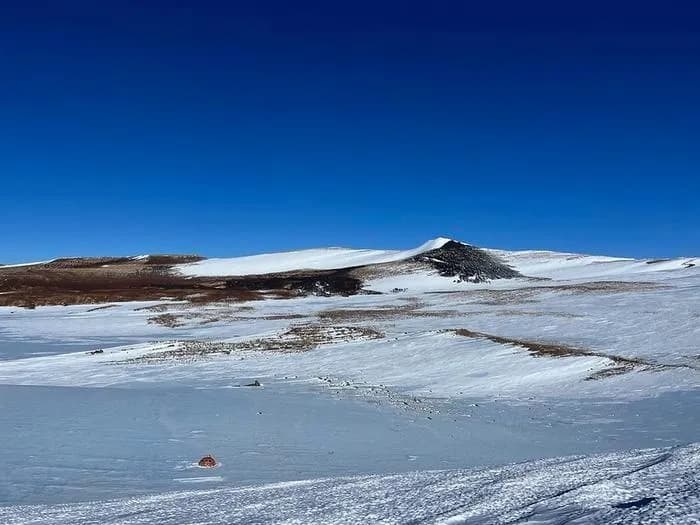
- •Analysis of million-year-old Antarctic ice reveals that ocean heat variations, not CO2, drove climate change over 3 million years.
- •While greenhouse gas concentrations remained stable, ocean temperatures changed dramatically, proven through noble gas ratio analysis.
- •The discovery that ocean circulation was the key driver of ancient climate transitions provides important implications for current climate crisis response strategies.
Ocean, Not Greenhouse Gases, Controlled Ancient Climate
Analysis of million-year-old ice cores from Antarctica's Allan Hills has revealed that ocean heat content, not carbon dioxide (CO2), was the primary driver of Earth's climate change over the past 3 million years. Two studies published Wednesday in the international journal Nature provide the first evidence that while greenhouse gas concentrations remained relatively stable, ocean temperatures fluctuated dramatically.
The COLDEX research team, led by Dr. Sarah Shackleton of Woods Hole Oceanographic Institution (WHOI), reconstructed ancient ocean temperatures by analyzing noble gas ratios trapped in ancient air bubbles. The researchers confirmed that variations in ocean heat content fluctuated far more dramatically than changes in CO2 or methane (CH4). This discovery fundamentally challenges existing understanding of past climate transition mechanisms.
Truth Revealed by Million-Year-Old Air
The research team focused on a 'time capsule' trapped in Antarctic ice. Shallow ice cores drilled from the Allan Hills Blue Ice Area (BIA) contained atmospheric samples from 3.1 million to 400,000 years ago. Noble gas ratios contained in air bubbles within the ice served as a natural 'thermometer' that indirectly revealed ocean temperatures of that era.
The analysis showed that CO2 and methane concentrations during the early Pleistocene remained within the range observed over the last 800,000 years. In contrast, ocean heat content changed with extreme amplitude during the same period. The researchers stated, "Temperature variations existed that cannot be explained by greenhouse gases alone," adding that "changes in ocean circulation patterns were likely the key driver."
Paradigm Shift in Climate Theory
This discovery demands important revisions to existing models of Earth's climate system. The scientific community has long believed that periodic climate changes between glacial and interglacial periods were primarily controlled by atmospheric greenhouse gas concentrations. However, on a long-term scale of 3 million years, the ocean appears to have been a far more powerful climate regulator.
In ancient ice over 1 million years old, the variability of glacial-interglacial cycles was dampened, leaving only long-term average values. While this is a natural phenomenon due to ice mixing and compression, it paradoxically provided more useful information for understanding long-term climate trends.
Clues for Modern Climate Crisis Solutions
The research team emphasizes that this study provides insights not only for understanding past climate but also for addressing the ongoing climate crisis. If ocean circulation was a key driver of past climate change, then current ocean warming and circulation pattern changes caused by human activities could have far greater impacts than previously anticipated.
Conducted through the National Science Foundation's (NSF) Antarctic Program, this research will register ice core data collected under the Antarctic Treaty with the USAP-DC (U.S. Antarctic Program Data Center) for sharing with the international scientific community. The research team is continuing additional drilling operations in the Allan Hills region and plans to secure climate records from even older periods.
Future Outlook [AI Analysis]
This research is likely to suggest new research directions in climate science. First, the role of ocean heat content and circulation patterns in climate modeling is expected to be reevaluated. While existing models were designed with a focus on greenhouse gases, future models will need to more precisely reflect ocean-atmosphere interactions.
Second, attempts to secure older ice cores from polar regions such as Antarctica and Greenland are likely to accelerate. Climate records extending beyond 3 million years could be the key to understanding the fundamental operating principles of the Earth system.
Third, given that current rapid ocean warming is occurring at a much faster rate than in the past, the importance of ocean-based climate response strategies is expected to be highlighted. However, ocean circulation mechanisms are far more complex and difficult to predict than the atmosphere, suggesting that considerable time and resources will need to be invested in related research.
댓글 (4)
The 관련 기사 잘 읽었습니다. 유익한 정보네요.
Ocean에 대해 더 알고 싶어졌습니다. 후속 기사 부탁드립니다.
흥미로운 주제입니다. 주변에도 공유해야겠어요.
공감합니다. 참고하겠습니다.
More in Life

브라질 볼소나로 전 대통령, 건강 악화로 임시 가택연금 조치

The decline of university bars, the end of the ‘pour and drink’ era

NASA appoints Jennifer Lyons as new director of Launch Services Program

NASA Shared Services Center Releases Fiscal Year 2026 Service Catalog and Performance Report

James Webb Telescope captures Saturn's icy rings in infrared light

Japanese elementary school students' #1 future wish is to be a 'streamer'... surpassing doctors and teachers
Latest News

"간부 잘 아는데 교통비 좀" 휴가 군인들 돈 뜯은 50대 구속
50대 A씨가 휴가 중인 군인들에게 부대 간부를 아는 척 접근해 돈을 사취

英 옥토퍼스, 이란 전쟁 이후 태양광 판매 50% 증가
이란 전쟁 이후 영국 옥토퍼스의 태양광 판매량 50% 증가

당정 "추경, 지방·취약계층에 더 지원되는 방식으로"
당정이 지방자치단체와 취약계층 중심의 추경 편성 방침 재확인

당정, 석유 최고가격제 손실 보전을 추경에 반영키로
당정이 석유 최고가격제 손실을 추경에 반영하기로 결정

어머니 폭행하고 금팔찌 빼앗은 30대 아들 경찰에 붙잡혀
어머니 폭행 후 금팔찌 빼앗은 30대 남성 체포

아이티 갱단 폭력사태로 10개월간 5천명 이상 사망
아이티에서 지난 10개월간 갱단 폭력으로 5천명 이상 사망

서방 정보당국 "러시아, 우크라이나 전쟁 후 이란에 드론·식량 공급"
서방 정보당국, 러시아의 이란 드론·식량 공급 작업 거의 완료 파악

6년 전 세 살 딸 살해한 30대 친모 구속송치
경찰, 6년 전 세 살 딸 살해 혐의 30대 친모를 구속송치