Argentina Refuses Central Bank Intervention Despite Dollar Surge
Government emphasizes 'no crisis' as exchange rate fluctuates within IMF-agreed band, absorbs liquidity through short-term bonds
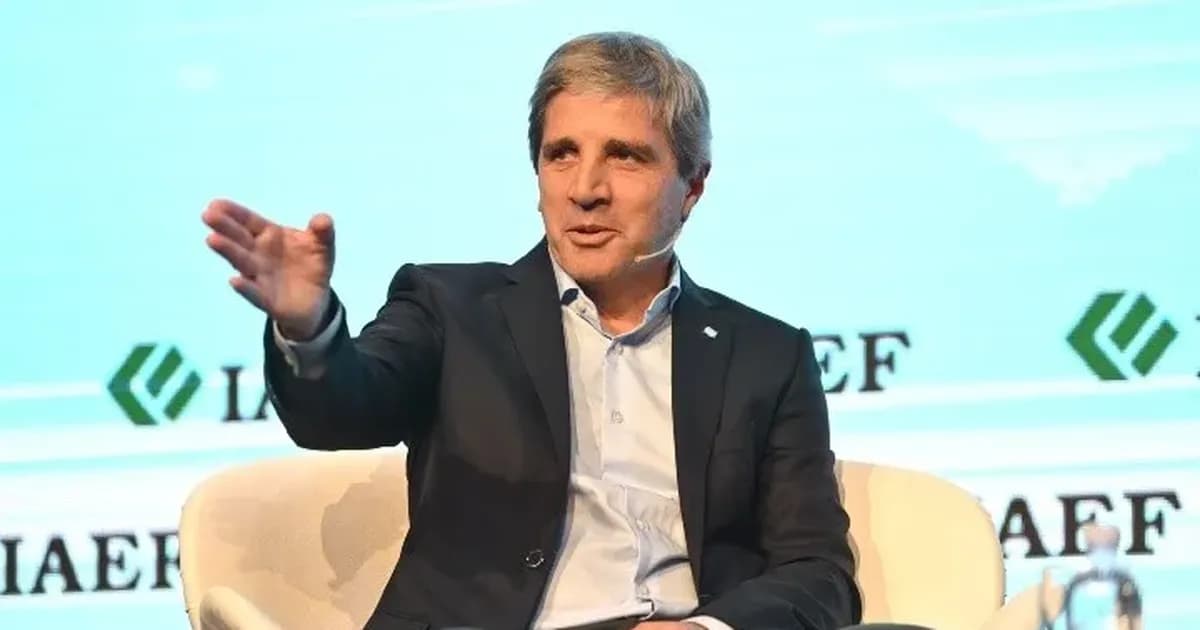
- •The Argentine government has stated there will be no central bank intervention despite consecutive dollar exchange rate increases, as fluctuations remain within the IMF-agreed band.
- •More than 8 trillion pesos in liquidity generated from July bonus payments and short-term bond maturities has been analyzed as causing a surge in dollar demand.
- •The government is deploying a strategy to manage exchange rate volatility before the October elections by absorbing idle funds through temporary bond auctions.
'No Intervention' Despite Dollar Surge
The Argentine government has completely ruled out the possibility of central bank (BCRA) intervention in the foreign exchange market despite the recent consecutive rise in the dollar exchange rate. A close associate of Economy Minister Luis 'Toto' Caputo told local media that "under no circumstances will the central bank intervene."
Since the beginning of July, the Argentine peso has shown simultaneous weakness across multiple exchange rate indicators. As of July 15, the official exchange rate stood at 1,295 pesos, the black market (blue dollar) at 1,350 pesos, and the tourist exchange rate at 1,683.5 pesos. Notably, the official exchange rate on this day broke several days of stability and returned to an upward trend.
The government maintains that this is not a crisis situation, emphasizing that exchange rate fluctuations are occurring within the band (1,000-1,400 pesos) agreed upon with the International Monetary Fund (IMF). A presidential office official stated, "There is no cause for concern as the exchange rate is fluctuating within the band."
Political Uncertainty and Liquidity Pressure
Market experts point to two factors behind this dollar surge. The first is political uncertainty. President Javier Milei recently characterized the Senate's passage of pension increases and provincial transfer budget expansion bills as an 'attempted institutional coup,' raising doubts about fiscal balance.
The second factor is increased peso liquidity in the market. The government analyzes that approximately 8 trillion pesos or more in spare funds were created in the market as early July bonus payments coincided with the maturity of Treasury short-term bonds (LEFI). The explanation is that this influx of funds into the foreign exchange market led to a surge in dollar demand.
Preemptive Liquidity Absorption Strategy
The government suddenly announced a temporary bond auction on the 15th. The Treasury plans to reissue five types of capitalization certificates (LECAP) with maturities between 15 and 90 days to absorb idle funds remaining in the banking sector. This is interpreted as a preemptive measure to minimize exchange rate volatility ahead of the October elections.
On the same day, futures dollar exchange rates recorded 1,315 pesos for August and 1,450 pesos for December, showing that the market expects an additional depreciation of approximately 12% by year-end. However, Minister Caputo's side claimed that "the dollar is falling now," asserting that the temporary bond auction is proving effective.
Milei Government's Exchange Rate Policy Dilemma
Argentina has suffered economic pain from recurring exchange rate crises for decades. In 2018, the peso's value plummeted by more than 50%, forcing the country to receive a $57 billion bailout from the IMF, and in 2019, it had no choice but to reintroduce capital controls. President Milei has advocated for 'dollarization' since taking office last year, but has adopted a managed floating exchange rate system at the IMF's request.
Argentina's country risk index currently stands at 717 points, significantly exceeding the emerging market average. This means that international investors still rate Argentina's economic uncertainty as high. The government faces the difficult situation of having to catch three rabbits simultaneously: maintaining fiscal balance, managing political pressure ahead of elections, and fulfilling commitments to the IMF.
Future Outlook [AI Analysis]
In the short term, the Treasury's liquidity absorption measures are likely to contribute to exchange rate stability. However, structurally, three risk factors remain.
First, if political uncertainty continues ahead of the October elections, capital outflow pressure may resurface. Second, if the exchange rate approaches the IMF-set band ceiling (1,400 pesos), there is a risk of strengthened speculative buying in the market. Third, changes in the international interest rate environment or economic recession in major trading partners could reduce foreign currency inflows, potentially accelerating peso weakness.
In the long term, the Milei government will only be able to restore market confidence by demonstrating fiscal soundness and successfully pushing forward structural reforms. Given that exchange rate stability comes not simply from whether the central bank intervenes but from confidence in economic fundamentals, the coming months are expected to be an important testing ground for determining the success or failure of the Milei government's economic policies.
댓글 (3)
기사 잘 봤습니다. 다른 시각의 분석도 읽어보고 싶네요.
그 부분은 저도 궁금했습니다.
Refuses에 대해 더 알고 싶어졌습니다. 후속 기사 부탁드립니다.
More in Economy
Middle East Conflict Drives Manufacturing Outlook to 10-Month Low

Lee Jae-myung Administration Excludes Multi-Home Officials from Real Estate Policymaking

Volkswagen CEO Says Germany Should Learn from China's Industrial Strategy

Russia Anticipates Economic Gains from US-Iran Conflict
U.S. Federal Reserve Unveils Bank Capital Regulation Modernization Plan
Federal Reserve Announces Enforcement Actions Against Two Former Bank Employees
Latest News
이스라엘, 헤즈볼라 무기 통로 레바논 다리 공습
이스라엘군, 헤즈볼라 무기 통로 레바논 다리 공습
중동행 전세기 전쟁보험료 최고 7천500만원
중동행 전세기 전쟁보험료가 최고 5만달러(7천500만원)로 상승
이란 탄도미사일, 이스라엘 방어망 뚫고 160명 부상
이란 탄도미사일이 이스라엘 방공망을 통과해 160명 부상

Southeast Asia Growth Forecasts Cut Amid Oil Price Surge, Threatening Korean Exports
Maybank Research has downgraded ASEAN-6's 2026 growth forecast from 4.8% to 4.5%.

Reddit Considers Face ID to Block Bots While Maintaining Anonymity
Reddit is considering implementing biometric authentication systems such as Face ID and Touch ID to block AI bots while maintaining anonymity.

BTS Tops March Artist Brand Reputation Rankings with First Full Group Comeback in 4 Years
BTS ranked first in the Korean Corporate Reputation Research Institute's March Artist Brand Reputation Rankings based on 99 million data points.

Santo Domingo's Malecón Sports Park Construction Progressing Smoothly
Construction of a soccer field and skate park is progressing smoothly in the Malecón area of Santo Domingo, Dominican Republic.

Pogačar Overcomes Crash to Win Milano-Sanremo, Achieves Four Monument Victories
Tadej Pogačar defeated Tom Pidcock to win Milano-Sanremo, achieving his fourth Monument victory.