Judith Butler on 'Privilege and Responsibility' Amid Threats to Academic Freedom in Trump Era
Gender theorist criticizes anti-discrimination turned into tool of oppression, calls for collective courage
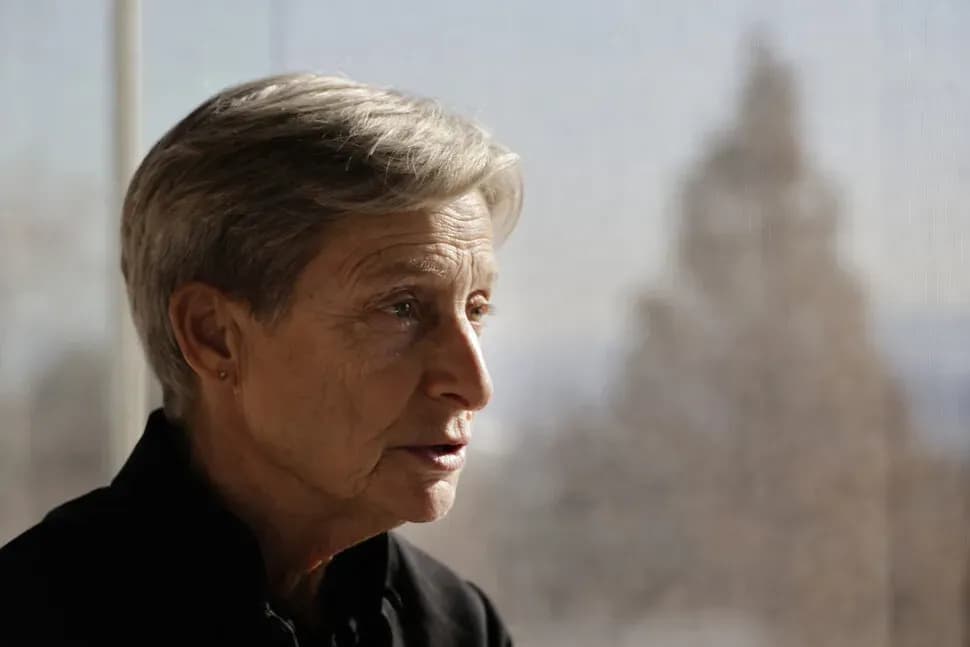
- •World-renowned gender theorist Judith Butler continues to voice critical perspectives despite threats to academic freedom under Trump's second administration.
- •Butler criticizes how anti-discrimination movements have been co-opted as tools of oppression by the reactionary right, expressing concern for immigrants and vulnerable populations.
- •She emphasizes the role of intellectuals in presenting both critique and imagination simultaneously, calling for solidarity through collective courage.
Trump's Second Term Threatens Academic Freedom
World-renowned gender and queer theorist Judith Butler, professor at UC Berkeley, continues to voice critical perspectives despite heightened threats to academic freedom following the inauguration of Trump's second administration. In an exclusive written interview with Hankyoreh, Professor Butler revealed that "I have been considering refuge if the situation worsens," while noting "I am a relatively privileged person" and expressing concern for those facing greater risks.
The Trump administration has conducted anti-Semitism investigations targeting major U.S. universities, and UC Berkeley, where Butler teaches, submitted student and faculty lists to the government. This incident in progressive California has sent shockwaves through academia.
"The Deportation Cases of the Past Year Have Been Chillingly Horrific"
Professor Butler sharply criticized the reality following Trump's return to power, stating "the deportation cases I've witnessed over the past year have been chillingly horrific." She emphasized that "those at greatest risk of harm in the United States are immigrants, students on international visas, and people deprived of social welfare benefits including medical services and affordable educational opportunities."
"None of us anticipated witnessing scenes of such authoritarian violence. The federal government has been threatening universities despite being obligated to support education."
In some states, the term 'gender' itself has become unusable in educational settings, and legal rights are being stripped away, including bans on gender-affirming medical services for transgender youth. Butler characterized this as "not only chilling but harmful."
Anti-Discrimination Becomes a Tool of Oppression
Professor Butler sharply pointed out the reality that anti-discrimination movements have been co-opted as tools of the reactionary right. In America's anti-gender campaigns, 'gender' is distorted as code for pedophilia and a means of indoctrinating children into homosexuality.
Christian fundamentalists in the U.S., South Korea, and elsewhere have attacked Butler, labeling her a 'pedophile.' In 2017 at a conference in Rio de Janeiro, Brazil, an effigy of Butler was burned in a scene reminiscent of medieval witch hunts.
Butler countered: "There are claims that knowledge of LGBTQ+ worlds and lives is harmful to youth, but depriving young people of knowledge about their own world is itself harmful."
From Gender Theory to Radical Democracy
Butler, who opened a new chapter in gender and queer theory with 'Gender Trouble' in 1990, is not simply a gender theorist. Her philosophy aims for radical democracy and consistently questions who is not protected from injury and death, and who does not have status as a life worthy of mourning.
Through works like 'Undoing Gender,' 'Excitable Speech,' 'Precarious Life,' and 'The Force of Nonviolence,' Butler has consistently emphasized 'livable lives' and interdependence. She stresses that "precarious life is life considered disposable" and that we must become "a place where all life can be mourned."
From 'Red' to 'Gender' in South Korea
South Korean society shows similar patterns. Korea, which once labeled communists as 'Reds,' now extends this stigma to 'gender.' In 2024, National Human Rights Commission Chairperson Ahn Chang-ho stated that "the anti-discrimination law could be exploited for communist revolution," and former President Yoon Suk-yeol cited 'eradicating pro-North anti-state forces' as justification for martial law.
Butler met with Hankyoreh 21 in Seoul in December 2024, 12 hours after Yoon's martial law declaration, predicting that "martial law could cost Yoon his presidency"—which indeed came to pass. At the time, Butler diagnosed Yoon's martial law as a "confession."
The Psychoanalytic Mechanism of Political Denunciation
Butler explains that "a psychoanalytic perspective is necessary to understand the political sphere."
"Certain types of political denunciation involve mechanisms of transference and projection operating simultaneously. One group condemns another as destroyers of the nation, but the denunciation itself enacts that very destruction."
Nationalism operates in this way, defining who belongs to the nation and who should be excluded. This is a form of xenophobia or racism that can gradually lead to militarized borders, detention camps, and denial of asylum rights, she warned.
"We Must Present Both Critique and Imagination"
Butler identified what intellectuals should do when political and religious powers threaten the right to know and academic freedom as "presenting critique and imagination simultaneously."
"We must track and understand how the 'anti-gender ideology' movement is becoming increasingly effective, but we must also present a vision of a world that affirms human complexity. Those who are intersex or whose actual experience doesn't align with the biological sex assigned at birth must be recognized."
This means that gender is closer to a spectrum or mosaic than a rigid, mutually exclusive binary opposition.
Confronting Through Collective Courage
Butler sent warm New Year's greetings to Hankyoreh and its readers, conveying a message of hope.
"Find strength in each other, resist individualism and heroism and depression, build local communities, and revel in intellectual life, the world of art, and multilingualism. Imagine together, dream together, and cultivate collective courage as a way of life."
In Trump's second term in 2025, facing powers that respond to the question 'Who's Afraid of Gender?' with ideological censorship and threats, Butler expressed determination to clarify and defend academic freedom as much as possible. She warns that religious or state powers seeking a return to a 'stable' patriarchal order can emerge as forces of salvation and restoration by stirring up fear, urging us toward vigilant criticism and solidarity.
댓글 (3)
간결하면서도 핵심을 잘 정리한 기사네요.
Butler에 대해 더 알고 싶어졌습니다. 후속 기사 부탁드립니다.
on 관련 기사 잘 읽었습니다. 유익한 정보네요.
More in Special

The Corsican Mafia Exposed: Breaking a Century of Silence

AI-Generated Fake Person Used to Sell Dubai Flight Seats

Facebook Groups Traded Endangered Species Using Code Language — Indonesian Broker Network Exposed

G6 Alliance Declares Support for Hormuz Strait Security... Reverses Stance Under Trump Pressure

Seoul's Average Monthly Rent Surpasses 1.51 Million Won as Soaring Official Property Prices Trigger 'Housing Cost Bomb'

Rihanna Tops Spotify Without New Album for 10 Years, Proving Power of Catalog
Latest News

이스라엘, 헤즈볼라 무기 통로 레바논 다리 공습
이스라엘군, 헤즈볼라 무기 통로 레바논 다리 공습

중동행 전세기 전쟁보험료 최고 7천500만원
중동행 전세기 전쟁보험료가 최고 5만달러(7천500만원)로 상승

이란 탄도미사일, 이스라엘 방어망 뚫고 160명 부상
이란 탄도미사일이 이스라엘 방공망을 통과해 160명 부상

Middle East Conflict Drives Manufacturing Outlook to 10-Month Low
The Korea Institute for Industrial Economics & Trade survey shows April manufacturing outlook PSI plummeted to 88, falling below baseline for the first time in 10 months.

Lee Jae-myung Administration Excludes Multi-Home Officials from Real Estate Policymaking
President Lee Jae-myung has ordered the exclusion of multi-home owning public officials from all real estate policy processes.

Southeast Asia Growth Forecasts Cut Amid Oil Price Surge, Threatening Korean Exports
Maybank Research has downgraded ASEAN-6's 2026 growth forecast from 4.8% to 4.5%.

Volkswagen CEO Says Germany Should Learn from China's Industrial Strategy
Volkswagen CEO stated that Germany should learn from China's systematic industrial planning approach.

Reddit Considers Face ID to Block Bots While Maintaining Anonymity
Reddit is considering implementing biometric authentication systems such as Face ID and Touch ID to block AI bots while maintaining anonymity.