1940s America: UN Housing Complex That Defied Racial Segregation
Parkway Village in New York Housed Families from 50 Nations During Whites-Only Era
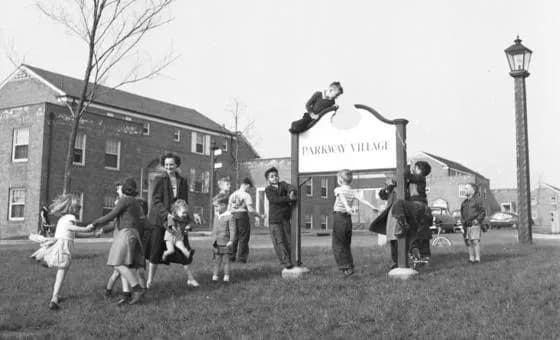
- •Parkway Village, established in New York in 1947 as UN staff housing, was America's first integrated housing complex where families from 50 countries lived together during an era when racial segregation was legally enforced.
- •Children from traditionally rival nations—India-Pakistan, Arab-Jewish—played and learned together, creating an atmosphere of cooperation and understanding.
- •This case, which created change through practice 17 years before the Civil Rights Act, offers insights for multicultural integration and urban planning today.
When Racial Segregation Was Law
Parkway Village, established in New York in 1947, was more than just housing for UN staff. At the time, many U.S. states legally mandated racial separation in schools, transportation, and restrooms, while the military remained racially divided. Laws banning interracial marriage were in effect, and numerous housing developments enforced "whites-only" policies.
In this environment, Parkway Village emerged as America's first racially integrated housing complex, where UN staff families from over 50 countries lived together. Early UN employees, including Nobel Peace Prize laureate Ralph Bunche, made their homes here.
Children's Friendships Across Borders
Carlos Figueroa, an early Parkway Village resident who later became a UN employee, recalls those days:
"I became friends with children from Europe, the Middle East, Asia, Africa, Latin America, and the Caribbean. Growing up together, we tasted each other's cuisines, learned about different cultures, and picked up bits of various languages."
By 1952, approximately 500 UN families resided in Parkway. Figueroa shares a particularly striking memory:
"Seeing children from traditionally rival nations—Indians and Pakistanis, Arabs and Jews—playing together, attending the same schools, and learning to get along in an atmosphere of cooperation and understanding, if not love and trust, was enlightening."
A Space That Practiced UN Principles
Rula Hinedi, head of UN tour guides who recently led a field survey of Parkway Village, explains the project's significance:
"From the beginning, the UN sought to play a leading role in eliminating racial discrimination worldwide. When the UN decided to establish its permanent headquarters in New York, there was perhaps no clearer demonstration of its intention to practice this principle than developing Parkway Village."
Amid low-rise buildings, winding walkways, and open lawns, Parkway Village became a symbolic space demonstrating the possibility of integration during an era when racial segregation was legally enforced, where staff from over 50 countries lived together.
Parkway in Historical Context
1947 preceded the full emergence of the American Civil Rights Movement. It was seven years before the 1954 Brown v. Board of Education decision declaring school segregation unconstitutional, and 17 years before the Civil Rights Act of 1964.
Against this backdrop, Parkway Village is evaluated as a case where change was created through practice before laws changed. As the UN established its New York headquarters and addressed staff housing needs, it directly applied the organization's universal human rights principles to architecture and community design.
Implications for Korea
Parkway Village's experiment holds meaning for Korea as it transforms into a multicultural society. With foreign residents in Korea recently exceeding 2.5 million and community integration emerging as a critical issue, this 1940s New York housing complex serves as a historical reference showing how physical space design can promote social integration.
Just as children then played and learned together, naturally accepting each other's differences, it offers the lesson that shared spaces and common experiences can be powerful tools for overcoming prejudice.
Future Outlook [AI Analysis]
The Parkway Village case likely offers several implications for modern urban planning and social integration policy.
First, with the growth of international organizations and multinational corporations today, renewed attention to multicultural residential space design is expected. Second, demonstrating that physical integration can lead to social integration, it may be referenced in public housing and urban regeneration projects.
Third, as a historical case where the UN practically implemented organizational values, it could stimulate discussion about the social responsibility and leadership role of international organizations.
댓글 (4)
기사 잘 봤습니다. 다른 시각의 분석도 읽어보고 싶네요.
그 부분은 저도 궁금했습니다.
America: 관련 기사 잘 읽었습니다. 유익한 정보네요.
간결하면서도 핵심을 잘 정리한 기사네요.
More in Global



Latest News

당정, 석유 최고가격제 손실 보전을 추경에 반영키로
당정이 석유 최고가격제 손실을 추경에 반영하기로 결정

6년 전 세 살 딸 살해한 30대 친모 구속송치
경찰, 6년 전 세 살 딸 살해 혐의 30대 친모를 구속송치

中企 수입 나프타의 80% 이상이 중동산…공급망 위기 심화
중소기업 수입 나프타의 80% 이상이 중동산으로 공급 의존도 높음

미·이란 긴장 한 달, 금융시장 요동…장기화 우려
미·이란 갈등으로 증시 변동성 확대, 코스피 6천 고지 후 등락

미·이란 전쟁 한 달, 미국 전문가 "종전·확전 기로"
미·이란 전쟁 1개월 도래, 종전·확전 기로 평가

미·이란 전쟁 1개월, 한국 안보·공급망 취약점 노출
미·이란 전쟁 장기화로 한국 안보·경제 취약점 노출