61 Years Since Humanity's First Spacewalk: Leonov's Historic Gamble Between Life and Death
On March 18, 1965, a 12-minute spacewalk became the first step toward the International Space Station era
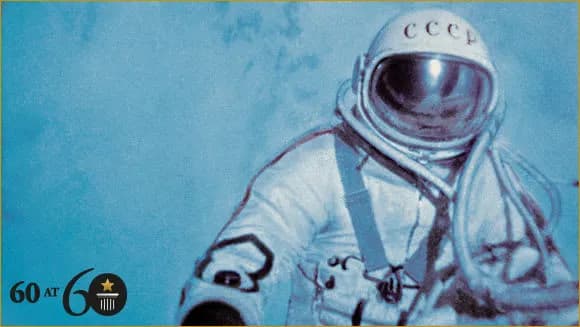
- •On March 18, 1965, Soviet cosmonaut Alexei Leonov performed humanity's first spacewalk for 12 minutes and 9 seconds, opening a new chapter in space exploration history.
- •When spacesuit inflation made re-entry impossible, this life-threatening experiment that succeeded by reducing pressure below safety limits became the technical foundation enabling satellite repairs and International Space Station construction.
- •Leonov, also an artist, created the first artwork in space and commanded the 1975 US-Soviet Apollo-Soyuz docking mission, leaving a model of international cooperation.
12 Minutes in Vacuum: Opening a New Chapter in Space Exploration
On March 18, 1965, Soviet cosmonaut Alexei Leonov opened the hatch of the Voskhod 2 spacecraft and floated into space for 12 minutes and 9 seconds, performing humanity's first extravehicular activity (EVA). This was more than just a "first" record. In a critical moment when his spacesuit inflated to dangerous levels making re-entry impossible, Leonov barely managed to return to the airlock by releasing pressure below the safety threshold. These 12 minutes were a decisive experiment proving that humans could work outside spacecraft, laying the foundation for subsequent satellite repairs, space station construction, and lunar landing programs.
Born in 1934, Leonov was the Soviet Union's 11th cosmonaut. But he was more than just a pilot—he was also an artist. During the Voskhod 2 mission, he brought along colored pencils modified for zero gravity and sketched an orbital sunrise, creating the first artwork made in space. Ten years later, in July 1975, Leonov commanded the Soyuz capsule in a two-day docking mission with NASA's Apollo capsule, establishing a model case for international space cooperation.
Why Spacewalks Matter: The Future That Would Be Impossible Without Work Outside the Capsule
Leonov's spacewalk was not mere performance. At the time, the United States and Soviet Union were racing to the Moon, and landing on the lunar surface required astronauts to handle equipment and perform tasks outside their spacecraft. Leonov's experiment proved this was physiologically and technically possible. Without this experiment's success, Neil Armstrong's 1969 Moon landing would have been impossible.
Moreover, Leonov's spacewalk became the practical foundation for decades of subsequent space development. The Hubble Space Telescope repair missions starting in 1984, the International Space Station (ISS) constructed from 1998, and the commercial space station era gaining momentum from 2021 were all built on the premise that "work can be done outside in a spacesuit." The Fédération Aéronautique Internationale (FAI) officially recognized Leonov's 12 minutes and 9 seconds as a world record, describing it as "humanity's bold victory on the brink of catastrophe."
What Changed: Soviet Lead, American Pursuit
Before Leonov's spacewalk, astronauts operated only inside their capsules. Both Yuri Gagarin's first human spaceflight in 1961 and John Glenn's Earth orbit flight in 1962 were confined to capsule interiors. Leonov was the first to break through this limitation.
| Category | Before Leonov (1961-1964) | After Leonov (1965-Present) |
|---|---|---|
| Astronaut Activity Range | Inside capsule only | External capsule work possible |
| Spacesuit Technology | Capsule pressure maintenance only | Independent life support for vacuum environment |
| Possible Missions | Observation, experiments | Satellite repair, station assembly, lunar landing |
| Space Exploration Strategy | Capsule-centered short missions | Long-term habitable modular structures |
Leonov's spacewalk was replicated by the United States in less than three months. On June 3, 1965, American Ed White performed a spacewalk during the Gemini 4 mission. However, White died in the 1967 Apollo 1 launchpad fire, becoming the first fatality of the space race. Leonov survived until 2019, remaining a living witness to space exploration history.
Historical Context of Spacewalks: From Cold War Technology Competition to International Cooperation Era [AI Analysis]
Leonov's spacewalk occurred at the peak of Cold War space competition. After the Soviet Union's 1957 Sputnik 1 launch and Gagarin's first human flight in 1961 gave them the lead, the United States responded with President Kennedy's 1961 declaration to land on the Moon "within a decade." Leonov's spacewalk was another demonstration of Soviet technological superiority.
However, Leonov's personal trajectory symbolized space exploration's future shift from competition to cooperation. In the 1975 Apollo-Soyuz Test Project (ASTP), he commanded Soyuz 19 and docked with NASA's Apollo capsule, creating a symbolic moment of US-Soviet cooperation during the Cold War. This spirit continued into the 1990s with ISS construction, and as of 2024, the ISS functions as a platform for international cooperation jointly operated by the United States, Russia, Europe, Japan, and Canada.
Another of Leonov's legacies is his identity as an "artist-cosmonaut." Before becoming a pilot, he dreamed of being an artist and never stopped creating, even in space. His orbital sunrise sketch from Voskhod 2 initiated space art, establishing a tradition continued by numerous astronauts who have since created photographs, videos, and music in space.
Future Outlook: Evolution of Spacewalk Technology and the Commercial Space Era [AI Analysis]
Sixty-one years after Leonov's 12-minute spacewalk, extravehicular activity has become routine work. As of 2024, more than 10 EVAs are conducted annually at the ISS alone, and spacesuit technology has evolved from Leonov-era rigid pressure suits to next-generation equipment like the xEMU (Exploration Extravehicular Mobility Unit) with vastly improved joint mobility.
Future spacewalk technology will likely develop in three directions. First, the commercial space station era will see increasingly frequent spacewalks. Axiom Space, Blue Origin, Sierra Space, and others are planning commercial station construction in the late 2020s, requiring large-scale EVA for assembly and maintenance. Second, as lunar base construction begins in earnest, new EVA protocols for gravity environments will be established. NASA's Artemis program targets lunar South Pole base construction by 2028. Third, spacesuit automation is progressing. "Smart spacesuits" integrating AI-based life support systems, robotic assist arms, and AR heads-up displays are under development.
Leonov's legacy extends beyond the "first" title. He left three values: human courage to overcome technical limitations, international cooperation transcending competition, and the fusion of science and art. Without his boldness in surviving 12 minutes in vacuum 61 years ago, today's space stations, Hubble Telescope, and commercial space travel that we take for granted would not exist.
[IMG:1]
댓글 (4)
너무 슬픈 소식이네요. 피해자 분들과 가족에게 위로를 보냅니다.
마음이 무겁습니다. 삼가 고인의 명복을 빕니다.
이런 일이 다시는 반복되지 않았으면 합니다. Since 관련 대책이 시급합니다.
다시는 이런 일이 없어야 합니다.
More in AI & Tech
영국 정치지도자들, 아동 성착취 혐의에 대한 긴급 조사 촉구

A humanoid robot performing in China has a child's face on it.

U.S. jury finds Meta and Google responsible for ‘social media addiction’… 3.7 billion won compensation ruling

Japanese X-ray Observatory makes first direct measurement of ultrafast 'cosmic wind' in galaxy M82

NASA selects 24 people for 2026 Astrophysics Postdoctoral Fellowships

Ethereum is at a crossroads to ‘redefine its identity’ ahead of the quantum computing and AI era
Latest News
"간부 잘 아는데 교통비 좀" 휴가 군인들 돈 뜯은 50대 구속
50대 A씨가 휴가 중인 군인들에게 부대 간부를 아는 척 접근해 돈을 사취

英 옥토퍼스, 이란 전쟁 이후 태양광 판매 50% 증가
이란 전쟁 이후 영국 옥토퍼스의 태양광 판매량 50% 증가

당정 "추경, 지방·취약계층에 더 지원되는 방식으로"
당정이 지방자치단체와 취약계층 중심의 추경 편성 방침 재확인

당정, 석유 최고가격제 손실 보전을 추경에 반영키로
당정이 석유 최고가격제 손실을 추경에 반영하기로 결정
어머니 폭행하고 금팔찌 빼앗은 30대 아들 경찰에 붙잡혀
어머니 폭행 후 금팔찌 빼앗은 30대 남성 체포

아이티 갱단 폭력사태로 10개월간 5천명 이상 사망
아이티에서 지난 10개월간 갱단 폭력으로 5천명 이상 사망
서방 정보당국 "러시아, 우크라이나 전쟁 후 이란에 드론·식량 공급"
서방 정보당국, 러시아의 이란 드론·식량 공급 작업 거의 완료 파악

6년 전 세 살 딸 살해한 30대 친모 구속송치
경찰, 6년 전 세 살 딸 살해 혐의 30대 친모를 구속송치