Ancient River Delta from 4.2 Billion Years Ago Discovered 115 Feet Below Mars Surface
Perseverance Rover Confirms Water-Rich Ancient Environment Beneath Jezero Crater
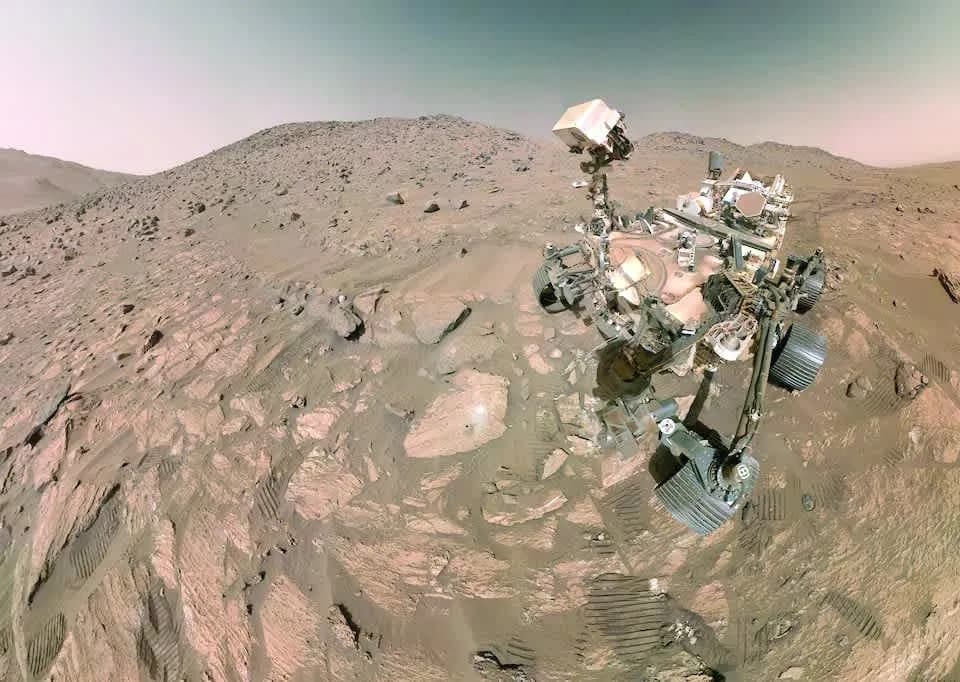
- •NASA's Perseverance rover discovered an ancient river delta formed 4.2 billion years ago, 35 meters beneath Mars' Jezero Crater.
- •The sedimentary layers detected by ground-penetrating radar represent some of the oldest evidence of water on Mars.
- •The confirmed water-rich environment increases the possibility of discovering traces of ancient life.
Oldest Evidence of Water in Mars History
NASA's Perseverance rover has discovered traces of an ancient river delta formed approximately 3.7 to 4.2 billion years ago, buried 35 meters (about 115 feet) beneath the Martian surface. Published Wednesday in the journal Science Advances, this finding represents one of the oldest pieces of evidence for water on Mars, predating surface observations of the western delta by hundreds of millions of years.
The Radar Imager for Mars' Subsurface Experiment (RIMFAX) aboard Perseverance detected layered sediments beneath Jezero Crater, indicating that a river once flowed here and formed a delta. Researchers explain that this discovery suggests Mars' aqueous environment may have persisted much longer than previously estimated.
New Possibilities for Searching for Signs of Life
Dr. Emily Cardarelli, first author from the University of California, Los Angeles (UCLA), stated that this region possessed a water-rich environment "capable of preserving biosignatures." Water-rich environments are essential conditions for the emergence and maintenance of life, and this discovery raises expectations for finding traces of ancient life on Mars.
Delta sediments are particularly known as favorable environments for preserving organic matter and microbial traces. As river-transported sediments accumulate in layers, chemical and biological information from that time period can be preserved together. Researchers plan to prioritize locations that can access these subsurface structures in future sampling plans.
Evolution of Mars Water Environment Research
Research on Mars' water environment began in earnest in the early 2000s when Mars orbiters discovered dried riverbeds and mineral traces. The Curiosity rover, which landed in 2012, secured evidence of a past lake in Gale Crater, and Perseverance, which landed in 2021, confirmed the presence of water approximately 3 billion years ago through surface delta deposits in Jezero Crater.
This discovery is significant in that it provides information from a much deeper time period that could not be obtained through surface observations alone. RIMFAX is equipment capable of analyzing subsurface geological structures at depths exceeding 10 meters using radio waves, and has three-dimensionally reconstructed the continuity and shape of subsurface sedimentary layers through data collected as the rover moves.
Current Mars water environment research is evolving beyond simply determining the presence of water to revealing how long and in what form water existed. Jezero Crater is an impact structure with a diameter of 45 kilometers, estimated to have formed about 3.9 billion years ago. This research suggests the possibility that water began flowing shortly after the crater's formation.
Future Prospects [AI Analysis]
NASA plans to bring rock samples collected by Perseverance back to Earth through the Mars Sample Return mission in the early 2030s. If samples from near the newly discovered subsurface delta are included, there is a high possibility of obtaining decisive clues about Mars' early history and the potential for life.
South Korea's participation in Mars exploration is also becoming active. The Korea Aerospace Research Institute (KARI) is reviewing participation plans for Mars exploration based on its experience developing lunar landers in the 2030s, and is expected to accumulate Mars exploration technology through international cooperation with NASA. Perseverance's discovery is expected to serve as important reference material for evaluating the possibility of utilizing water resources for future human Mars exploration.
Subsurface delta research is likely to influence life exploration strategies for other celestial bodies in the solar system, including Jupiter's moon Europa and Saturn's moon Enceladus. If methodologies for analyzing ancient environments preserved beneath the surface are validated, similar radar technology is expected to be applied to other exploration missions.
댓글 (3)
기사 잘 봤습니다. 다른 시각의 분석도 읽어보고 싶네요.
공감합니다. 참고하겠습니다.
River 관련 기사 잘 읽었습니다. 유익한 정보네요.
More in Global





Latest News

당정, 석유 최고가격제 손실 보전을 추경에 반영키로
당정이 석유 최고가격제 손실을 추경에 반영하기로 결정

6년 전 세 살 딸 살해한 30대 친모 구속송치
경찰, 6년 전 세 살 딸 살해 혐의 30대 친모를 구속송치

中企 수입 나프타의 80% 이상이 중동산…공급망 위기 심화
중소기업 수입 나프타의 80% 이상이 중동산으로 공급 의존도 높음

미·이란 긴장 한 달, 금융시장 요동…장기화 우려
미·이란 갈등으로 증시 변동성 확대, 코스피 6천 고지 후 등락

미·이란 전쟁 한 달, 미국 전문가 "종전·확전 기로"
미·이란 전쟁 1개월 도래, 종전·확전 기로 평가

미·이란 전쟁 1개월, 한국 안보·공급망 취약점 노출
미·이란 전쟁 장기화로 한국 안보·경제 취약점 노출