CERN Solves 20-Year Puzzle with Discovery of New Baryon Containing Two Charm Quarks
LHCb Experiment Successfully Observes Ξcc+ Particle with Mass Four Times That of a Proton
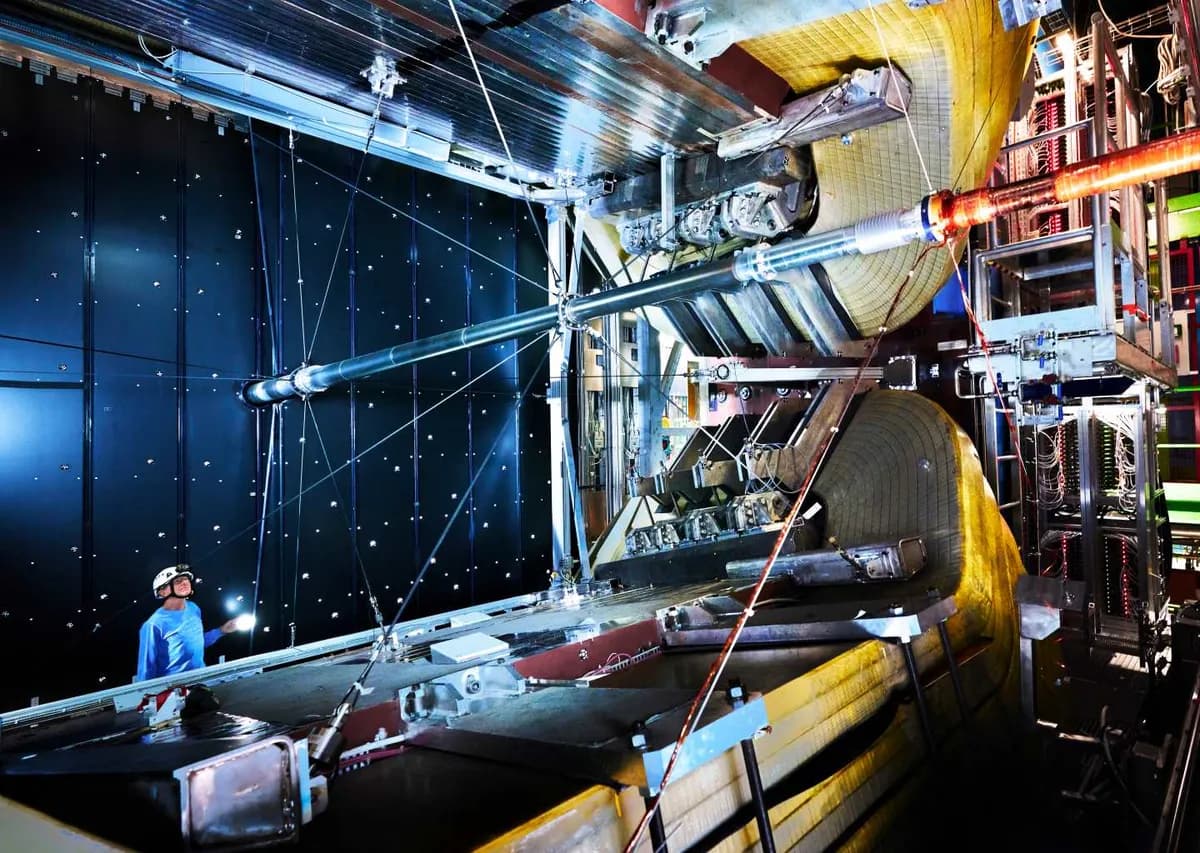
- •CERN's LHCb experiment team discovered a new baryon Ξcc+ containing two charm quarks, ending a 20-year debate.
- •This particle, with mass four times that of a proton, provides crucial clues for understanding how the strong force operates.
- •The LHCb detector upgraded in 2023 is expected to enable discovery of more exotic hadrons.
Historic Discovery Ends 20-Year Debate
The LHCb experiment team at CERN's Large Hadron Collider (LHC) announced on March 16 at the Moriond Electroweak Conference the discovery of a new baryon Ξcc+ (Xi-cc-plus) composed of two charm quarks and one down quark. This discovery, with statistical significance exceeding 7 sigma, represents only the second observation in history of a baryon containing two heavy quarks.
This particle has a structure similar to a proton but contains heavier charm quarks instead of two up quarks, resulting in a mass approximately four times that of a proton. LHCb spokesperson Vincenzo Vagnoni stated, "This is the first new particle confirmed since the detector upgrade completed in 2023, and the second doubly heavy quark baryon observed since LHCb's detection about 10 years ago."
The World of Quarks: Why It Matters
Quarks are fundamental building blocks of matter, existing in six types: up, down, charm, strange, top, and bottom. Typically, combinations of 2 quarks form mesons, while combinations of 3 form baryons. Unlike the stable proton, most hadrons are unstable and short-lived, making observation difficult. Creating them requires colliding particles in high-energy colliders like the LHC, and although the unstable particles generated decay immediately, analyzing the stable particles produced in the process allows physicists to infer the characteristics of the original particle.
Researchers have discovered numerous new hadrons using this method, and with this discovery, the total number of hadrons discovered by LHC experiments has reached 80. This particle particularly provides decisive evidence resolving unconfirmed claims that have been the subject of debate in the physics community for over 20 years.
Historical Development of Quark Physics
Quark theory was independently proposed by Murray Gell-Mann and George Zweig in 1964 and experimentally verified at the Stanford Linear Accelerator Center (SLAC) in 1968. The subsequent 1974 discovery of the J/ψ meson containing charm quarks, known as the "November Revolution," marked a turning point in particle physics.
With the activation of CERN's LHC in the 2000s, quark research entered a new phase. Following the 2012 Higgs boson discovery, the LHC has demonstrated the diversity of quark combinations through discoveries of exotic hadrons such as tetraquarks (4-quark particles) and pentaquarks (5-quark particles). Since LHCb's first discovery of the doubly heavy quark baryon Ξcc++ in 2017, physicists have predicted the existence of other particles with similar structures, and the current Ξcc+ discovery represents a continuation of this trajectory.
Unlocking the Secrets of the Strong Force
The core significance of this discovery lies in refining Quantum Chromodynamics (QCD) models. QCD is the theory explaining the strong force that binds quarks together, describing how quarks form not only protons and neutrons but also more complex hadron structures. However, the dynamics of how two or more heavy quarks combine has remained a theoretical challenge.
Doubly heavy quark particles like Ξcc+ serve as unique laboratories for studying interactions between heavy quarks. By precisely measuring this particle's mass, lifetime, and decay pathways, physicists can compare results with QCD predictions and gain deeper understanding of how the strong force operates. The LHCb detector upgraded in 2023 particularly features data collection capabilities improved by a factor of 5 compared to before, increasing the likelihood of discovering even rarer particles in the future.
Future Prospects [AI Analysis]
The LHC has now entered its final operational season and is scheduled to accumulate unprecedented amounts of collision data through 2025. This is likely to lead to discoveries of more exotic hadrons. The next targets are expected to include doubly heavy quark particles containing bottom quarks, or baryons with three heavy quarks.
International collaborative research teams including the University of Manchester have dramatically improved data processing speed by utilizing the upgraded detector and machine learning analysis techniques. This opens the possibility of shortening the particle discovery cycle from years to months, which would have been the case in the past. Over the next decade, when the High-Luminosity LHC (HL-LHC), the successor to the LHC, becomes operational, quark physics is expected to enter a golden age of more precise measurements and exploration of new physical phenomena.
댓글 (4)
관계자분들의 노력에 박수를 보냅니다.
Solves 정말 대단하네요! 좋은 소식입니다.
좋은 소식에 기분이 좋아지네요.
20-Year 소식 반갑습니다. 앞으로가 더 기대됩니다.
More in AI & Tech

영국 정치지도자들, 아동 성착취 혐의에 대한 긴급 조사 촉구

A humanoid robot performing in China has a child's face on it.

U.S. jury finds Meta and Google responsible for ‘social media addiction’… 3.7 billion won compensation ruling

Japanese X-ray Observatory makes first direct measurement of ultrafast 'cosmic wind' in galaxy M82

NASA selects 24 people for 2026 Astrophysics Postdoctoral Fellowships

Ethereum is at a crossroads to ‘redefine its identity’ ahead of the quantum computing and AI era
Latest News

"간부 잘 아는데 교통비 좀" 휴가 군인들 돈 뜯은 50대 구속
50대 A씨가 휴가 중인 군인들에게 부대 간부를 아는 척 접근해 돈을 사취

英 옥토퍼스, 이란 전쟁 이후 태양광 판매 50% 증가
이란 전쟁 이후 영국 옥토퍼스의 태양광 판매량 50% 증가

당정 "추경, 지방·취약계층에 더 지원되는 방식으로"
당정이 지방자치단체와 취약계층 중심의 추경 편성 방침 재확인

당정, 석유 최고가격제 손실 보전을 추경에 반영키로
당정이 석유 최고가격제 손실을 추경에 반영하기로 결정
어머니 폭행하고 금팔찌 빼앗은 30대 아들 경찰에 붙잡혀
어머니 폭행 후 금팔찌 빼앗은 30대 남성 체포

아이티 갱단 폭력사태로 10개월간 5천명 이상 사망
아이티에서 지난 10개월간 갱단 폭력으로 5천명 이상 사망

서방 정보당국 "러시아, 우크라이나 전쟁 후 이란에 드론·식량 공급"
서방 정보당국, 러시아의 이란 드론·식량 공급 작업 거의 완료 파악

6년 전 세 살 딸 살해한 30대 친모 구속송치
경찰, 6년 전 세 살 딸 살해 혐의 30대 친모를 구속송치