Google Expands Camera-Based AI Search 'Search Live' to 200 Countries
Personalized AI Features Now Free for All US Users… Global AI Search Competition Intensifies
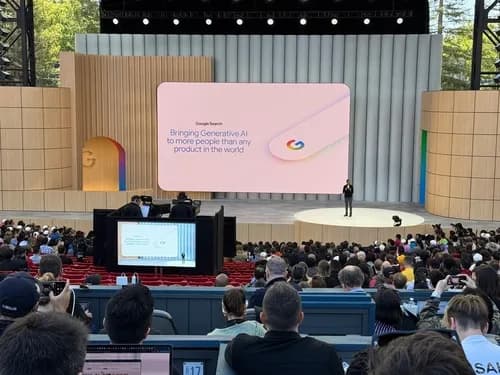
- •Google announced plans to expand camera-based AI search 'Search Live' to 200 countries, then retracted; currently available only in US and India with additional market testing underway.
- •Personalized AI feature 'Personal Intelligence' opened to all free users in the US, allowing connection of personal data from Gmail, Photos, etc. with AI.
- •Google aims to secure leadership in AI search market competition against ChatGPT, Copilot, etc. by offering multimodal search and personalization features for free.
Real-Time Camera Search Expands Globally
Google has expanded its camera-based conversational AI search feature 'Search Live' to over 200 countries. Since its initial launch in the United States last year, the service has been rapidly expanding into global markets, allowing users to identify objects in real-time through their camera and ask questions via voice.
Update (March 19, 2026, 4:00 PM): Google retracted parts of this announcement shortly after the initial release. The company stated that "Search Live has not been rolled out to all users worldwide" and that it is "currently available in the United States and India, with testing underway in additional markets." However, Google is still conducting tests in more markets, leaving the door open for future global expansion.
Alongside this, Google has opened its 'Personal Intelligence' feature—previously available only to paid subscribers—to all free users in the United States. This feature allows users to connect personal data from Gmail, Google Photos, and other services with AI to receive customized search results.
Personalized AI Removes Paywall Barriers
Personal Intelligence is available in Google Search's 'AI Mode,' the Gemini app, and Gemini within Chrome browser. When users connect their Gmail or Google Photos accounts, the AI references personal data to provide more accurate and personalized responses.
Google has clearly addressed privacy concerns by stating that "AI models do not directly train on users' Gmail inboxes or Google Photos libraries." Both features are optional, and users can disconnect them at any time.
This move is interpreted as part of Google's strategy to significantly expand access to AI-powered search services. By offering advanced features previously available only through the paid Google One subscription for free, Google appears to be aiming to gain an advantage over competitors like OpenAI's ChatGPT and Microsoft's Copilot.
Why Now: Shifting Dynamics in the AI Search Market
Google's latest moves come at a time when the AI search market is rapidly being reshaped. Since ChatGPT added search functionality in 2023 and Microsoft integrated AI into Bing, Google has faced challenges to its dominant position in the search market. Particularly among younger users, conversational AI-based information retrieval has been increasing, revealing the limitations of traditional keyword-based search.
Search Live is Google's core strategy in response to this trend. The multimodal experience of pointing a camera at objects and asking questions via voice provides mobile-centric users with a much more intuitive and faster search method. For example, users can point their camera at a plant and ask "How do I care for this plant?" to receive immediate customized answers.
The free opening of Personal Intelligence follows the same logic. AI search utilizing personal data provides much higher accuracy and relevance than general search. This increases user loyalty and extends the time users spend within Google's ecosystem.
Google's Strategy Compared to Competitors
| Feature | Google Search Live | ChatGPT Search | Bing AI | Perplexity |
|---|---|---|---|---|
| Multimodal Support | Real-time camera+voice | Text-focused | Text-focused | Text-focused |
| Personal Data Integration | Gmail, Photos, etc. | Limited | OneDrive integration | None |
| Free Access | Fully free | Free basic (limited) | Free basic | Free basic |
| Launch Scope | US, India (expanding) | Worldwide | Worldwide | Worldwide |
Google's greatest strength is integration with its vast existing service ecosystem. The ability to seamlessly connect AI with services already used by hundreds of millions—Gmail, Photos, Calendar, Drive—creates an entry barrier that competitors cannot easily replicate.
In contrast, ChatGPT has a strong identity as an independent AI assistant, Bing has strengths in integration with the Microsoft Office ecosystem, and Perplexity focuses on source transparency and academic accuracy.
AI Search Timeline: 2023-2026
The AI search market has undergone dramatic changes over the past three years. The conversational AI search boom that began with ChatGPT's explosive growth in early 2023 is now evolving toward multimodal experiences and personalization.
2023: ChatGPT surpassed 100 million monthly active users, proving the potential of AI search. Google responded by launching Bard (now Gemini).
2024: Google fully introduced AI Overviews, and OpenAI announced SearchGPT, marking the full-scale AI transformation of the search market. From this period, multimodal search integrating images, voice, and video beyond text became a core topic.
2025: Major companies began strengthening personal data integration features. Microsoft enhanced Copilot's integration with OneDrive and Outlook, while Google launched Personal Intelligence as a paid service.
2026 Present: With Google's global expansion of Search Live (in testing) and free opening of Personal Intelligence, the AI search market is shifting to a competition over "who can provide better experiences to more users for free."
Future Outlook and Implications [AI Analysis]
Google's latest actions signal three important changes in the AI search market.
First, multimodal search is likely to become the standard. Camera and voice-based search is much faster and more intuitive than typing, especially in mobile environments. If Search Live expands globally, competitors are expected to rush to release similar features.
Second, competition for free personalized AI is expected to intensify. Google's conversion of Personal Intelligence to free service is a signal in the user data acquisition race. The more personal data that can be connected more deeply, the higher the AI's accuracy and usefulness, so more companies are likely to attract users by offering personalization features for free.
Third, privacy debates may reignite. While Google stated that "AI models do not train on personal data," user concerns will not easily disappear. Particularly as regulatory environments strengthen with Europe's GDPR and various US state privacy laws, AI companies will need to pay more attention to providing transparency and control.
Google's announcement goes beyond a simple feature update—it's part of an aggressive strategy to reclaim dominance in the AI search market. Whether this strategy can effectively counter the challenges from ChatGPT and Copilot, and how much users will accept personal data connection, will be key variables determining the future landscape of the AI search market.
댓글 (5)
흥미로운 주제입니다. 주변에도 공유해야겠어요.
공감합니다. 참고하겠습니다.
기사 잘 봤습니다. 다른 시각의 분석도 읽어보고 싶네요.
간결하면서도 핵심을 잘 정리한 기사네요.
그 부분은 저도 궁금했습니다.
More in this series
More in AI & Tech

영국 정치지도자들, 아동 성착취 혐의에 대한 긴급 조사 촉구

A humanoid robot performing in China has a child's face on it.

U.S. jury finds Meta and Google responsible for ‘social media addiction’… 3.7 billion won compensation ruling

Japanese X-ray Observatory makes first direct measurement of ultrafast 'cosmic wind' in galaxy M82

NASA selects 24 people for 2026 Astrophysics Postdoctoral Fellowships

Ethereum is at a crossroads to ‘redefine its identity’ ahead of the quantum computing and AI era
Latest News

"간부 잘 아는데 교통비 좀" 휴가 군인들 돈 뜯은 50대 구속
50대 A씨가 휴가 중인 군인들에게 부대 간부를 아는 척 접근해 돈을 사취
英 옥토퍼스, 이란 전쟁 이후 태양광 판매 50% 증가
이란 전쟁 이후 영국 옥토퍼스의 태양광 판매량 50% 증가
당정 "추경, 지방·취약계층에 더 지원되는 방식으로"
당정이 지방자치단체와 취약계층 중심의 추경 편성 방침 재확인

당정, 석유 최고가격제 손실 보전을 추경에 반영키로
당정이 석유 최고가격제 손실을 추경에 반영하기로 결정

어머니 폭행하고 금팔찌 빼앗은 30대 아들 경찰에 붙잡혀
어머니 폭행 후 금팔찌 빼앗은 30대 남성 체포

아이티 갱단 폭력사태로 10개월간 5천명 이상 사망
아이티에서 지난 10개월간 갱단 폭력으로 5천명 이상 사망

서방 정보당국 "러시아, 우크라이나 전쟁 후 이란에 드론·식량 공급"
서방 정보당국, 러시아의 이란 드론·식량 공급 작업 거의 완료 파악

6년 전 세 살 딸 살해한 30대 친모 구속송치
경찰, 6년 전 세 살 딸 살해 혐의 30대 친모를 구속송치