IBM's Bennett and University of Montreal's Brassard Win Turing Award for Quantum Cryptography Protocol
BB84 Protocol Pioneers Quantum Information Science—First Turing Award Recognition for Quantum Physics Research
- •IBM's Bennett and University of Montreal's Brassard won the 2025 Turing Award for developing the BB84 quantum cryptography protocol, with a prize of $1 million.
- •BB84 detects eavesdropping through physical laws, marking the first Turing Award recognition of quantum physics research in the award's history.
- •In an era where quantum computers can render RSA encryption obsolete, BB84 maintains security, and national competition to build quantum communication networks is accelerating.
Quantum Cryptography Pioneers Receive Computing's Highest Honor
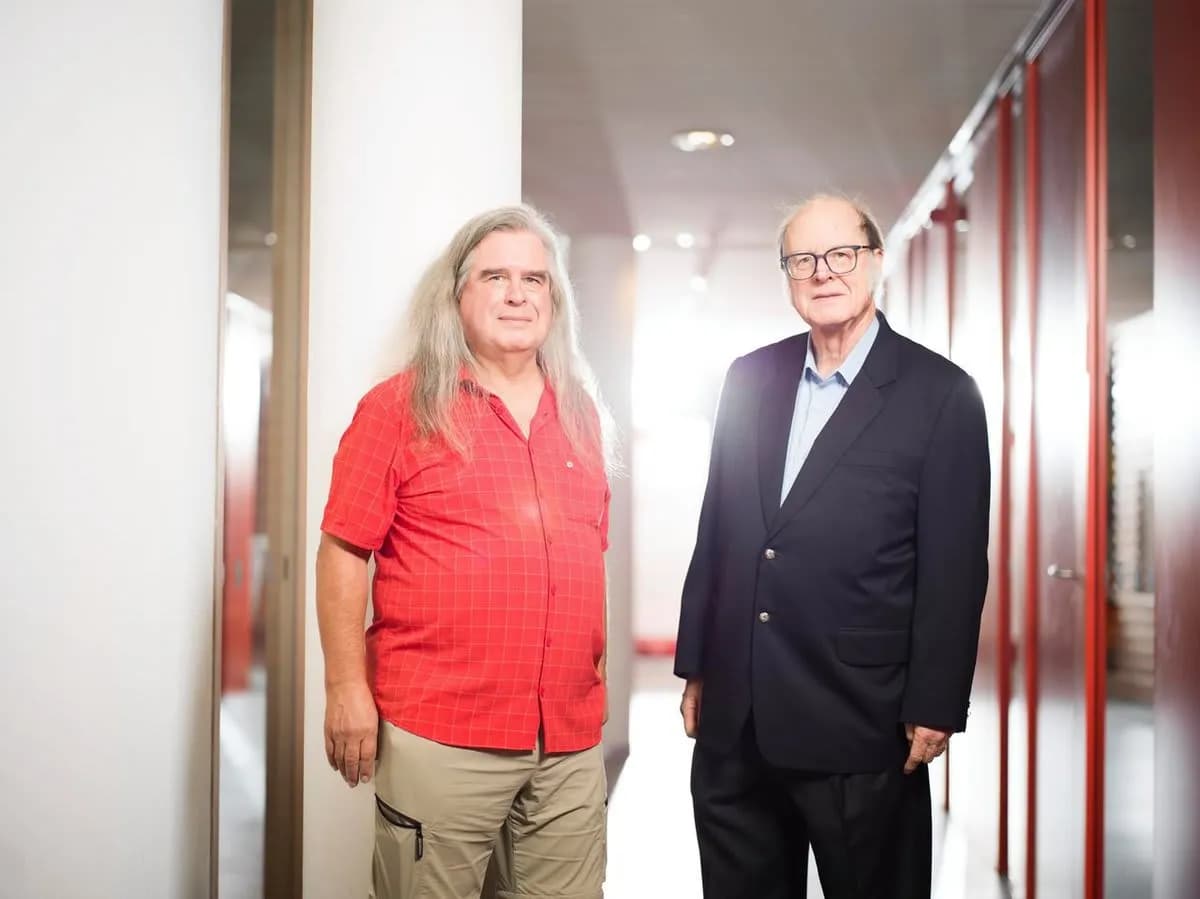
The Association for Computing Machinery (ACM) announced that Charles H. Bennett (82) of IBM Research and Professor Gilles Brassard of the University of Montreal have been selected as the 2025 ACM A.M. Turing Award recipients for developing the BB84 quantum cryptography protocol. The award comes with a $1 million prize (approximately 1.4 billion Korean won). The Turing Award, often called the "Nobel Prize of Computing," is funded by Google.
ACM cited their "pivotal role in establishing the foundations of Quantum Information Science and revolutionizing secure communications and computing" as the reason for the award. According to Nature, this marks the first time in Turing Award history that research related to quantum physics has been recognized. ACM President Yannis Ioannidis stated, "These two individuals have fundamentally changed our understanding of information itself."
BB84 Protocol: Cryptography Protected by Physical Laws
The BB84 protocol, jointly developed by Bennett and Brassard in 1984, is an encryption method that can fundamentally detect eavesdropping by utilizing the physical laws of quantum mechanics. While traditional cryptographic systems relied on mathematical complexity (such as the difficulty of prime factorization), BB84 achieved a paradigm shift by leveraging the uncertainty principle of quantum measurement.
Specifically, BB84 uses the polarization states of photons to transmit secret keys. If an eavesdropper measures the photons during transmission, the quantum state becomes disturbed, allowing the sender and receiver to immediately detect the intrusion. This provides "Information-Theoretic Security" that cannot be broken regardless of computational power—even with the emergence of quantum computers.
This research has influenced a wide range of fields beyond cryptography, including algorithm design, computational complexity theory, learning theory, interactive proofs, and mathematical physics. ACM emphasized that "their research has encouraged an entire generation of physicists and computer scientists to collaborate across disciplinary boundaries."
The Birth and Expansion of Quantum Information Science
| Period | Major Events | Significance |
|---|---|---|
| 1984 | BB84 Protocol Published | Theoretical foundation of quantum cryptography established |
| 1991 | First Laboratory Implementation Successful | Quantum Key Distribution (QKD) demonstrated |
| 2000s | Fiber-optic Quantum Communication Network Pilot Operations | National-level investment begins in China, Europe, etc. |
| 2016 | China Launches Quantum Satellite 'Micius' | Satellite-based quantum communication era begins |
| 2020s | Quantum Computing Commercialization Competition | Corporate participation expands with IBM, Google, IonQ, etc. |
The BB84 protocol was close to theoretical curiosity when published in 1984, but after its first laboratory implementation in 1991, it entered the practical phase in the 2000s. China launched the world's first quantum communication satellite 'Micius' in 2016, integrating quantum cryptography technology into national security infrastructure, and the European Union has been promoting the pan-European Quantum Communication Infrastructure (EuroQCI) construction since 2019.
Currently, the Quantum Key Distribution (QKD) equipment market is growing at over 20% annually, with accelerated adoption in high-reliability industries such as finance, defense, and healthcare. South Korea is also aiming to build a quantum cryptographic communication network connecting Seoul-Daejeon-Busan by 2027 under the leadership of the Ministry of Science and ICT.
The Quantum Computing Era: Crisis and Alternatives for Traditional Cryptography
The renewed attention to Bennett and Brassard's research is driven by the practical realization of quantum computers. Quantum computers being developed by Google, IBM, and others can decrypt RSA encryption—the foundation of current internet security—within minutes using Shor's algorithm. The U.S. National Institute of Standards and Technology (NIST) published Post-Quantum Cryptography standards in 2024, but these still have the limitation of depending on mathematical complexity.
In contrast, BB84 remains secure in the quantum computing era because it is protected by physical laws. However, current QKD technology has constraints on transmission distance (approximately 100-200km) and transmission speed (several Mbps per second), requiring the development of relay technologies such as quantum repeaters for widespread commercialization.
[AI Analysis] The Future of Quantum Information Science and Industry Outlook
This Turing Award symbolizes that quantum technology is transitioning from theoretical academic exploration to core infrastructure for industry and national security. The following changes are expected over the next 5-10 years.
First, the global expansion of quantum cryptographic communication networks is likely to accelerate. Stimulated by China and Europe's leading investments, the United States, Japan, and South Korea are also expected to begin full-scale national-level quantum infrastructure construction. Financial institutions and cloud service providers are particularly likely to adopt quantum security solutions early.
Second, parallel development of quantum computing and quantum cryptography is anticipated. IBM, Google, IonQ, and others are expected to provide integrated quantum cryptography technology alongside quantum computer commercialization. This could take on the aspect of an arms race where "attack and defense" develop simultaneously.
Third, institutionalization of interdisciplinary fusion research is expected to proceed. Just as Bennett and Brassard broke down the boundaries between physics and computer science, quantum information science requires collaboration across various fields including materials engineering, optics, electronics, and mathematics. Major research institutions are already pursuing the establishment of specialized quantum information departments and research centers.
Finally, standardization and regulatory discussions are expected to materialize. International consultations are needed regarding interoperability of quantum cryptography equipment, authentication systems, and international standards, and the possibility of intensified technological hegemony competition during this process cannot be ruled out.
The philosophy of "physical foundations for information protection" presented by the BB84 protocol is now, 40 years later, becoming a new safety net for digital civilization.
댓글 (3)
이런 긍정적인 뉴스가 더 많았으면 좋겠습니다.
Bennett 정말 대단하네요! 좋은 소식입니다.
and 소식 반갑습니다. 앞으로가 더 기대됩니다.
More in AI & Tech

영국 정치지도자들, 아동 성착취 혐의에 대한 긴급 조사 촉구

A humanoid robot performing in China has a child's face on it.

U.S. jury finds Meta and Google responsible for ‘social media addiction’… 3.7 billion won compensation ruling

Japanese X-ray Observatory makes first direct measurement of ultrafast 'cosmic wind' in galaxy M82

NASA selects 24 people for 2026 Astrophysics Postdoctoral Fellowships

Ethereum is at a crossroads to ‘redefine its identity’ ahead of the quantum computing and AI era
Latest News
"간부 잘 아는데 교통비 좀" 휴가 군인들 돈 뜯은 50대 구속
50대 A씨가 휴가 중인 군인들에게 부대 간부를 아는 척 접근해 돈을 사취
英 옥토퍼스, 이란 전쟁 이후 태양광 판매 50% 증가
이란 전쟁 이후 영국 옥토퍼스의 태양광 판매량 50% 증가
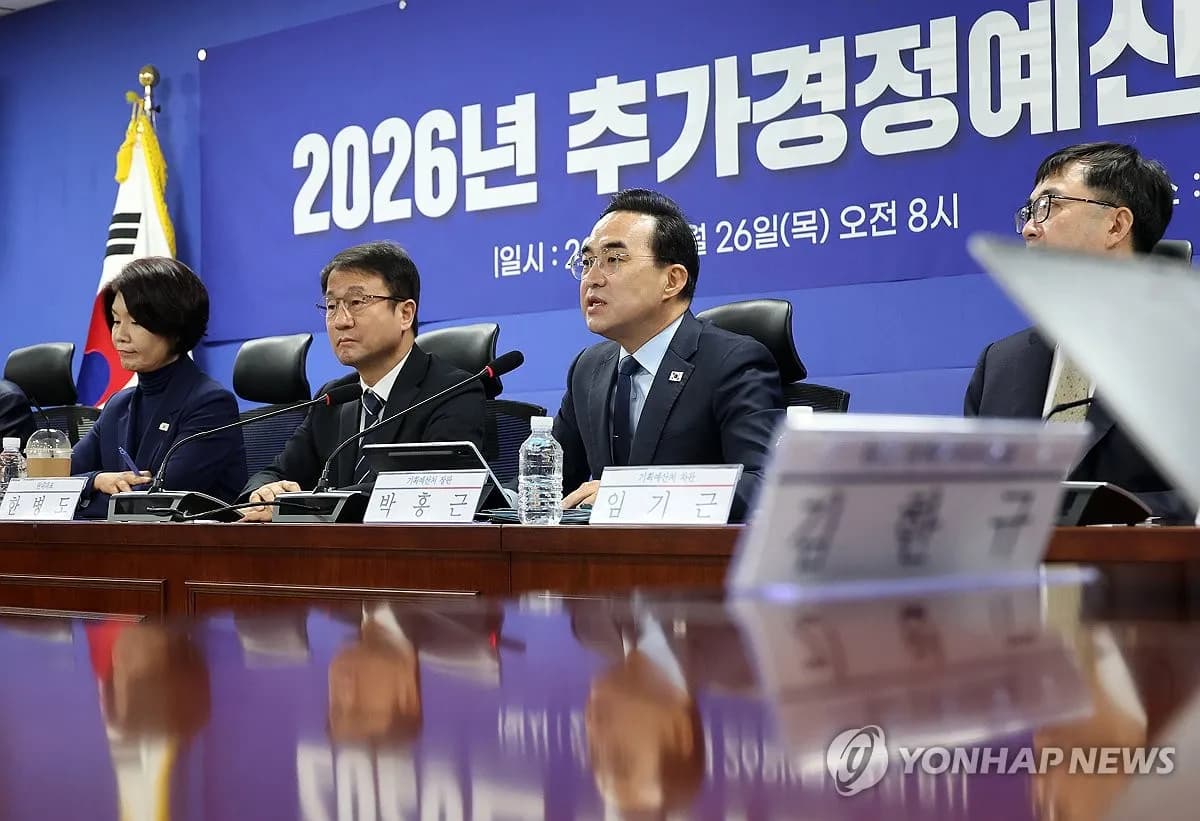
당정 "추경, 지방·취약계층에 더 지원되는 방식으로"
당정이 지방자치단체와 취약계층 중심의 추경 편성 방침 재확인

당정, 석유 최고가격제 손실 보전을 추경에 반영키로
당정이 석유 최고가격제 손실을 추경에 반영하기로 결정
어머니 폭행하고 금팔찌 빼앗은 30대 아들 경찰에 붙잡혀
어머니 폭행 후 금팔찌 빼앗은 30대 남성 체포

아이티 갱단 폭력사태로 10개월간 5천명 이상 사망
아이티에서 지난 10개월간 갱단 폭력으로 5천명 이상 사망
서방 정보당국 "러시아, 우크라이나 전쟁 후 이란에 드론·식량 공급"
서방 정보당국, 러시아의 이란 드론·식량 공급 작업 거의 완료 파악

6년 전 세 살 딸 살해한 30대 친모 구속송치
경찰, 6년 전 세 살 딸 살해 혐의 30대 친모를 구속송치