India-Arab Summit Agrees to Double Trade by 2030
Joint Declaration Condemns Pahalgam Terror While Reaffirming Palestinian Support
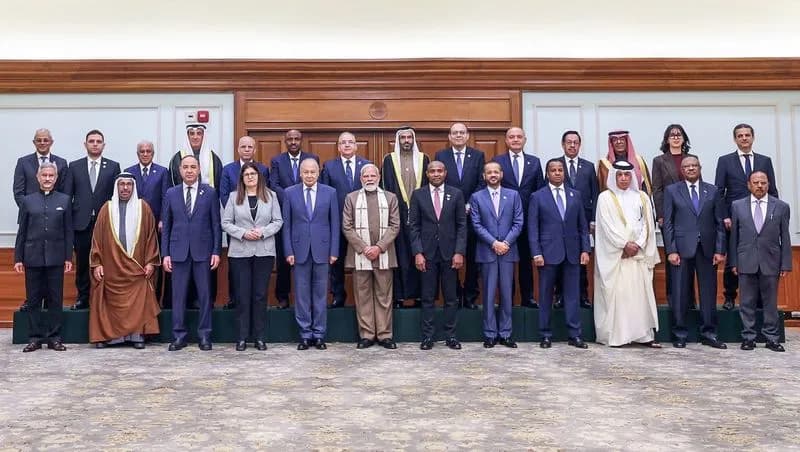
- •India and the Arab League agreed to double trade to $500 billion by 2030, with enhanced cooperation in space, agriculture, and technology.
- •A joint declaration condemned the Pahalgam terror attack while reaffirming Palestinian support, attempting diplomatic balance between security cooperation and traditional positions.
- •The establishment of a space cooperation working group and exploration of local currency settlement systems reflect global supply chain restructuring and de-dollarization trends.
India Sets $500 Billion Trade Target with Arab League
India and the Arab League have agreed to expand bilateral trade to $500 billion by 2030, doubling the current volume. At the India-Arab Foreign Ministers' Meeting held in New Delhi on the 1st (local time), Prime Minister Narendra Modi issued a joint declaration that reaffirmed support for the Palestinian people while strongly condemning the Pahalgam terrorist attack that occurred in April last year.
Current trade between India and Arab nations stands at $240 billion. To double this within six years, both sides have committed to strengthening SME cooperation, expanding investment linkages, and introducing local currency settlement systems.
Terror Condemnation and Diplomatic Balance
The joint declaration stated, "We strongly condemn the heinous terrorist attack targeting innocent Indian tourists in Pahalgam" and "reaffirm the full and unwavering support of India and Arab countries against all forms of terrorism."
Notably, the minister from Saudi Arabia, which signed a defense agreement with Pakistan last year, also attended the meeting. India is attempting diplomatic balance by maintaining relationships with Arab nations that have traditionally supported Palestine while building consensus on cross-border terrorism issues.
Blueprint for Space, Agriculture, and Technology Cooperation
Both sides have detailed cooperation across various sectors through the 'India-Arab Cooperation Forum Action Programme (2026-2028)'.
Space Cooperation
- Establishment of India-Arab Space Cooperation Working Group
- Joint remote sensing missions for climate, agriculture, urban planning, and disaster management
- Training programs for Arab scientists and engineers at Indian space research centers
- Joint incubation hubs for space technology startups
Economic and Technology Cooperation
- Strengthening cooperation between small and medium enterprises (SMEs)
- Exploration of voluntary local currency settlement systems
- Cooperation in agriculture and food security
- Expanded private sector participation in satellite development, launch, and data services
Implications for South Korea
India's moves demonstrate a new paradigm in Middle East diplomacy. It represents 'pragmatic diplomacy' that pursues security cooperation and economic interests while maintaining traditional support for Palestine.
South Korea has also been strengthening cooperation with Middle Eastern countries in energy, construction, and defense, while maintaining a cautious stance on the Palestinian-Israeli conflict. India's case suggests that an approach harmonizing diplomatic principles with practical interests is possible.
The space cooperation sector offers particular insights for Korea. The Korea Aerospace Research Institute (KARI) is pursuing lunar exploration cooperation with the United Arab Emirates (UAE), and Saudi Arabia has shown strong interest in building its own space program. The India-Arab space cooperation model provides a reference for Korea to expand space sector collaboration with Middle Eastern countries.
Future Outlook [AI Analysis]
The India-Arab trade expansion demonstrates the growing role of the Middle East in global supply chain restructuring. The introduction of local currency settlement systems aligns with the global de-dollarization trend aimed at reducing dollar dependency.
Space cooperation is expected to expand beyond simple technology sharing to data sovereignty dimensions. Arab countries need independent satellite data to address domestic challenges such as climate change, water scarcity, and desertification, and India can support this with its low-cost space launch technology.
However, the long-term sustainability of India's balanced diplomacy remains uncertain. Conflicts with Pakistan and strengthening defense cooperation with Israel could potentially impact relations with Arab countries.
댓글 (3)
흥미로운 주제입니다. 주변에도 공유해야겠어요.
기사 잘 봤습니다. 다른 시각의 분석도 읽어보고 싶네요.
간결하면서도 핵심을 잘 정리한 기사네요.
More in Global



Latest News

당정, 석유 최고가격제 손실 보전을 추경에 반영키로
당정이 석유 최고가격제 손실을 추경에 반영하기로 결정

6년 전 세 살 딸 살해한 30대 친모 구속송치
경찰, 6년 전 세 살 딸 살해 혐의 30대 친모를 구속송치

中企 수입 나프타의 80% 이상이 중동산…공급망 위기 심화
중소기업 수입 나프타의 80% 이상이 중동산으로 공급 의존도 높음

미·이란 긴장 한 달, 금융시장 요동…장기화 우려
미·이란 갈등으로 증시 변동성 확대, 코스피 6천 고지 후 등락

미·이란 전쟁 한 달, 미국 전문가 "종전·확전 기로"
미·이란 전쟁 1개월 도래, 종전·확전 기로 평가

미·이란 전쟁 1개월, 한국 안보·공급망 취약점 노출
미·이란 전쟁 장기화로 한국 안보·경제 취약점 노출