NASA Artemis II Rocket Rollout Imminent for Moon Return Mission
First crewed lunar mission in 52 years enters final preparation phase, targeting April 1 launch
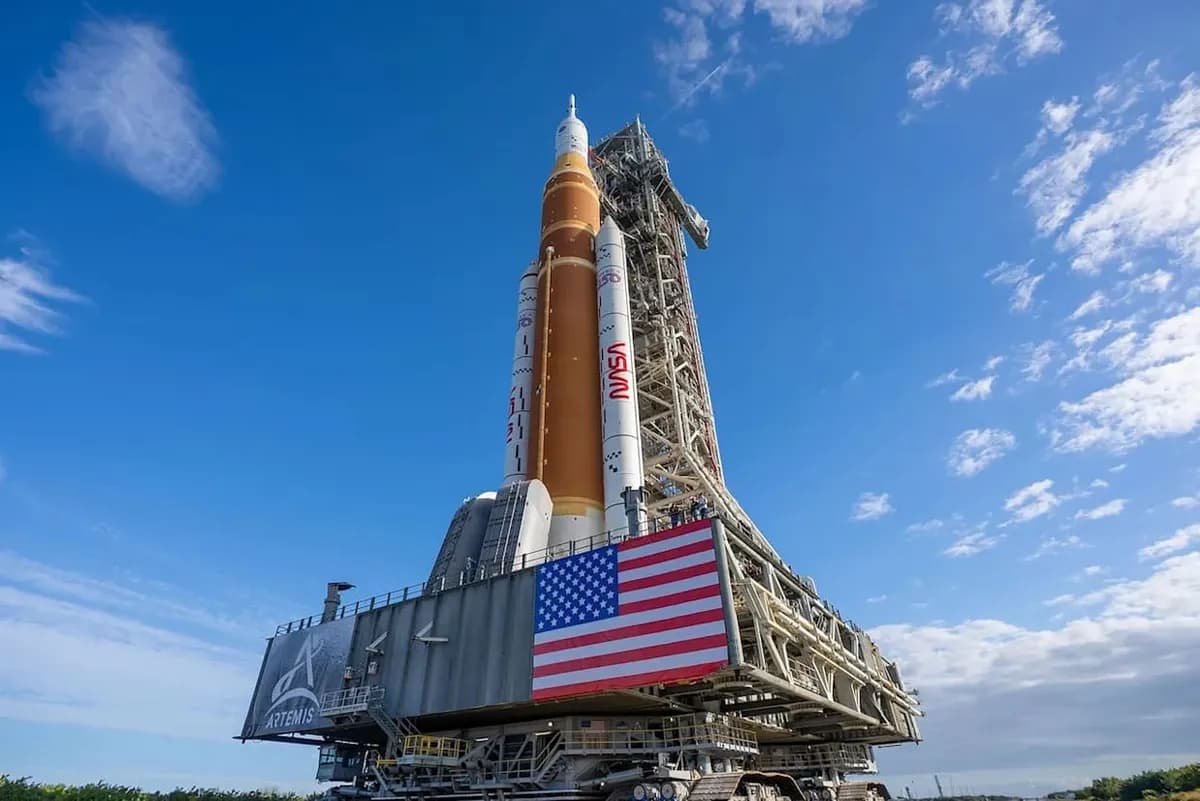
- •NASA will transport the Artemis II launch vehicle to the launch pad on March 19, maintaining the April 1 launch schedule for the first crewed lunar mission in 52 years.
- •The four-member crew has entered pre-launch quarantine, including the first woman and first Black astronaut to participate in lunar orbital flight.
- •The Artemis program is a long-term project targeting lunar landing in 2027, Moon base construction in the 2030s, and ultimately Mars exploration.
Countdown Begins for Half-Century Moon Return
NASA has entered a critical phase of the Artemis II mission, which will send humans to lunar orbit for the first time since Apollo 17 in 1972—a gap of 52 years. On March 18, NASA announced that the Space Launch System (SLS) rocket and Orion spacecraft will be transported from the Vehicle Assembly Building to Launch Pad 39B at Kennedy Space Center on Thursday, March 19, at 8 p.m. local time.
The launch vehicle, weighing a total of 11 million pounds (approximately 5,000 tons), will be carried by Crawler-Transporter 2 at a speed of 1 mph over a distance of 4 miles, taking approximately 12 hours. This process will be livestreamed on NASA's YouTube channel. The four-member astronaut crew will enter pre-launch quarantine in Houston on the same day for final health assessments.
Faster-Than-Expected Recovery Keeps Launch on Schedule
NASA had initially postponed the rollout to March 20 due to electrical harness replacement work. However, ground teams completed repairs faster than expected, allowing the April 1 launch date to remain intact. A NASA official stated, "Thanks to the swift response of our engineering team, we've been able to maintain the schedule for this historic mission."
Artemis II will carry a four-person crew consisting of NASA astronauts Commander Reid Wiseman, Victor Glover, Christina Koch, and Canadian Space Agency (CSA) astronaut Jeremy Hansen. Notably, Glover will become the first Black astronaut to travel to the Moon, while Koch will be the first woman to do so.
52 Years After Apollo: What's Different?
| Category | Apollo Program (1969-1972) | Artemis II (2026) | Change |
|---|---|---|---|
| Purpose | Lunar landing and surface exploration | Lunar orbital flight and system verification | Building sustainable exploration foundation |
| Crew | 3 (all white males) | 4 (includes women, Black, Canadian) | Diversity achieved |
| Spacecraft | Apollo Command/Service Module (6.2 tons) | Orion spacecraft (26 tons) | 4x heavier, reusable |
| Rocket | Saturn V (3,000-ton thrust) | SLS Block 1 (3,992-ton thrust) | 33% thrust increase |
| Flight Duration | 8-12 days | Approximately 10 days | Similar but focused on system verification |
| Next Step | Program ended (1972) | Artemis III lunar landing (planned 2027) | Sustainable exploration framework |
Unlike Apollo, Artemis II is a "flyby" mission that will orbit the Moon without landing. This serves as a crucial step before the actual lunar landing mission, Artemis III (scheduled for 2027), to validate the safety and performance of the SLS rocket and Orion spacecraft in an actual crewed environment.
Beyond the Moon to Mars: Artemis Program's Long Journey
The Artemis program officially launched under the Trump administration in 2017, and the uncrewed test flight Artemis I was successfully completed in November 2022. During that mission, the Orion spacecraft flew for 26 days, reaching 40,000 miles beyond the far side of the Moon—setting a record for the farthest distance traveled by a human-rated spacecraft.
The ultimate goal of the Artemis program extends far beyond simply returning to the Moon. NASA plans to establish a permanent outpost called "Artemis Base Camp" at the lunar south pole by the 2030s, using it as a stepping stone for crewed Mars exploration in the late 2030s. The lunar south pole is particularly promising because water ice exists in permanently shadowed regions, enabling production of drinking water and rocket fuel (hydrogen-oxygen).
To achieve this, NASA has selected SpaceX's Starship as the lunar lander, and Blue Origin is also participating in developing a large cargo lander. Additionally, the lunar orbital space station "Gateway" will be constructed in phases starting in 2027, serving as an intermediate waypoint for Moon and Mars exploration.
What Lies Ahead [AI Analysis]
The success of Artemis II will likely serve as a watershed moment determining the direction of human space exploration for the next decade. If the April launch proceeds as planned and the crew returns safely, the Artemis III lunar landing mission in 2027 will gain significant momentum.
However, several variables exist. First, the high launch cost of the SLS rocket (approximately $4.2 billion per launch) remains a persistent point of controversy. If SpaceX's Starship dramatically reduces launch costs through a fully reusable system, voices in Congress and within NASA may grow louder calling for a reassessment of SLS dependency.
Second, China's lunar exploration program is progressing rapidly and warrants attention. China aims to achieve independent crewed lunar landing before 2030 and has already demonstrated technical capability through successful far-side sample return (Chang'e 6, 2024). This raises the possibility that 21st-century lunar exploration could evolve into a new "space race" dynamic.
Third, there's potential for expanded international cooperation. Over 50 countries have already signed the Artemis Accords, and major space agencies including the European Space Agency (ESA) and Japan Aerospace Exploration Agency (JAXA) plan to participate in Gateway and lunar surface outpost construction. This could present a new model for multinational space cooperation following the International Space Station (ISS).
From a technical perspective, demonstration of In-Situ Resource Utilization (ISRU) technology will emerge as a key challenge. If technology to extract water from lunar ice and convert it to fuel becomes practical, it could fundamentally transform the current inefficient structure of transporting all resources from Earth. NASA plans initial demonstrations of such technology during the Artemis IV mission in 2028.
Ultimately, Artemis II is likely to be recorded not as a simple "Moon trip," but as the starting point of an era when humanity expands its sphere of activity beyond low Earth orbit into the solar system. Fifty-seven years after Neil Armstrong took his first steps on the lunar surface in 1969, humanity is now preparing for an era of living and working on the Moon.
댓글 (3)
NASA 관련 기사 잘 읽었습니다. 유익한 정보네요.
Artemis에 대해 더 알고 싶어졌습니다. 후속 기사 부탁드립니다.
공감합니다. 참고하겠습니다.
More in AI & Tech

영국 정치지도자들, 아동 성착취 혐의에 대한 긴급 조사 촉구

A humanoid robot performing in China has a child's face on it.

U.S. jury finds Meta and Google responsible for ‘social media addiction’… 3.7 billion won compensation ruling

Japanese X-ray Observatory makes first direct measurement of ultrafast 'cosmic wind' in galaxy M82

NASA selects 24 people for 2026 Astrophysics Postdoctoral Fellowships

Ethereum is at a crossroads to ‘redefine its identity’ ahead of the quantum computing and AI era
Latest News

"간부 잘 아는데 교통비 좀" 휴가 군인들 돈 뜯은 50대 구속
50대 A씨가 휴가 중인 군인들에게 부대 간부를 아는 척 접근해 돈을 사취

英 옥토퍼스, 이란 전쟁 이후 태양광 판매 50% 증가
이란 전쟁 이후 영국 옥토퍼스의 태양광 판매량 50% 증가

당정 "추경, 지방·취약계층에 더 지원되는 방식으로"
당정이 지방자치단체와 취약계층 중심의 추경 편성 방침 재확인

당정, 석유 최고가격제 손실 보전을 추경에 반영키로
당정이 석유 최고가격제 손실을 추경에 반영하기로 결정

어머니 폭행하고 금팔찌 빼앗은 30대 아들 경찰에 붙잡혀
어머니 폭행 후 금팔찌 빼앗은 30대 남성 체포

아이티 갱단 폭력사태로 10개월간 5천명 이상 사망
아이티에서 지난 10개월간 갱단 폭력으로 5천명 이상 사망

서방 정보당국 "러시아, 우크라이나 전쟁 후 이란에 드론·식량 공급"
서방 정보당국, 러시아의 이란 드론·식량 공급 작업 거의 완료 파악

6년 전 세 살 딸 살해한 30대 친모 구속송치
경찰, 6년 전 세 살 딸 살해 혐의 30대 친모를 구속송치