OpenAI Upgrades Agents SDK with Native Sandbox Execution and Model-Native Harness
New SDK capabilities target secure, long-running agents spanning files and tools
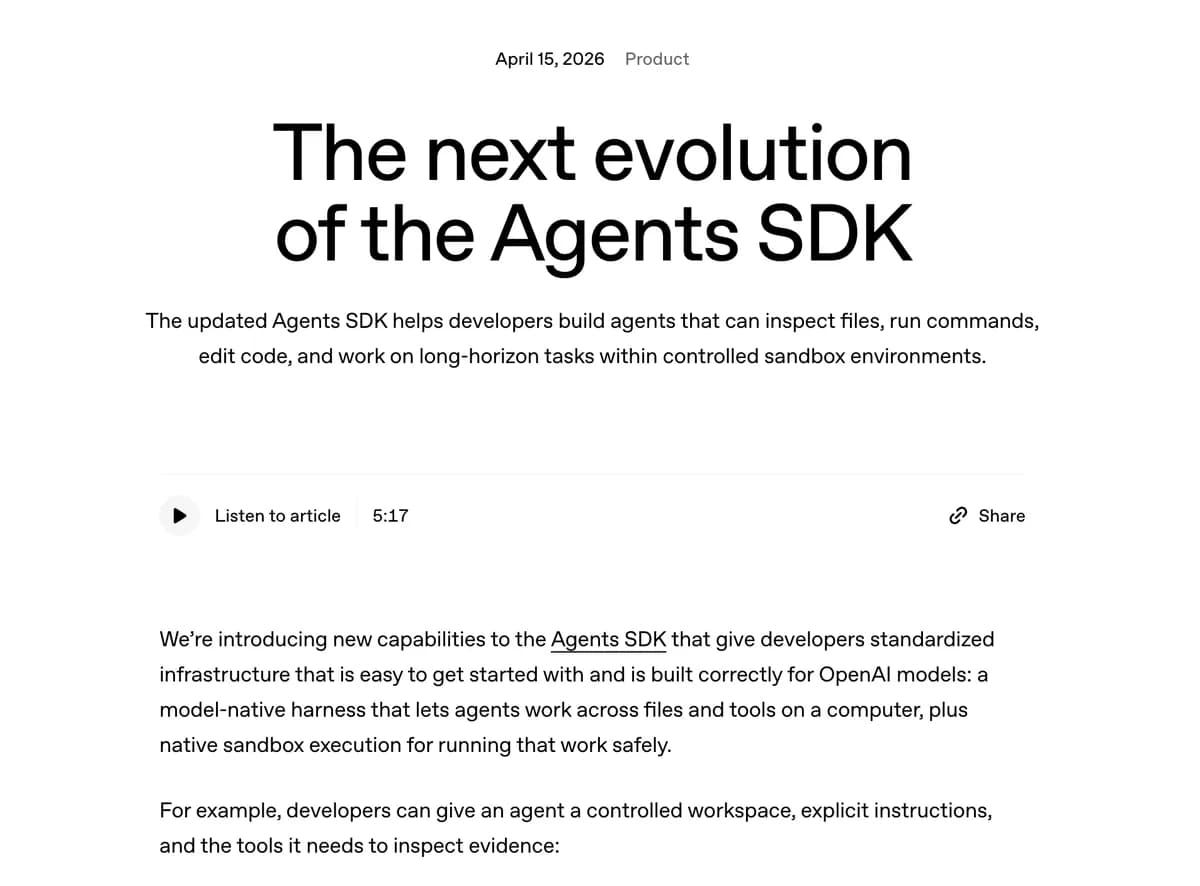
- •OpenAI has added native sandbox execution and a model-native harness to its Agents SDK.
- •The update provides security isolation and long-running agent support directly at the SDK level.
- •The move signals OpenAI's strategy to consolidate its agent ecosystem around its own stack amid growing competition.
Sandbox Built In: The Next Step for the Agents SDK
OpenAI has released a significant update to its Agents SDK. The update introduces two core capabilities: native sandbox execution, which isolates code execution in secure environments, and a model-native harness designed to integrate models more tightly with tools and files. The primary goal is to help developers build secure, long-running agents without having to manage underlying infrastructure complexity.
Why Now, Why These Features
The AI agent market has expanded rapidly since 2025. Agents have moved far beyond simple chatbots—they now read files, execute code, call external APIs, and complete multi-step tasks in real enterprise environments. Two core challenges have emerged in this shift.
The first is security. When agents can execute code directly, there is a real risk that unexpected or malicious code could affect the host system. Previously, developers had to build their own sandbox environments manually. The second is persistence. Unlike single-turn response generation, long-running agents must maintain state across sessions—a technically demanding problem.
OpenAI's update addresses both of these issues at the SDK level. Developers can now focus on agent logic and design rather than low-level infrastructure concerns.
What Changed
| Feature | Previous Agents SDK | This Update | Change |
|---|---|---|---|
| Code execution environment | Developer must configure manually | Native sandbox included | Significantly reduced setup complexity |
| Model-tool integration | Separate wrappers required | Model-native harness provided | Standardized integration |
| Long-running agent support | Limited | Explicit support | Improved stability |
| File/tool scope | Primarily single-session | Cross-file and cross-tool support | Expanded task scope |
| Security isolation | Dependent on external solutions | Integrated at SDK level | Security as default |
The Evolution of Agent Framework Competition
Competition among agent development frameworks began in earnest after 2023. LangChain popularized the concept of chain-based agents, while AutoGPT ignited interest in autonomous execution. In 2024, Anthropic's Claude introduced computer use capabilities, enabling agents to interact at the operating system level. In the same year, OpenAI experimentally released the Swarm framework.
By 2025, OpenAI launched the Agents SDK as a formal product, making clear its strategy to directly define the standard for agent development. Competing in a market alongside Microsoft's AutoGen, Google's ADK, and open-source platforms like CrewAI, OpenAI is differentiating itself through tight optimization with its own models. This update is the next chapter of that strategy.
[AI Analysis] Where Is the Agent SDK Standards Race Headed?
The introduction of native sandbox execution carries significance beyond a simple feature addition. Providing security as a default at the SDK level is effectively a declaration that OpenAI intends to define the standard for agent runtimes.
Several scenarios are likely to follow. First, enterprise customers may find increased incentive to migrate to OpenAI's agent stack to reduce the cost of building their own sandbox infrastructure. Second, the model-native harness is likely to be optimized for GPT-4o and future OpenAI models, raising questions about compatibility with third-party models.
Third, improved support for long-running agents is likely to accelerate competition with the traditional RPA (Robotic Process Automation) market. As organizations shift from rule-based automation to intelligent agents, this update could significantly speed that transition.
Competitor responses will be worth watching closely. With Google ADK and Anthropic's agent APIs evolving in similar directions, sandbox execution and long-running agent support will likely become table-stakes features across the industry.
댓글 (34)
깔끔한 기사입니다. OpenAI이 앞으로 어떻게 전개될지 주목해야겠습니다. 나중에 다시 읽어볼 만합니다.
Upgrades에 대해 더 알고 싶어졌습니다.
Agents이 일상에 어떤 영향을 줄지 생각해보게 됩니다.
Agents-SDK에 대해 처음 접하는 정보가 있었습니다.
LLM 관련 배경 설명이 이해하기 쉬웠습니다.
깔끔한 기사입니다. OpenAI의 전문가 코멘트가 설득력 있었습니다. 주변에도 공유해야겠어요.
핵심만 잘 정리해주시네요.
읽기 좋은 기사입니다. Agents이 일상에 어떤 영향을 줄지 생각해보게 됩니다. 잘 정리된 기사네요.
몰랐던 사실을 알게 됐습니다. Agents-SDK 주제로 시리즈 기사가 나오면 좋겠습니다.
LLM이 앞으로 어떻게 전개될지 주목해야겠습니다.
OpenAI에 대해 주변 사람들과 이야기 나눠볼 만합니다.
좋은 기사 감사합니다.
Agents의 전문가 코멘트가 설득력 있었습니다.
Agents-SDK이 일상에 어떤 영향을 줄지 생각해보게 됩니다.
LLM 주제로 시리즈 기사가 나오면 좋겠습니다. 나중에 다시 읽어볼 만합니다.
매일 여기서 뉴스 보고 있어요.
깔끔한 기사입니다. Upgrades 기사에서 언급된 사례가 흥미로웠습니다. 후속 기사 부탁드립니다.
Agents 관련 배경 설명이 이해하기 쉬웠습니다.
Agents-SDK의 전문가 코멘트가 설득력 있었습니다.
다양한 주제를 다뤄주셔서 좋습니다.
구독 중인데 만족합니다.
Upgrades이 일상에 어떤 영향을 줄지 생각해보게 됩니다.
잘 읽었습니다. Agents 기사에서 언급된 사례가 흥미로웠습니다. 전문가 의견도 더 듣고 싶습니다.
이런 시각도 있었군요. Agents-SDK에 대해 더 알고 싶어졌습니다.
LLM에 대해 더 알고 싶어졌습니다. 계속 지켜봐야겠습니다.
OpenAI 기사에서 언급된 사례가 흥미로웠습니다. 생각이 바뀌었습니다.
기자님 수고하셨습니다.
Agents 관련 통계가 의외였습니다. 생각이 바뀌었습니다.
잘 읽었습니다. Agents-SDK 관련 배경 설명이 이해하기 쉬웠습니다. 주변에도 공유해야겠어요.
LLM이 일상에 어떤 영향을 줄지 생각해보게 됩니다.
깔끔한 기사입니다. OpenAI의 전문가 코멘트가 설득력 있었습니다.
Upgrades 관련 배경 설명이 이해하기 쉬웠습니다.
북마크해두겠습니다. Agents의 향후 전망이 궁금합니다.
기사 잘 읽었습니다.
More in this series
More in AI & Tech

Latest News
원화 수출 결제 비중 3.4%, 33년 만에 사상 최고
2025년 원화 수출 결제 비중 3.4%로 1992년 통계 작성 이래 사상 최고치 기록
미-이란 협상 기대감에 닛케이 사상 최고치, 아시아 증시 동반 상승
닛케이 225 지수가 장중 사상 최고치를 돌파하며 1.6% 이상 상승했다.
호르무즈 봉쇄가 바꾼 세계 에너지 지도
호르무즈 봉쇄로 유럽의 미국산 항공유 수입이 2015년 이후 최고치를 기록했다.
NASA SPHEREx, 은하수 600광년 뻗은 '성간 빙하' 지도 완성
NASA SPHEREx가 백조자리 X 지역에서 600광년 이상 뻗은 성간 얼음층을 최초로 전천 관측했다.

이재명, 'AI 제조혁신·국부펀드' 총동원령…위기를 기회로
이재명 대통령, 수보회의서 AI 제조혁신과 국부펀드 설립 총동원 지시.

서울 아파트값 7개월 만에 첫 하락…세금 폭탄 앞 급매 쏟아져
서울 아파트 실거래가지수가 3월에 0.59% 하락해 7개월 만에 첫 내림세를 기록했다.
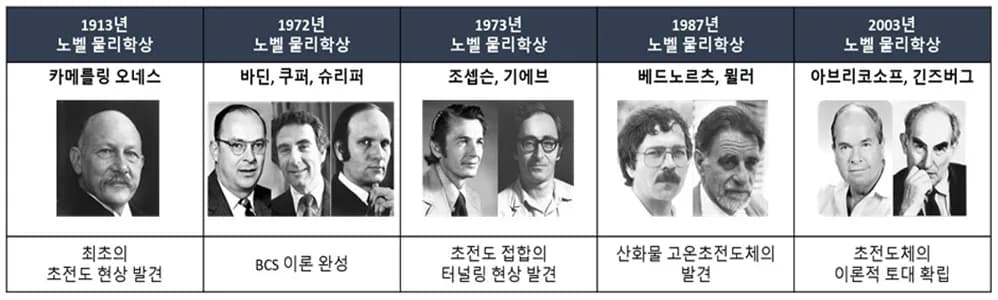
초전도 양자 쌍 첫 촬영 성공, 70년 BCS 이론의 맹점 드러나
프랑스 CNRS 연구팀이 Physical Review Letters에 초전도 양자 쌍 형성 과정의 최초 직접 이미징 결과를 발표했다.
면화 가격 18.5% 급등… 호르무즈 봉쇄가 바꾼 글로벌 섬유 시장
면화 선물 가격이 중동 전쟁 이후 18.5% 급등해 파운드당 0.77달러를 기록했다.