Seoul's 'National Standard' Apartment Size Shifts: 59㎡ Surpasses 84㎡ in Monthly Rent Transactions
Surge in 1-2 Person Households and Jeonse-to-Monthly Rent Conversion Reverses Small Unit Demand After 2 Years
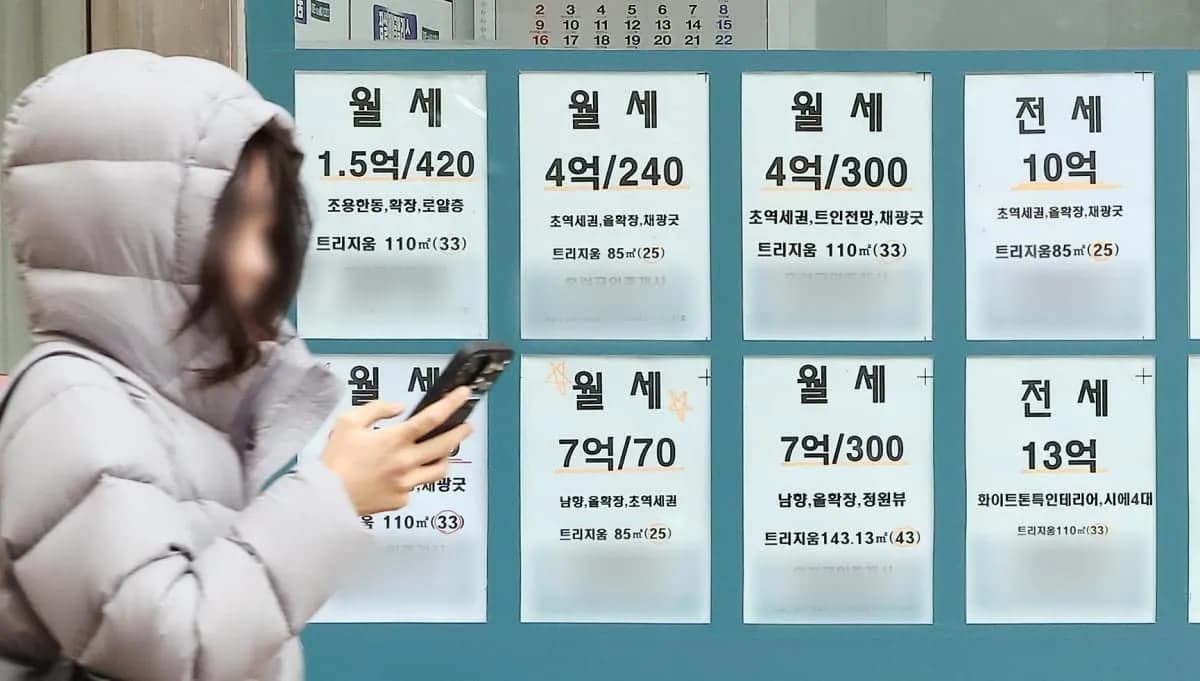
- •Seoul's 59㎡ apartment monthly rent transactions surpassed 84㎡ units for the first time in two years, reshaping the national standard unit structure.
- •With 1-2 person households approaching 40% and accelerating jeonse-to-monthly rent conversion, demand for smaller units has surged.
- •Centered in residential-dense areas like Nowon and Seongbuk, 59㎡ transactions are active and emerging as the new national standard size.
59㎡ Surpasses 84㎡ After Two Years
The long-standing dominance of 84㎡ units as Seoul's "national standard" apartment size is being challenged. According to an analysis of Ministry of Land, Infrastructure and Transport transaction data by Jipoom, monthly rent transactions for 59㎡ apartments in Seoul reached 4,494 units in January-February 2025, exceeding 84㎡ units (3,494 transactions) by 1,000 units. This represents approximately 28% higher volume.
During the same period in 2024, 84㎡ monthly rent transactions totaled 3,558 units, surpassing 59㎡ units (3,295 transactions), but the transaction structure has completely reversed over two years. While 84㎡ units still dominate the sales market, 59㎡ sales transactions surged approximately 75% from 1,339 units in 2024 to 2,348 units this year, clearly indicating expanding demand for smaller units.
Changing Household Structure Drives Market Restructuring
Behind this shift lies a fundamental change in Korea's household structure. According to the Ministry of the Interior and Safety, single-person households nationwide reached 8.04 million in 2024, accounting for 36.1% of all households, with Seoul recording the highest rate at 39.9%. As single-person households become the predominant household type, preference for smaller units is structurally expanding.
The conversion from jeonse (lump-sum deposit rental) to monthly rent due to jeonse supply shortages is also accelerating small apartment transactions. The proportion of monthly rent transactions for Seoul apartments rose from 39.6% in 2021 to 46.9% in 2026. Downtown areas like Jongno-gu (64.1%) and Jung-gu (57.4%), as well as industrial hinterlands including Guro, Geumcheon, and Gwanak, already exceed 50% monthly rent ratios.
Jeonse transactions decreased for both unit sizes. Jeonse transactions for 59㎡ units dropped from 6,060 in 2024 to 3,445 this year, while 84㎡ units decreased from 7,841 to 6,304 during the same period. As jeonse demand declines, the shift toward monthly rent is gaining full momentum.
Active Small Unit Transactions Centered in Nowon and Seongbuk
Regional analysis reveals a clear divide between small and medium-to-large unit demand. Sales transactions for 59㎡ units were highest in Nowon-gu with 242 units, followed by Seongbuk-gu (232 units), Eunpyeong-gu (179 units), Guro-gu (171 units), and Gangseo-gu (135 units). Notably in Nowon-gu, 59㎡ transaction volume nearly matched 84㎡ units (240 transactions), highlighting strong preference for smaller units.
Conversely, 84㎡ sales transactions were concentrated in Seongbuk-gu (300 units), Gangseo-gu (246 units), and Nowon-gu (240 units). In areas with large-scale established apartment complexes and concentrated actual residence demand, 84㎡ transactions maintain their strength.
Regional differences also emerged in the monthly rent market. Monthly rent transactions for 59㎡ units were highest in Nowon-gu with 413 units, followed by Gangdong-gu and Songpa-gu (282 units each), Gangseo-gu (255 units), and Yeongdeungpo-gu (245 units). For 84㎡ monthly rent transactions, Songpa-gu led with 411 units, followed by Gangnam-gu (328 units), Seocho-gu (279 units), Seongdong-gu (205 units), and Mapo-gu (193 units), showing that medium-to-large monthly rent transactions remain centered in premium residential areas.
Past and Present: Evolution of the National Standard Size
The concept of "national standard size" serves as an indicator of Korea's evolving residential culture. In the 1980s-90s, 84㎡ units (formerly 25 pyeong) became synonymous with "moderately spacious and moderately affordable" apartments, designed for middle-class four-person households as the standard. The layout of living room, three bedrooms, and two bathrooms was optimized for the typical nuclear family model of parents and two children.
Throughout the 2000s, 84㎡ remained the preferred size for both actual residents and investors, establishing itself as "the most tradable unit size." However, from the late 2010s, with the surge in single-person households and trends toward late marriage and non-marriage, demand for 59㎡ units (formerly 18 pyeong) began gradually increasing.
Since 2020, as the jeonse market rapidly contracted and conversion to monthly rent accelerated, the practicality of smaller units has been reassessed. Relatively lower deposits, monthly rents, and maintenance costs provide economic rationality for 1-2 person households. Now, 59㎡ is emerging as the new "national standard size."
Future Outlook [AI Analysis]
The restructuring of demand by unit size in Seoul's apartment market is likely to establish itself as a medium-to-long-term trend rather than a short-term phenomenon. According to Statistics Korea population projections, single-person household ratios are expected to exceed 40% by 2030, which will continuously support demand for smaller units.
Structural changes in the jeonse and monthly rent markets are also expected to accelerate this trend. Increasing jeonse deposit burdens and expanded use of lease renewal rights will further solidify the monthly rent market, and 59㎡ units with relatively lower barriers to entry are likely to emerge as primary choices.
However, regional disparities are expected to persist. Premium residential areas like Gangnam, Seocho, and Songpa will maintain preference for medium-to-large units, while residential-dense areas like Nowon, Seongbuk, and Eunpyeong are likely to restructure toward small unit-centered markets. In future new construction markets, an increased proportion of 59㎡ units is anticipated, which could fundamentally transform Seoul's apartment market unit size structure.
댓글 (3)
Seoul 관련 기사 잘 읽었습니다. 유익한 정보네요.
좋은 의견이십니다.
National에 대해 더 알고 싶어졌습니다. 후속 기사 부탁드립니다.
More in Economy

당정, 석유 최고가격제 손실 보전을 추경에 반영키로

미·이란 긴장 한 달, 금융시장 요동…장기화 우려

뉴욕증시 3대 지수 동반 상승…이란 휴전 기대감

Elon Musk's X recruits a cryptocurrency expert as head of design... ‘X Money’ launch imminent

BitGo-GK Sync plans to build ‘tokenized deposit’ infrastructure for banks
The other side of prediction markets: Ethical dilemmas of cryptocurrency platforms dealing in war and terrorism
Latest News
"간부 잘 아는데 교통비 좀" 휴가 군인들 돈 뜯은 50대 구속
50대 A씨가 휴가 중인 군인들에게 부대 간부를 아는 척 접근해 돈을 사취

英 옥토퍼스, 이란 전쟁 이후 태양광 판매 50% 증가
이란 전쟁 이후 영국 옥토퍼스의 태양광 판매량 50% 증가
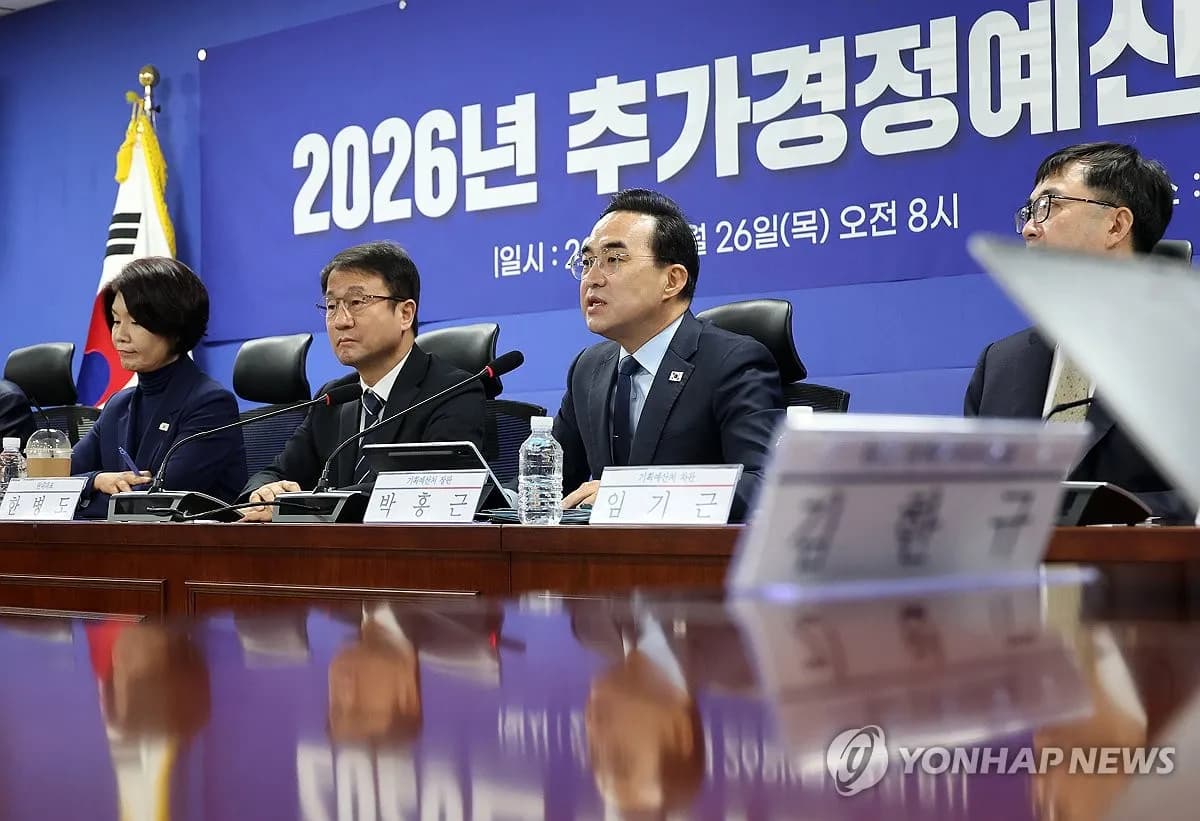
당정 "추경, 지방·취약계층에 더 지원되는 방식으로"
당정이 지방자치단체와 취약계층 중심의 추경 편성 방침 재확인
어머니 폭행하고 금팔찌 빼앗은 30대 아들 경찰에 붙잡혀
어머니 폭행 후 금팔찌 빼앗은 30대 남성 체포
아이티 갱단 폭력사태로 10개월간 5천명 이상 사망
아이티에서 지난 10개월간 갱단 폭력으로 5천명 이상 사망

서방 정보당국 "러시아, 우크라이나 전쟁 후 이란에 드론·식량 공급"
서방 정보당국, 러시아의 이란 드론·식량 공급 작업 거의 완료 파악

6년 전 세 살 딸 살해한 30대 친모 구속송치
경찰, 6년 전 세 살 딸 살해 혐의 30대 친모를 구속송치

中企 수입 나프타의 80% 이상이 중동산…공급망 위기 심화
중소기업 수입 나프타의 80% 이상이 중동산으로 공급 의존도 높음