Wall Street Falls for Second Day on Soaring Oil Prices and Fed's Hawkish Stance
Brent Crude Surges to $112 per Barrel... Probability of Rate Cut This Year Plunges to 48%
- •New York's three major indices fell for the second consecutive day amid surging oil prices from Middle East conflict and the Fed's hawkish stance.
- •Brent crude soared to around $112 per barrel, causing the probability of rate cuts this year to plummet to 48%.
- •Tech stocks including Micron and Tesla led the decline as stagflation concerns intensified.
Dual Pressure from Middle East Conflict and Fed Tightening
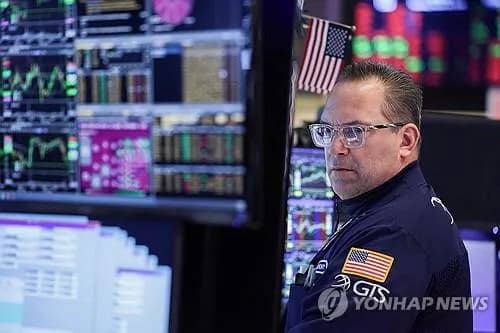
New York's three major stock indices closed lower for the second consecutive day on April 19 (local time). The Dow Jones Industrial Average fell 0.44% to 46,021.43, the S&P 500 declined 0.27% to 6,606.49, and the Nasdaq dropped 0.28% to 22,090.69. The S&P 500 has fallen more than 3% year-to-date, reaching its lowest level in four months.
All major indices traded below their 200-day moving averages, indicating significantly weakened market momentum. By sector, materials (-1.55%) and consumer goods (-0.87%) led the decline.
Soaring Oil Prices Trigger Stagflation Concerns
Following Iran's attacks on Middle Eastern energy facilities, Brent crude spiked to $119 per barrel during trading before pulling back, but still maintains elevated levels near $112. While President Donald Trump requested that Israel exercise restraint in repeated attacks on Iranian natural gas infrastructure, mutual targeting of energy facilities continues to drive upward pressure on oil prices.
Charlie Ripley, senior strategist at Allianz Investment Management, told Reuters, "The longer oil prices stay at elevated levels, the greater the stagflation threat becomes and the market's narrative about the macroeconomic environment begins to shift."
Fed's Increasingly Hawkish Tone
Federal Reserve Chair Jerome Powell's continued hawkish comments following the rate hold have sharply reduced market expectations for rate cuts. According to CME FedWatch, the probability of no rate cuts this year has risen to 48%, with investors viewing the likelihood of rate cuts before mid-2027 as low.
Both the Bank of England (BOE) and European Central Bank (ECB) also held rates steady, citing uncertainty from the Middle East conflict as a key variable. Mike Dickson, head of Horizon Investment Research, noted, "The market is digesting Powell's and other central banks' comments, and this represents a real inflation risk."
However, U.S. initial jobless claims unexpectedly declined, suggesting the labor market remains resilient. This, combined with inflationary pressures, makes the Fed's policy decisions increasingly difficult.
Tech Stocks Lead Decline
Among individual stocks, tech-led declines were prominent. Micron Technology fell 3.8% despite reporting quarterly results that significantly exceeded market expectations, due to concerns about its capital expenditure expansion plans. Nvidia also declined 1%.
Tesla plummeted 3.2% following news of the National Highway Traffic Safety Administration's (NHTSA) expanded investigation into its Full Self-Driving technology. The Russell 2000 index approached a 10% decline from its intraday all-time high, suggesting potential entry into correction territory.
Inflation Re-ignition Concerns Since 2022
Since the Russia-Ukraine war in 2022, volatility in global energy markets has been a key variable determining central bank policy direction. The oil price spike at that time triggered the Fed's aggressive rate hikes, and after inflation peaked in the first half of 2023, it entered an easing phase.
However, as the Middle East conflict re-escalated in 2025, oil prices are surging again. This is raising a scenario similar to 2022's energy-driven inflation re-ignition, further increasing uncertainty about the Fed's interest rate policy.
Outlook [AI Analysis]
The trajectory of the Middle East conflict and whether attacks on energy facilities continue are likely to determine short-term market direction. If oil prices remain above $110 per barrel, the timing of Fed rate cuts could be pushed back even further beyond 2027.
For tech stocks, despite earnings improvements, valuation pressures from prolonged rate holds are expected to persist. Particularly, semiconductor companies that have announced capital expenditure increases face the challenge of addressing market concerns about capital efficiency.
If stagflation concerns materialize, the U.S. economy could face the double burden of high inflation and low growth, which could create widespread correction pressure on global stock markets.
댓글 (5)
기사 잘 봤습니다. 다른 시각의 분석도 읽어보고 싶네요.
Street 관련 기사 잘 읽었습니다. 유익한 정보네요.
좋은 의견이십니다.
Falls에 대해 더 알고 싶어졌습니다. 후속 기사 부탁드립니다.
좋은 의견이십니다.
More in Economy

당정, 석유 최고가격제 손실 보전을 추경에 반영키로

미·이란 긴장 한 달, 금융시장 요동…장기화 우려
뉴욕증시 3대 지수 동반 상승…이란 휴전 기대감

Elon Musk's X recruits a cryptocurrency expert as head of design... ‘X Money’ launch imminent

BitGo-GK Sync plans to build ‘tokenized deposit’ infrastructure for banks

The other side of prediction markets: Ethical dilemmas of cryptocurrency platforms dealing in war and terrorism
Latest News

"간부 잘 아는데 교통비 좀" 휴가 군인들 돈 뜯은 50대 구속
50대 A씨가 휴가 중인 군인들에게 부대 간부를 아는 척 접근해 돈을 사취

英 옥토퍼스, 이란 전쟁 이후 태양광 판매 50% 증가
이란 전쟁 이후 영국 옥토퍼스의 태양광 판매량 50% 증가

당정 "추경, 지방·취약계층에 더 지원되는 방식으로"
당정이 지방자치단체와 취약계층 중심의 추경 편성 방침 재확인

어머니 폭행하고 금팔찌 빼앗은 30대 아들 경찰에 붙잡혀
어머니 폭행 후 금팔찌 빼앗은 30대 남성 체포

아이티 갱단 폭력사태로 10개월간 5천명 이상 사망
아이티에서 지난 10개월간 갱단 폭력으로 5천명 이상 사망

서방 정보당국 "러시아, 우크라이나 전쟁 후 이란에 드론·식량 공급"
서방 정보당국, 러시아의 이란 드론·식량 공급 작업 거의 완료 파악

6년 전 세 살 딸 살해한 30대 친모 구속송치
경찰, 6년 전 세 살 딸 살해 혐의 30대 친모를 구속송치

中企 수입 나프타의 80% 이상이 중동산…공급망 위기 심화
중소기업 수입 나프타의 80% 이상이 중동산으로 공급 의존도 높음