China's Belt and Road Initiative Emerges as New Growth Engine for Global South Amid Trade War
Nigeria Case Study Reveals BRI's Potential for Structural Transformation
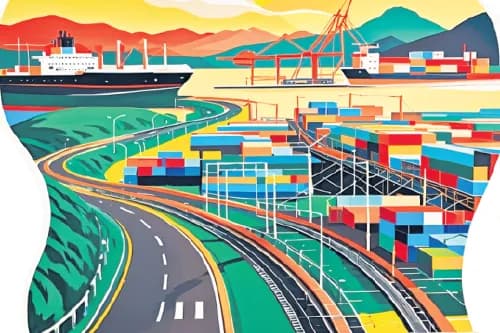
- •As the U.S.-led trade war fragments global supply chains, China's Belt and Road Initiative is emerging as an alternative platform for developing country growth.
- •Nigeria has begun resolving logistics bottlenecks and securing manufacturing competitiveness through BRI-supported railway and port projects.
- •Infrastructure alone is insufficient; institutional capacity and governance improvements are key variables determining BRI's long-term success.
In the Age of Tariff Barriers, Infrastructure Is the Answer
As the trade war initiated by the United States in 2018 intensifies with high tariffs targeting electric vehicles, solar panels, and semiconductors in 2024, global supply chains are experiencing significant disruption. The International Monetary Fund (IMF) warned in a 2023 report that sustained geopolitical fragmentation could reduce global GDP by up to 7% in the long term, with developing countries that depend on open trade to advance their technology and income levels facing disproportionate impacts.
In this context, China's Belt and Road Initiative (BRI) remains one of the few scalable development pathways available to the Global South as a long-term platform for productivity, connectivity, and structural transformation. While not a perfect solution, the BRI focuses on key sectors that enhance total factor productivity, including ports, railways, power plants, and digital infrastructure.
Nigeria Resolves Logistics Bottlenecks Through BRI
Nigeria, Africa's most populous nation and West Africa's economic bellwether, has begun addressing decades-long logistics bottlenecks through the BRI. The Lagos-Ibadan standard-gauge railway, which opened in 2021, has reduced transit times along a critical freight and passenger corridor while alleviating pressure on Apapa Road, which had long obstructed port access. The earlier Abuja-Kaduna railway demonstrated how rail connectivity, when combined with security and last-mile infrastructure, can facilitate regional commerce and commuter flows.
On the coast, Lekki Deep Sea Port, officially inaugurated in 2023, has emerged as Nigeria's first modern deep-sea gateway. Equipped with the depth and facilities to handle the latest generation of container ships, the port is expected to expand its annual throughput capacity to several million TEU (twenty-foot equivalent units). It is already reshaping West African shipping patterns, reducing feeder dependence, and lowering logistics costs for both imports (capital goods, intermediate products) and exports (agricultural products, light industrial goods).
Lekki Port, integrated with the Lekki Free Trade Zone and new highway connections, exemplifies how BRI-related projects can layer onto industrial ecosystems to maximize spillover effects.
Infrastructure Driving Structural Transformation
These projects are not isolated construction works but form the backbone of Nigeria's long-delayed structural transformation. When freight transport becomes predictable and affordable, producers can secure inputs at lower costs, rotate inventory more efficiently, and achieve economies of scale in manufacturing.
Such changes open pathways for countries to move beyond raw material dependence toward higher value-added roles in regional and global value chains. Research indicates that well-executed infrastructure investments can raise annual growth rates by approximately 2 percentage points while reducing inequality and improving welfare.
Beyond Infrastructure: Institutions and Capacity Building
However, infrastructure alone is insufficient. True transformation depends on institutional capacity, skilled labor, and a business environment capable of productively utilizing new connectivity. The success of the BRI hinges on recipient countries' domestic governance, project selection, and macroeconomic management.
Future Outlook [AI Analysis]
In a world of rising tariff barriers, the BRI is likely to offer Global South countries an alternative growth trajectory. Particularly as African and Southeast Asian nations build manufacturing bases and integrate into regional value chains, China-led infrastructure investment appears positioned to fundamentally reshape the productivity and competitiveness of these economies.
For long-term sustainability, however, project quality management—including debt management, environmental impact assessment, and local job creation—will remain critical challenges. For success stories like Nigeria to proliferate, transparent contractual structures and local capacity building must proceed in parallel.
댓글 (4)
이 문제의 본질이 무엇인지 깊이 생각해볼 필요가 있습니다.
댓글란이 과열되지 않았으면 합니다. 차분한 논의가 필요해요.
팩트에 기반한 냉정한 판단이 필요한 시점입니다.
균형 잡힌 시각이 필요하다는 데 동의합니다.
More in Economy

Middle East Conflict Drives Manufacturing Outlook to 10-Month Low

Lee Jae-myung Administration Excludes Multi-Home Officials from Real Estate Policymaking
Volkswagen CEO Says Germany Should Learn from China's Industrial Strategy

Russia Anticipates Economic Gains from US-Iran Conflict
U.S. Federal Reserve Unveils Bank Capital Regulation Modernization Plan
Federal Reserve Announces Enforcement Actions Against Two Former Bank Employees
Latest News
이스라엘, 헤즈볼라 무기 통로 레바논 다리 공습
이스라엘군, 헤즈볼라 무기 통로 레바논 다리 공습
중동행 전세기 전쟁보험료 최고 7천500만원
중동행 전세기 전쟁보험료가 최고 5만달러(7천500만원)로 상승

이란 탄도미사일, 이스라엘 방어망 뚫고 160명 부상
이란 탄도미사일이 이스라엘 방공망을 통과해 160명 부상

Southeast Asia Growth Forecasts Cut Amid Oil Price Surge, Threatening Korean Exports
Maybank Research has downgraded ASEAN-6's 2026 growth forecast from 4.8% to 4.5%.

Reddit Considers Face ID to Block Bots While Maintaining Anonymity
Reddit is considering implementing biometric authentication systems such as Face ID and Touch ID to block AI bots while maintaining anonymity.

BTS Tops March Artist Brand Reputation Rankings with First Full Group Comeback in 4 Years
BTS ranked first in the Korean Corporate Reputation Research Institute's March Artist Brand Reputation Rankings based on 99 million data points.

Santo Domingo's Malecón Sports Park Construction Progressing Smoothly
Construction of a soccer field and skate park is progressing smoothly in the Malecón area of Santo Domingo, Dominican Republic.

Pogačar Overcomes Crash to Win Milano-Sanremo, Achieves Four Monument Victories
Tadej Pogačar defeated Tom Pidcock to win Milano-Sanremo, achieving his fourth Monument victory.