Why We Need Utopian Imagination in the Post-Climate Catastrophe Era
The Northern Hemisphere's Delayed Awakening and New Directions from Climate Justice Movements
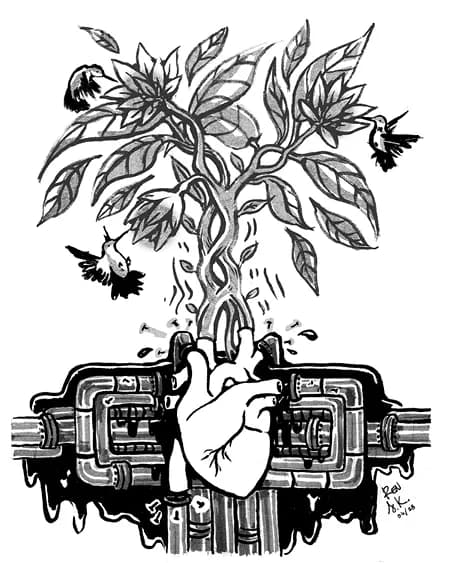
- •Climate catastrophe signals were first detected in the Southern Hemisphere in the 1970s, while the Northern Hemisphere only began experiencing impacts after the 1990s.
- •Current global warming levels and carbon concentrations are at their highest in 100,000 to 3 million years, and the causal relationship between climate and disasters has become measurable fact.
- •Climate justice movements demand recognition of historical responsibility and restructuring of inequality beyond technological solutions, proposing utopian imagination as a new principle for action.
The Catastrophe Has Already Begun
Towns reduced to ashes by California wildfires, recurring floods covering Vermont and North Carolina, inundation paralyzing major South Asian cities. Images of climate catastrophe now dominate our consciousness almost weekly. What was once considered 'a problem for future generations' has transformed into an ongoing disaster across the globe, including North America.
Decades of satellite data confirm what climate justice activists have long argued. Climate catastrophe signals were detected as early as the 1970s in the Caribbean, East Africa, and East Asia, spread to most of the Southern Hemisphere in the 1980s, and only reached the Northern Hemisphere between the mid-1990s and 2000s.
Those who emitted the least were hit first and hardest. This is the essence of the climate crisis.
Causation Proven by Science
The causal relationship between climate change and weather disasters has now become a routinely measurable figure. Honest commentators can no longer claim uncertainty about whether specific disasters result from climate change.
The scientific community has confirmed these facts:
• Current global warming levels represent extreme conditions not experienced in at least 100,000 years • Atmospheric CO2 concentrations are at their highest in 2-3 million years • Earth's life-sustaining boundaries—biodiversity, water cycle integrity, land use patterns, nitrogen and phosphorus cycles—are simultaneously collapsing
Belated Awakening and Signs of Change
For decades, climate activists held one belief: that once evidence became clear, the public would become alert and substantial solutions would be legislated.
This actually happened to some extent. The 2010s saw the emergence of Extinction Rebellion and the student-led Fridays for Future movement, with large-scale protests in major American and European cities. Climate protection policies also expanded, though insufficiently.
Technological changes are also detectable. Construction costs for new renewable energy facilities have become cheaper than maintaining existing fossil fuel infrastructure in many regions, and wind and solar power generation has begun genuinely replacing fossil fuels rather than merely supplementing them.
Directions Proposed by Climate Justice Movements
The emerging global climate justice movement demands transformation beyond simple technological solutions. As voices from the Southern Hemisphere, including India, coalesce, fundamental questions have come to the forefront: 'Who is responsible, who pays the costs, and whose future takes priority?'
The 'Utopian Imperative' proposed by this movement redefines the climate crisis not as merely a technical problem but as an issue of justice and equity. It argues that renewable energy transition alone is insufficient—the entire structure of global inequality must be restructured.
Future climate policy is likely to develop in these directions:
1. Recognition of Historical Responsibility: Expanding discussions on reparations for developed nations' cumulative emissions
2. Technology Transfer and Financial Support: Providing substantial resources to strengthen Southern Hemisphere nations' adaptive capacity
3. Locally-Led Solutions: Building community-centered resilience rather than top-down technological fixes
4. Economic System Reassessment: Fundamental transformation discussions of infinite-growth-centered capitalist economic models
For those of us living in the climate 'post-apocalypse' era, what we need may not be fear of disaster, but practical utopianism that imagines and builds a more just and sustainable world.
댓글 (4)
이 위기를 어떻게 극복할 수 있을지 전문가 의견이 더 필요합니다.
걱정이 많이 되네요. 좋은 지적입니다.
We 상황이 심각하네요. 서민들 피해가 걱정됩니다.
이 부분은 저도 주시하고 있습니다.
More in Life

Beyond Vaccines: Refusal of Newborn Vitamin K Shots Spreads

NASA Restores Historic 80-Year-Old 'Hangar One' at Ames Research Center

NASA X-59 Supersonic Experimental Aircraft Completes Second Test Flight Successfully

Australian Researchers Develop World's First Quantum Battery Prototype
The Ocean Was the True Driver of 3 Million Years of Climate Change

Heat Waves to Cause 700,000 Premature Deaths by 2050… Climate Crisis Undermines Exercise Habits
Latest News
이스라엘, 헤즈볼라 무기 통로 레바논 다리 공습
이스라엘군, 헤즈볼라 무기 통로 레바논 다리 공습
중동행 전세기 전쟁보험료 최고 7천500만원
중동행 전세기 전쟁보험료가 최고 5만달러(7천500만원)로 상승

이란 탄도미사일, 이스라엘 방어망 뚫고 160명 부상
이란 탄도미사일이 이스라엘 방공망을 통과해 160명 부상

Middle East Conflict Drives Manufacturing Outlook to 10-Month Low
The Korea Institute for Industrial Economics & Trade survey shows April manufacturing outlook PSI plummeted to 88, falling below baseline for the first time in 10 months.

Lee Jae-myung Administration Excludes Multi-Home Officials from Real Estate Policymaking
President Lee Jae-myung has ordered the exclusion of multi-home owning public officials from all real estate policy processes.

Southeast Asia Growth Forecasts Cut Amid Oil Price Surge, Threatening Korean Exports
Maybank Research has downgraded ASEAN-6's 2026 growth forecast from 4.8% to 4.5%.

Volkswagen CEO Says Germany Should Learn from China's Industrial Strategy
Volkswagen CEO stated that Germany should learn from China's systematic industrial planning approach.

Reddit Considers Face ID to Block Bots While Maintaining Anonymity
Reddit is considering implementing biometric authentication systems such as Face ID and Touch ID to block AI bots while maintaining anonymity.