Ancient Mitla Tomb Replica Opens at Oaxaca Governor's Palace
Immersive Cultural Exhibition Recreates 'Lyobaa,' Gateway to the Afterlife
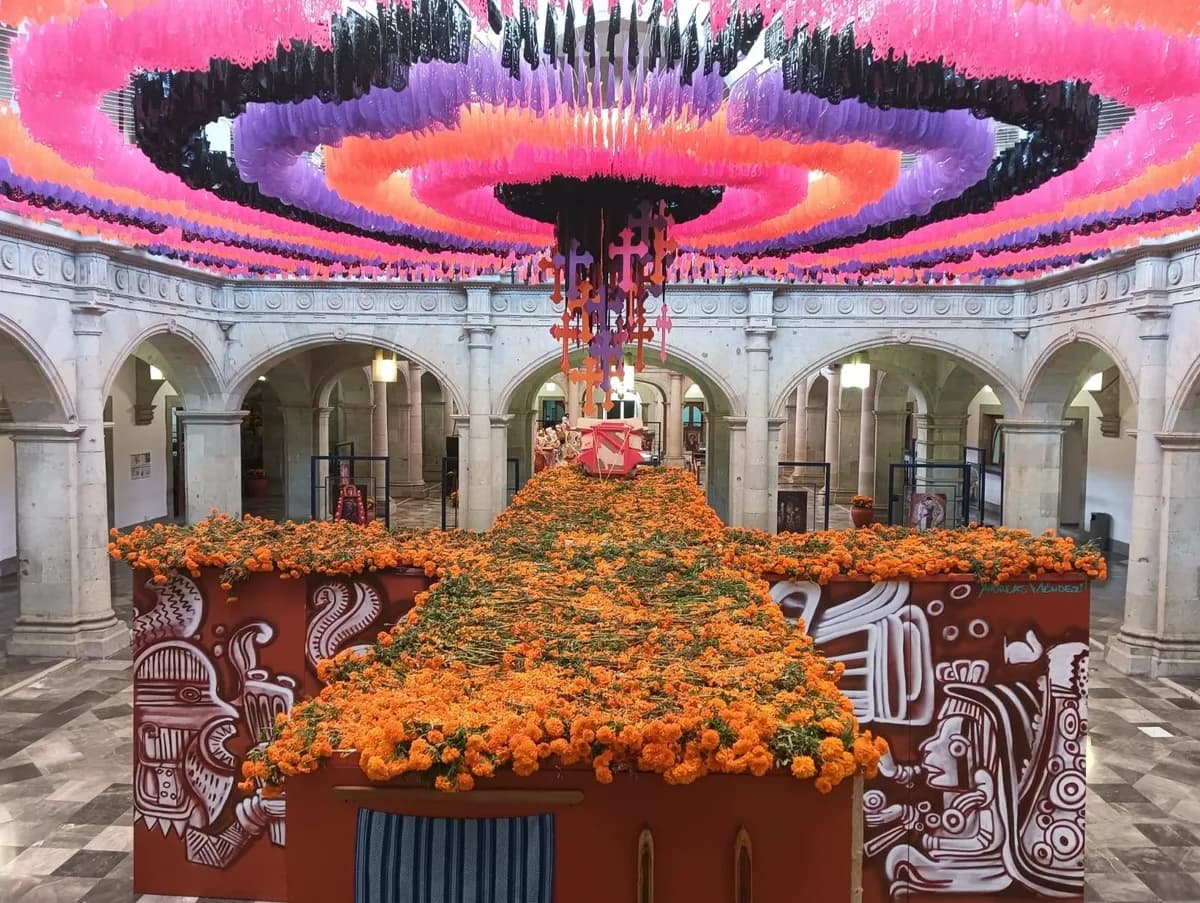
- •An immersive exhibition recreating Tomb 1 of Mitla from the Zapotec civilization has opened at the Governor's Palace in Oaxaca, Mexico.
- •The exhibition faithfully recreates the sacred space considered a gateway to the afterlife and axis of the universe, featuring greca patterns and geometric designs.
- •This collaborative project involving artists, archaeologists, and the Mitla community is available for free viewing during the Day of the Dead period.
Zapotec Cultural Heritage Brought to Modern Times
A replica exhibition of Tomb 1 of Mitla, a key archaeological site of the Zapotec civilization, has opened to the public at the Governor's Palace in Oaxaca, Mexico. The exhibition was designed to coincide with Día de Muertos (Day of the Dead) celebrations and features an immersive space where visitors can experience 'Lyobaa'—the entrance to the afterlife as believed by the ancient Zapotec people.
Oaxaca Governor Salomón Jara Cruz and DIF Oaxaca Honorary President Irma Bolaños Quijano toured the exhibition on October 30, officially marking its opening. Governor Jara stated, "We have brought this exhibition to the people's house so they can better understand and appreciate Oaxaca's roots," adding that "visitors can directly observe the pillars of life inscribed with core symbols of Zapotec history and worldview."
Sacred Geometry: Recreating the Greca Patterns
Tomb 1 of Mitla, also known as the Cold Tomb (Tumba Fría), was a ceremonial space where funerary rites for important pre-Hispanic figures were conducted. In Zapotec cosmology, this tomb was not merely a burial site but an axis connecting the four cardinal directions of the universe and a gateway to the afterlife.
The exhibition faithfully recreates the sacred architectural style and symbolism of the original site. Visitors are greeted by grecas—stepped geometric patterns that represent the essence of Zapotec art—and intricate geometric designs. These patterns are not mere decorations but a symbolic code system representing cosmic order, the cycle of life, and the connection between gods and humans.
A Cultural Heritage Restoration Project Born from Collaboration
This installation is organized by the Oaxaca Secretariat of Culture and Arts (Seculta), with Luis García Lalo, director of the Ervin Frissell Archaeological Museum of Oaxaca, serving as overall coordinator. The project brought together experts from various fields, including artists Andreas Méndez and Rodrigo Hernández, archaeologist Juan Carlos Díaz Vásquez, sociologist Salvador Martínez, and cultural activist Jaime Juárez.
Particularly noteworthy is the direct involvement of the Mitla community in the project. This adds meaning beyond a simple exhibition, representing the continuation of living cultural heritage.
Day of the Dead: When Two Worlds Meet
The exhibition can be viewed alongside the monumental altar (Altar Monumental) installed in the central courtyard of the Governor's Palace. Mexico's Day of the Dead is a UNESCO Intangible Cultural Heritage, a celebration where families and communities gather to honor the dead based on the belief that deceased souls return to the world of the living.
The state government invites domestic and international visitors to experience the "Fiesta más Viva de Todas" (Most Living Festival of All). Admission to the exhibition is free and will remain open throughout the Day of the Dead period.
댓글 (2)
간결하면서도 핵심을 잘 정리한 기사네요.
Mitla에 대해 더 알고 싶어졌습니다. 후속 기사 부탁드립니다.
More in Culture & Art
Government Provides 1 Billion Won in Emergency Disaster Funds for Daejeon Factory Fire Recovery

Existence Blooming Through Vulnerability: Massimo Lagrotteria Solo Exhibition

Milan Design Week 2026: Hotels Transform into Laboratories of Dreams
The Future of Living on the Moon, Mars, and Deep Sea: Houses Designed by Architects

15,000-Year-Old Clay Beads Made by Children Rewrite Prehistoric Art History

Reuters Reports Banksy's Identity Revealed, Reigniting Anonymity Debate
Latest News

이스라엘, 헤즈볼라 무기 통로 레바논 다리 공습
이스라엘군, 헤즈볼라 무기 통로 레바논 다리 공습
중동행 전세기 전쟁보험료 최고 7천500만원
중동행 전세기 전쟁보험료가 최고 5만달러(7천500만원)로 상승
이란 탄도미사일, 이스라엘 방어망 뚫고 160명 부상
이란 탄도미사일이 이스라엘 방공망을 통과해 160명 부상

Middle East Conflict Drives Manufacturing Outlook to 10-Month Low
The Korea Institute for Industrial Economics & Trade survey shows April manufacturing outlook PSI plummeted to 88, falling below baseline for the first time in 10 months.

Lee Jae-myung Administration Excludes Multi-Home Officials from Real Estate Policymaking
President Lee Jae-myung has ordered the exclusion of multi-home owning public officials from all real estate policy processes.

Southeast Asia Growth Forecasts Cut Amid Oil Price Surge, Threatening Korean Exports
Maybank Research has downgraded ASEAN-6's 2026 growth forecast from 4.8% to 4.5%.

Volkswagen CEO Says Germany Should Learn from China's Industrial Strategy
Volkswagen CEO stated that Germany should learn from China's systematic industrial planning approach.

Reddit Considers Face ID to Block Bots While Maintaining Anonymity
Reddit is considering implementing biometric authentication systems such as Face ID and Touch ID to block AI bots while maintaining anonymity.