Brazilian Modernism's Past and Future Converge
Christie's LA Exhibition 'Lightness & Tension'—Where Tenreiro's Legacy Meets Lucas Simões' Contemporary Experiments
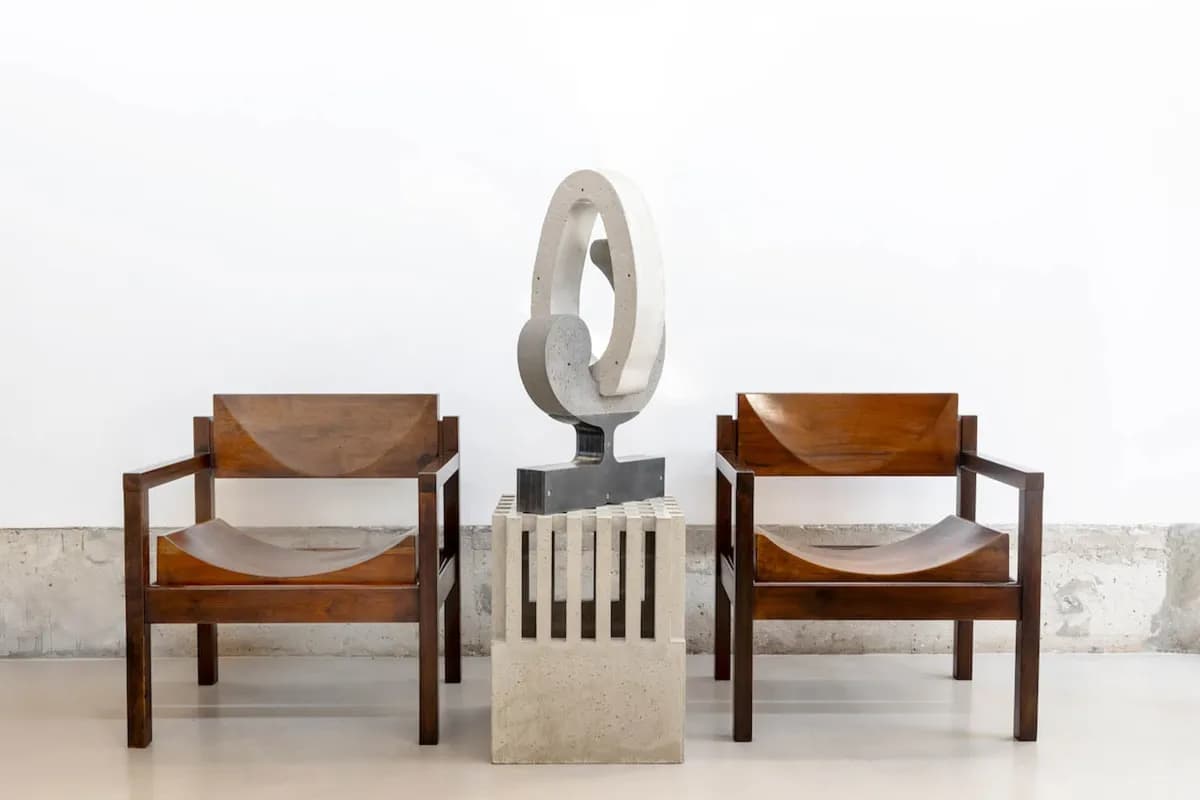
- •The exhibition opening September 5 at Christie's LA presents works by Brazilian modernist master Joaquim Tenreiro alongside contemporary artist Lucas Simões.
- •Curator Ulysses de Santi presents a new model that goes beyond preserving historical legacy to extending it through collaboration with contemporary artists.
- •Simões designs furniture as an extension of his sculptural practice, offering a contemporary reinterpretation of Tenreiro's question of 'lightness and tension.'
Reimagining a Master of 20th Century Brazilian Design
Joaquim Tenreiro, a pioneer of Brazilian modernism, established factories in Rio de Janeiro and São Paulo during the 1940s, crafting iconic furniture from native hardwoods, rattan, and cane. His works became essential pieces for Brazilian architects and formed a crucial pillar defining 20th-century Brazilian modernism.
Today, collector and curator Ulysses de Santi has been acquiring works by Tenreiro and his contemporaries, supplying pieces to institutions like the Los Angeles County Museum of Art (LACMA) and organizing collaborative exhibitions with Mendes Wood Gallery and Frieze.
On September 5, de Santi presents a special exhibition at Christie's LA: 'Lightness & Tension'. This exhibition looks beyond the past toward the future, juxtaposing Tenreiro's historical works with the debut furniture collection by São Paulo-based contemporary artist Lucas Simões, exploring the continuity of Brazilian modernism.
How Two Generations Meet
De Santi recalls his entry into design collecting:
"It was intuitive at first. I was drawn to the presence certain objects commanded in space. When I first saw a tea cart by Jorge Zalszupin, the curves, materials, and technical ingenuity were completely novel. It was elegant yet functional, expressive yet restrained. That piece opened the door to a much larger story—Brazilian modernism."
For over a decade, de Santi has collected historical pieces and established rigorous authentication systems. But at some point, he felt the need to move the conversation forward.
"I wanted to see how the legacy of modernism could inform new creation, and how contemporary work could reconfigure the past."
He proposed a collaboration with Lucas Simões, a longtime friend whose work he'd been collecting for over 20 years. While Simões is renowned for his installation art and sculpture, his architectural background has led him to design furniture and tools for his own studio use.
"I'm interested in integrating form, function, and meaning—creating objects that are visually compelling while serving practical purposes in daily life."
Within the Context of Brazilian Modernism
Brazilian modernism was not merely a derivative of European modernism. During the 1940s-50s, Brazilian architects and designers combined indigenous materials with artisanal techniques to construct a distinctive aesthetic. Oscar Niemeyer's organic architecture and Tenreiro's furniture complemented each other, creating the unique language of Brazilian modernism.
Tenreiro particularly focused on structures that simultaneously embodied lightness and tension. His chairs, composed of slender frames and woven rattan, maintained strength through exquisite balance. This design philosophy emerged from Brazil's tropical climate and spatial culture—where boundaries between outdoor and indoor spaces blur.
De Santi felt the need to move beyond merely preserving this legacy to reinterpreting it from a contemporary perspective. He believed Simões' work could fulfill this role.
Lucas Simões' New Experiments
As an artist, Simões has worked with space and materiality. His installations often reconfigure space by calculating the viewer's body and gaze. This approach extends to his furniture design.
"My furniture is an extension of my sculptural practice. I use the same materials and techniques, but they directly engage with the human body and domestic space. Integrating form, function, and meaning is the most intriguing challenge."
Simões' debut furniture collection doesn't replicate Tenreiro's legacy. Instead, it reinterprets the same question—how to simultaneously achieve lightness and tension—using contemporary materials and techniques. This is not simply a juxtaposition of past and present, but an attempt to create dialogue between two eras.
Future Prospects [AI Analysis]
This exhibition has the potential to demonstrate that Brazilian modernism is not merely historical legacy but an ongoing conversation. Particularly at a time when American collectors and museums are expanding their interest in Latin American design, the collaboration between de Santi and Simões will likely suggest directions for contemporary reinterpretations of Brazilian modernism.
The exhibition also proposes a new model for design collecting. Moving beyond preserving historical works, it extends that legacy through collaboration with contemporary artists. This is a curatorial strategy that shows not just the past on display, but how the past inspires present and future creation.
As de Santi noted, the time has come to "move the conversation forward." When Tenreiro's furniture is placed alongside Simões' experiments, we will witness that Brazilian modernism is not simply a 1940s style, but a design language that continues to evolve.
댓글 (3)
Brazilian에 대해 더 알고 싶어졌습니다. 후속 기사 부탁드립니다.
Modernism 관련 기사 잘 읽었습니다. 유익한 정보네요.
흥미로운 주제입니다. 주변에도 공유해야겠어요.
More in Culture & Art
Government Provides 1 Billion Won in Emergency Disaster Funds for Daejeon Factory Fire Recovery

Existence Blooming Through Vulnerability: Massimo Lagrotteria Solo Exhibition
Milan Design Week 2026: Hotels Transform into Laboratories of Dreams

The Future of Living on the Moon, Mars, and Deep Sea: Houses Designed by Architects

15,000-Year-Old Clay Beads Made by Children Rewrite Prehistoric Art History

Reuters Reports Banksy's Identity Revealed, Reigniting Anonymity Debate
Latest News

이스라엘, 헤즈볼라 무기 통로 레바논 다리 공습
이스라엘군, 헤즈볼라 무기 통로 레바논 다리 공습

중동행 전세기 전쟁보험료 최고 7천500만원
중동행 전세기 전쟁보험료가 최고 5만달러(7천500만원)로 상승

이란 탄도미사일, 이스라엘 방어망 뚫고 160명 부상
이란 탄도미사일이 이스라엘 방공망을 통과해 160명 부상
Middle East Conflict Drives Manufacturing Outlook to 10-Month Low
The Korea Institute for Industrial Economics & Trade survey shows April manufacturing outlook PSI plummeted to 88, falling below baseline for the first time in 10 months.

Lee Jae-myung Administration Excludes Multi-Home Officials from Real Estate Policymaking
President Lee Jae-myung has ordered the exclusion of multi-home owning public officials from all real estate policy processes.
Southeast Asia Growth Forecasts Cut Amid Oil Price Surge, Threatening Korean Exports
Maybank Research has downgraded ASEAN-6's 2026 growth forecast from 4.8% to 4.5%.

Volkswagen CEO Says Germany Should Learn from China's Industrial Strategy
Volkswagen CEO stated that Germany should learn from China's systematic industrial planning approach.

Reddit Considers Face ID to Block Bots While Maintaining Anonymity
Reddit is considering implementing biometric authentication systems such as Face ID and Touch ID to block AI bots while maintaining anonymity.