Digital Euro Launch in Crisis Amid Banking Sector and European Parliament Opposition
ECB President Lagarde's ambitious project delayed until 2029 amid political and economic resistance
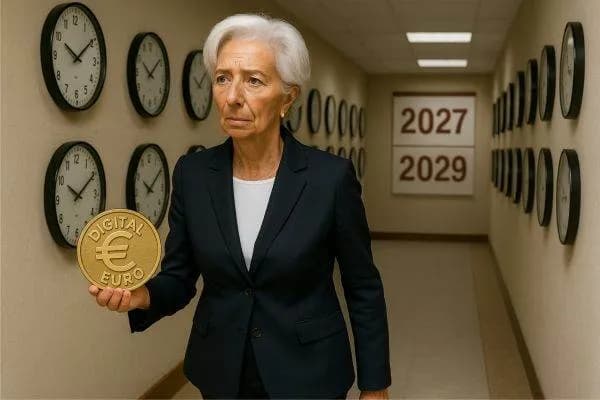
- •The ECB's digital euro project has been delayed until 2029 and is effectively adrift due to strong opposition from the banking sector and the European Parliament.
- •ECB President Lagarde pushed the digital euro as a financial sovereignty project to reduce dependence on American payment systems, but realization during her term has become impossible.
- •Commercial banks oppose the digital euro, claiming it threatens their deposit base, while Europe falls behind as China and the United States advance in the digital currency race.
Symbol of European Financial Sovereignty on the Brink of Collapse
The European Central Bank's (ECB) ambitious digital euro project is facing a serious crisis before it has even launched. According to a report by European media outlet Follow The Money, the digital euro—championed by ECB President Christine Lagarde as a key project for European financial sovereignty—is effectively adrift due to strong opposition from commercial banks and the European Parliament.
President Lagarde expressed her frustration at a central bank representatives' meeting in Helsinki last September, stating that the digital euro project is taking "too long" to get started. She acknowledged the reality that "by the time the digital euro finally launches, my term will be over," admitting it would be difficult to see the project completed before her term expires in October 2027.
Delayed Until 2029 Despite Six Years of Preparation
The digital euro project has been in preparation for approximately six years, but the launch date keeps being pushed back. The currently possible release date is expected to be 2029, several years later than originally planned.
The legislative process is also moving at a snail's pace. The digital euro bill submitted by the European Commission to the Strasbourg Parliament in June 2023 has been essentially shelved until now. Rather than accelerating the project, it has become a political battleground.
President Lagarde has publicly expressed dissatisfaction that the European Parliament's democratic processes are "acting as too strong a brake at a time when speed is crucial." This is not an authoritarian statement, but an expression of frustration at the reality that Europe is falling behind while other countries advance in the digital currency race.
Strong Resistance from the Banking Sector
The ECB has promoted the digital euro as a financial sovereignty tool to reduce dependence on American payment giants like Visa and Mastercard, and dollar-centric financial infrastructure.
However, commercial banks are strongly opposing this project. If the digital euro is introduced, customers could transfer bank deposits to central bank-issued digital currency, potentially undermining banks' deposit base and revenue structure.
The most influential opponent within the European Parliament is rapporteur Fernando Navarrete Rojas. According to Follow The Money's report, he is regarded as "the most important ally of maintaining the banking status quo."
Global Competition Over Digital Currency
Central Bank Digital Currency (CBDC) Implementation Status
The delay in the digital euro means Europe is falling behind in the global CBDC race. China is already conducting digital yuan pilot programs in several cities, and the United States is also accelerating research on the digital dollar.
The importance of "speed" emphasized by President Lagarde comes from precisely this geopolitical context. The country or economic bloc that first captures the standard in the digital currency era is likely to hold leadership in the future global financial system.
Financial Sovereignty vs. Banking Interests
The core of this conflict is the clash between long-term financial sovereignty and short-term banking interests. The ECB argues that for Europe to break free from its dependence on American payment systems, its own digital currency infrastructure is essential.
On the other hand, the banking sector worries that the digital euro will destabilize the existing financial system and weaken banks' intermediary function. Particularly, there are concerns about the risk of bank runs if customers massively convert deposits to digital euros during financial crises.
Technical Challenges and Privacy Controversies
Beyond political and economic opposition, the digital euro project faces technical challenges. Building a stable and scalable system that hundreds of millions of European citizens can use simultaneously is by no means a simple task.
Privacy issues are also controversial. Digital currency issued by a central bank has the potential to track all transaction records, leading civil society groups to warn of the risk of it becoming "surveillance currency."
Future Outlook [AI Analysis]
The direction of the digital euro project is likely to unfold in three scenarios.
First, there is the possibility of a compromise between the ECB and the banking sector. A middle ground could be found by limiting the functions of the digital euro (e.g., setting holding limits) or partially guaranteeing banks' role.
Second, the possibility that the project continues to be delayed and eventually abandoned cannot be ruled out. With launch during President Lagarde's term now impossible, it remains uncertain whether the next ECB president will show the same enthusiasm for this project.
Third, there is the possibility that an external shock could revive the project. For example, if the United States or China gains a decisive advantage in digital currency, or if Europe's payment system faces a serious crisis, political resistance could weaken.
Currently, it appears highly likely that the digital euro will not launch even by 2029. Between the long-term vision of financial sovereignty and the reality politics of protecting vested interests, Europe is still unable to find an answer.
댓글 (4)
불안한 시기에 정확한 보도가 중요합니다. 좋은 기사 감사합니다.
이 부분은 저도 주시하고 있습니다.
이 위기를 어떻게 극복할 수 있을지 전문가 의견이 더 필요합니다.
맞습니다. 대비가 필요한 시점이에요.
More in Special

The Corsican Mafia Exposed: Breaking a Century of Silence

AI-Generated Fake Person Used to Sell Dubai Flight Seats

Facebook Groups Traded Endangered Species Using Code Language — Indonesian Broker Network Exposed

G6 Alliance Declares Support for Hormuz Strait Security... Reverses Stance Under Trump Pressure

Seoul's Average Monthly Rent Surpasses 1.51 Million Won as Soaring Official Property Prices Trigger 'Housing Cost Bomb'

Rihanna Tops Spotify Without New Album for 10 Years, Proving Power of Catalog
Latest News

이스라엘, 헤즈볼라 무기 통로 레바논 다리 공습
이스라엘군, 헤즈볼라 무기 통로 레바논 다리 공습

중동행 전세기 전쟁보험료 최고 7천500만원
중동행 전세기 전쟁보험료가 최고 5만달러(7천500만원)로 상승

이란 탄도미사일, 이스라엘 방어망 뚫고 160명 부상
이란 탄도미사일이 이스라엘 방공망을 통과해 160명 부상

Middle East Conflict Drives Manufacturing Outlook to 10-Month Low
The Korea Institute for Industrial Economics & Trade survey shows April manufacturing outlook PSI plummeted to 88, falling below baseline for the first time in 10 months.

Lee Jae-myung Administration Excludes Multi-Home Officials from Real Estate Policymaking
President Lee Jae-myung has ordered the exclusion of multi-home owning public officials from all real estate policy processes.

Southeast Asia Growth Forecasts Cut Amid Oil Price Surge, Threatening Korean Exports
Maybank Research has downgraded ASEAN-6's 2026 growth forecast from 4.8% to 4.5%.

Volkswagen CEO Says Germany Should Learn from China's Industrial Strategy
Volkswagen CEO stated that Germany should learn from China's systematic industrial planning approach.

Reddit Considers Face ID to Block Bots While Maintaining Anonymity
Reddit is considering implementing biometric authentication systems such as Face ID and Touch ID to block AI bots while maintaining anonymity.