Sculptor Robert Grosvenor, Who Defied Genre Categorization, Dies at 88
A master who built his own artistic universe by crossing the boundaries of Minimalism for 60 years
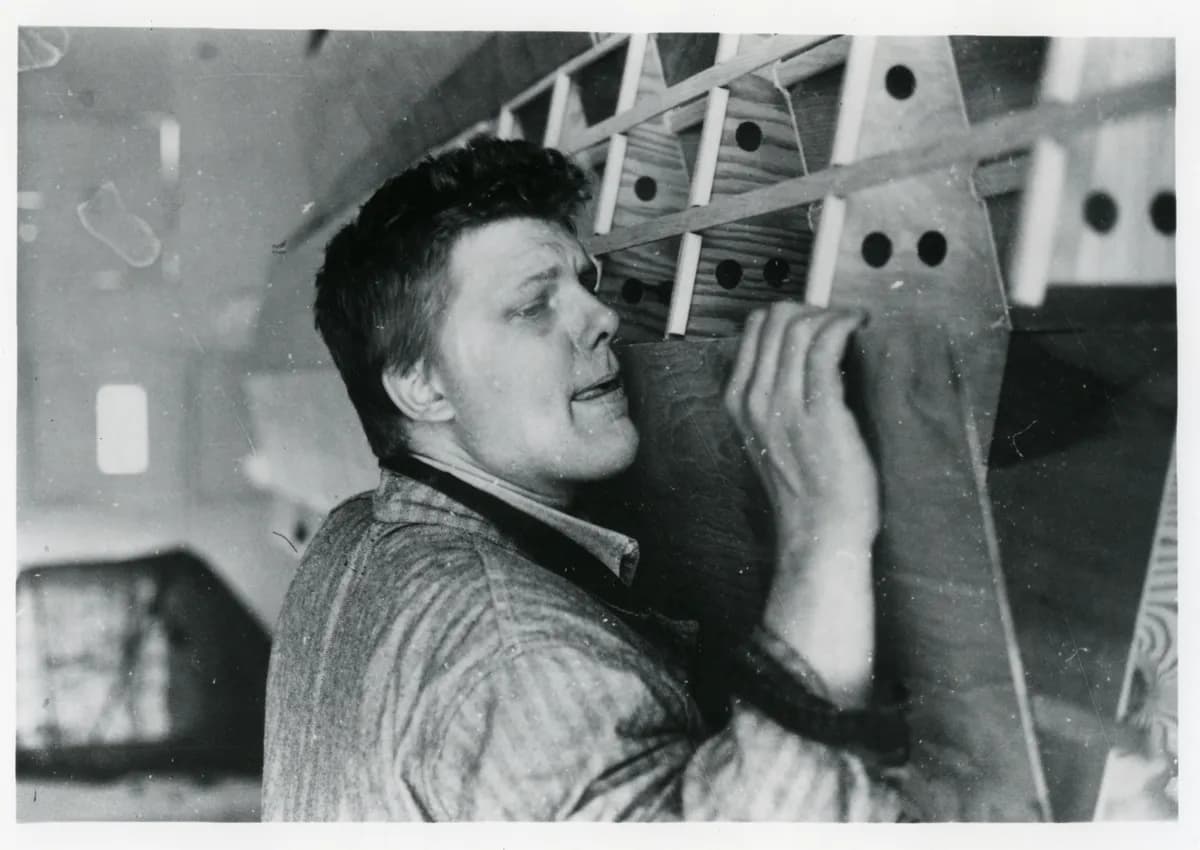
- •Robert Grosvenor, a pioneer of Minimalism and sculptor who defied genre categorization, has died at 88.
- •For 60 years, he built his own artistic universe by working across diverse media from large-scale abstract sculptures to photography and collage.
- •His works, which explored the boundary between art and function while expanding the limits of Minimalism, occupy a unique position in the history of modern sculpture.
An Artist Beyond Minimalism
Robert Grosvenor, a giant of American sculpture, passed away on September 3 at his Long Island, New York home at the age of 88. Paula Cooper Gallery, which has represented his work since 1968, officially announced his death.
Throughout his six-decade career, Grosvenor refused to be classified into any single genre, building his own distinctive formal language. While primarily known for large-scale abstract sculptures, his artistic universe encompassed diverse media including photography, drawing, and collage.
A Pioneer of Minimalism, Yet Beyond It
In the 1960s, Grosvenor gained recognition as a key figure in the Minimalist movement. He participated in the Jewish Museum's groundbreaking 1966 exhibition "Primary Structures" and the 1968 "Minimal Art" exhibition at the Gemeentemuseum in The Hague, standing alongside Donald Judd, Sol LeWitt, and Robert Morris.
However, he departed from Minimalism's strict formalism to forge his own path. He employed industrial materials in unconventional ways and explored concepts of spatial dynamics and functionality with wit. His works ranged from cantilevered steel structures that seemed to defy gravity to broken wooden beams and vehicle shells placed on the floor.
Art critic John Yau, commenting on Grosvenor's 2020 work—a complex sculpture composed of concrete blocks, rubber lining, and standing water—wrote: "The structure is simple and surprisingly economical, yet simultaneously humorous and generous. Grosvenor walks up to the line separating art and function without ever crossing it or commenting on it. This is his gift, and I know of no other sculptor with this ability."
An Artistic Journey Spanning Europe and America
Born in New York City in 1937, Grosvenor grew up in Rhode Island and Arizona. During his teenage years, he received classical training studying art and design in Europe. He attended the Ecole des Beaux Arts in Dijon, the Ecole Supérieure des Arts Décoratifs in Paris, and the University of Perugia in Italy.
In a 2019 interview with Brooklyn Rail, he revealed that during his student years, he was inspired by experimental artists such as Yves Klein, Lucio Fontana, and Piero Manzoni.
Returning to the United States in 1959, he completed six months of military service before moving to New York. There, he befriended members of Paula Cooper's cooperative Park Place Gallery and the Green Gallery, which provided early platforms for artists like Yayoi Kusama and Mark di Suvero. At the time, he described his work as "painting that has fallen off the wall," and began participating in group exhibitions from 1962.
Representative Works and Artistic Legacy
According to Paula Cooper Gallery, Grosvenor considered "Transoxiana," presented in 1965, as the starting point of his career. This 31-foot angular cantilevered sculpture was later exhibited in "Primary Structures" alongside pioneering Minimalist works.
"Topanga" (1965), a dynamic geometric work created after viewing photographs of a massive solar telescope in Arizona's Sonoran Desert, demonstrates his spatial sensibility. His untitled white steel structure from 1968-1970 astonished viewers with its seemingly airborne form.
Grosvenor intentionally left many works untitled and rarely provided explanations. This approach was his way of encouraging viewers to encounter the works directly and discover meaning for themselves.
A Figure on the Border Between Art and Function
While Grosvenor's works often perplexed audiences, it was precisely this opacity and dry wit that made his art distinctive. He explored the boundary between art and functionality while maintaining a balance that never tipped toward either side.
By refusing genre definitions for over 60 years while developing his own formal language, Grosvenor occupies a unique position in the history of modern sculpture. His works exist within the historical context of Minimalism while constantly expanding its boundaries and presenting new possibilities.
댓글 (5)
간결하면서도 핵심을 잘 정리한 기사네요.
Robert 관련 기사 잘 읽었습니다. 유익한 정보네요.
좋은 의견이십니다.
Grosvenor에 대해 더 알고 싶어졌습니다. 후속 기사 부탁드립니다.
그 부분은 저도 궁금했습니다.
More in Culture & Art
Government Provides 1 Billion Won in Emergency Disaster Funds for Daejeon Factory Fire Recovery

Existence Blooming Through Vulnerability: Massimo Lagrotteria Solo Exhibition
Milan Design Week 2026: Hotels Transform into Laboratories of Dreams
The Future of Living on the Moon, Mars, and Deep Sea: Houses Designed by Architects

15,000-Year-Old Clay Beads Made by Children Rewrite Prehistoric Art History

Reuters Reports Banksy's Identity Revealed, Reigniting Anonymity Debate
Latest News

이스라엘, 헤즈볼라 무기 통로 레바논 다리 공습
이스라엘군, 헤즈볼라 무기 통로 레바논 다리 공습
중동행 전세기 전쟁보험료 최고 7천500만원
중동행 전세기 전쟁보험료가 최고 5만달러(7천500만원)로 상승

이란 탄도미사일, 이스라엘 방어망 뚫고 160명 부상
이란 탄도미사일이 이스라엘 방공망을 통과해 160명 부상
Middle East Conflict Drives Manufacturing Outlook to 10-Month Low
The Korea Institute for Industrial Economics & Trade survey shows April manufacturing outlook PSI plummeted to 88, falling below baseline for the first time in 10 months.

Lee Jae-myung Administration Excludes Multi-Home Officials from Real Estate Policymaking
President Lee Jae-myung has ordered the exclusion of multi-home owning public officials from all real estate policy processes.

Southeast Asia Growth Forecasts Cut Amid Oil Price Surge, Threatening Korean Exports
Maybank Research has downgraded ASEAN-6's 2026 growth forecast from 4.8% to 4.5%.
Volkswagen CEO Says Germany Should Learn from China's Industrial Strategy
Volkswagen CEO stated that Germany should learn from China's systematic industrial planning approach.

Reddit Considers Face ID to Block Bots While Maintaining Anonymity
Reddit is considering implementing biometric authentication systems such as Face ID and Touch ID to block AI bots while maintaining anonymity.