Jensen Huang at Davos: "AI Will Become Essential Infrastructure Like Electricity"
NVIDIA CEO Envisions Era of $1 Trillion Infrastructure Build-Out with Five-Layer AI Stack
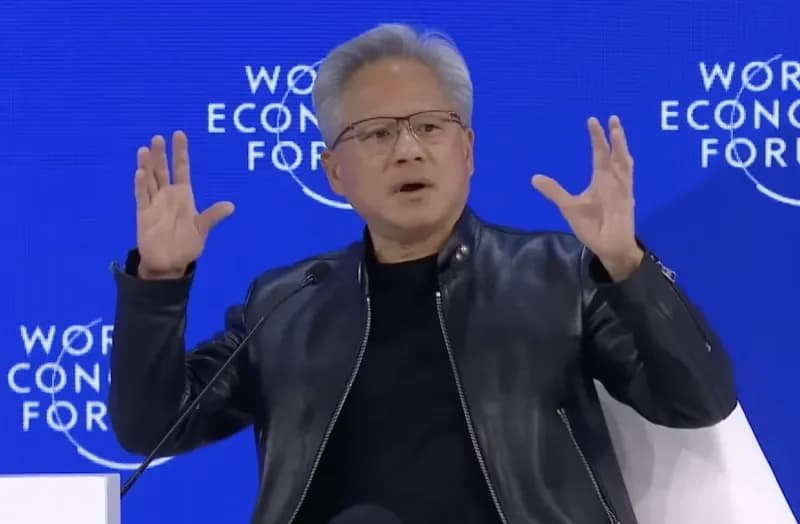
- •NVIDIA CEO Jensen Huang defined AI as essential infrastructure like electricity and roads at the Davos Forum, projecting an era of $1 trillion-scale infrastructure build-out.
- •The core differentiator is the paradigm shift from SQL-based structured data processing to neural network-based unstructured data processing.
- •NVIDIA has demonstrated a history of growth through platform transitions, recording an annualized compound return of 30-37% since its 1999 IPO.
One Statement That Settled the AI Bubble Debate
A session at the 2026 Davos Forum featuring Larry Fink, Chairman of BlackRock (the world's largest asset manager), and Jensen Huang, CEO of NVIDIA (the company with the largest market capitalization), has drawn significant attention. At this event, Jensen Huang presented a perspective that decisively addressed the "AI bubble" debate.
Here's the key point: AI is no longer simply a technology—it's becoming essential infrastructure, like electricity, roads, and telecommunications. Once you accept this premise, the ongoing investment appears not as overheating but as "the largest infrastructure build-out in modern history."
NVIDIA's Growth by the Numbers
Larry Fink opened the conversation with an intriguing comparison. BlackRock and NVIDIA went public almost simultaneously in 1999, but their trajectories have been strikingly different. NVIDIA has achieved an annualized compound return of 30-37%, and Fink remarked, "Imagine what it would have meant if pension funds had participated in the IPO back then."
Jensen Huang shared an anecdote: shortly after the IPO, when the market cap was $300 million, he sold some shares to buy his parents a Mercedes S-Class. He joked that it was "the most expensive car in the world at the time," but from today's perspective, it sounds like a story from an entirely different economic era.
Platform Shift: Why This Cycle Is Different
Fink's question was fundamental: "Why can AI be such a powerful growth driver? What makes it different from previous technology waves?"
Jensen Huang responded not with marketing slogans but with a "return to first principles." His core argument is clear: this is a platform shift similar to PC, internet, mobile, and cloud—and with each shift, the computing stack was reinvented and new classes of applications emerged.
Fundamental Change in Programming Paradigm
However, the essence of this change lies in the nature of programming itself.
| Category | Traditional Computing | AI Computing |
|---|---|---|
| Programming Method | Humans write algorithms | Learning from data |
| Data Type | Structured data (tables, fields) | Unstructured data (images, text, voice) |
| Core Engine | SQL database | Neural network inference engine |
| Processing Method | Explicit rule execution | Pattern recognition and reasoning |
Jensen Huang described SQL as "the most important database engine the world has known," emphasizing that nearly everything operated on top of it. But now, a new type of computer has emerged that can understand and reason about unstructured data.
Five-Layer AI Stack and $1 Trillion Infrastructure Build-Out
The "five-layer AI stack" concept presented by Jensen Huang was the core framework of the session. Although not all layers were detailed in the original discussion, he emphasized that each layer requires new infrastructure.
- Hardware Layer: AI accelerators like GPUs and TPUs
- Network Layer: Ultra-high-speed data transmission infrastructure
- Software Layer: AI frameworks and development tools
- Application Layer: Actual AI services
- Data Layer: Training and inference datasets
Jensen Huang described the investment scale needed to build this stack as a "trillion-dollar build-out." This means infrastructure investment exceeding $1 trillion is required.
Structural Causes of GPU Shortage
The conversation naturally led to GPU supply shortages. From Jensen Huang's perspective, this isn't simply a supply-demand imbalance.
It's a structural phenomenon occurring because the entire world is simultaneously building new computing infrastructure. Just as with electrical grids or road networks, supply struggles to keep pace with demand during the initial construction phase.
Comparison with Previous Technology Waves
| Technology Wave | Core Infrastructure | Scope of Impact | Build-Out Period |
|---|---|---|---|
| PC Era | Personal computer adoption | Individual productivity | 10+ years |
| Internet Era | Fiber optic cables, data centers | Information access | 15+ years |
| Mobile Era | 4G/5G networks, app ecosystem | Connectivity | 10+ years |
| Cloud Era | Large-scale data centers | Computing access | Ongoing |
| AI Era | GPU clusters, AI-dedicated infrastructure | Across industries | Early stage |
Jensen Huang explained that the computing stack was reinvented with each platform shift, and massive infrastructure investment was required each time. The AI era follows this pattern but is different in scale and speed from anything before.
Larry Fink's Investor Perspective
As BlackRock's chairman, Fink connected this discussion to asset management perspectives. He asked how pension funds and institutional investors should view this change, and Jensen Huang's response consistently returned to "infrastructure investment."
Investment in AI is not speculation but essential infrastructure construction, fundamentally the same in nature as 20th-century power grid or highway construction.
[AI Analysis] Future Outlook and Implications
The implications of the Davos conversation between Jensen Huang and Larry Fink are clear.
First, the AI investment cycle is likely to continue for at least 10 years or more. PC, internet, and mobile each underwent 10-15 years of infrastructure build-out, and AI is expected to have an even broader impact.
Second, GPU shortages are a structural problem unlikely to be resolved quickly. With the entire world simultaneously building AI infrastructure, supply expansion will take time. Competition will intensify not only among NVIDIA, AMD, and Intel but also among big tech companies developing their own chips.
Third, the change in programming paradigm will reshape the entire software industry. The shift from SQL-centered structured data processing to neural network-based unstructured data processing means not just a technical upgrade but the birth of new developer ecosystems and business models.
Fourth, the "AI bubble" debate may itself be based on a flawed premise. During essential infrastructure construction phases, what appears to be overinvestment often proves appropriate in hindsight. However, at the individual company level, there will still be winners and losers.
This Davos 2026 session elevated the level of AI discourse. The conversation's center of gravity has shifted from "Are chatbots good or bad?" to "How do we efficiently build $1 trillion in infrastructure?"
댓글 (3)
간결하면서도 핵심을 잘 정리한 기사네요.
기사 잘 봤습니다. 다른 시각의 분석도 읽어보고 싶네요.
at에 대해 더 알고 싶어졌습니다. 후속 기사 부탁드립니다.
More in this series
More in AI & Tech

Czech Drone Factory Fire Under Investigation for Terrorism

Trump Slams NATO Allies as 'Cowards' Over Strait of Hormuz Refusal
Google Unveils Gemini 3.1 Flash-Lite Optimized for High-Volume Processing

From Go AI to Life Sciences: AlphaGo's 10-Year Journey
Google DeepMind Unveils Framework for Measuring AGI Evolution

Perplexity Launches 'Comet' AI Browser for iPhone
Latest News

Santo Domingo's Malecón Sports Park Construction Progressing Smoothly
Construction of a soccer field and skate park is progressing smoothly in the Malecón area of Santo Domingo, Dominican Republic.

Beyond Vaccines: Refusal of Newborn Vitamin K Shots Spreads
Half of newborns at an Idaho hospital did not receive vitamin K injections due to parental refusal.

US Military Strikes Iranian Facilities Threatening Strait of Hormuz
US military strikes Iranian underground missile facilities near the Strait of Hormuz

The Corsican Mafia Exposed: Breaking a Century of Silence
Citizens in Corsica, France have begun publicly denouncing the mafia problem that has been taboo for decades.

UFC 313: Jones vs. Aspinall Heavyweight Title Fight Confirmed
UFC 313 confirmed for March 8: Jon Jones vs. Tom Aspinall heavyweight title fight

Black Combat: A New Leap for Korean MMA Promotion
Black Combat is rapidly growing as one of the top three domestic MMA promotions, securing a young fan base through digital marketing

Russia Anticipates Economic Gains from US-Iran Conflict
US-Iran tensions drive international oil prices up, increasing Russia's energy export revenues

Gas Sprayer Detected at BTS Comeback Concert Venue Metal Detector
Woman in her 50s caught carrying gas sprayer at BTS comeback concert venue