AMD Selects Samsung as Key HBM4 Supplier for Next-Gen AI GPUs
CEO Lisa Su's First Korea Visit Discusses Samsung Foundry Collaboration Possibilities
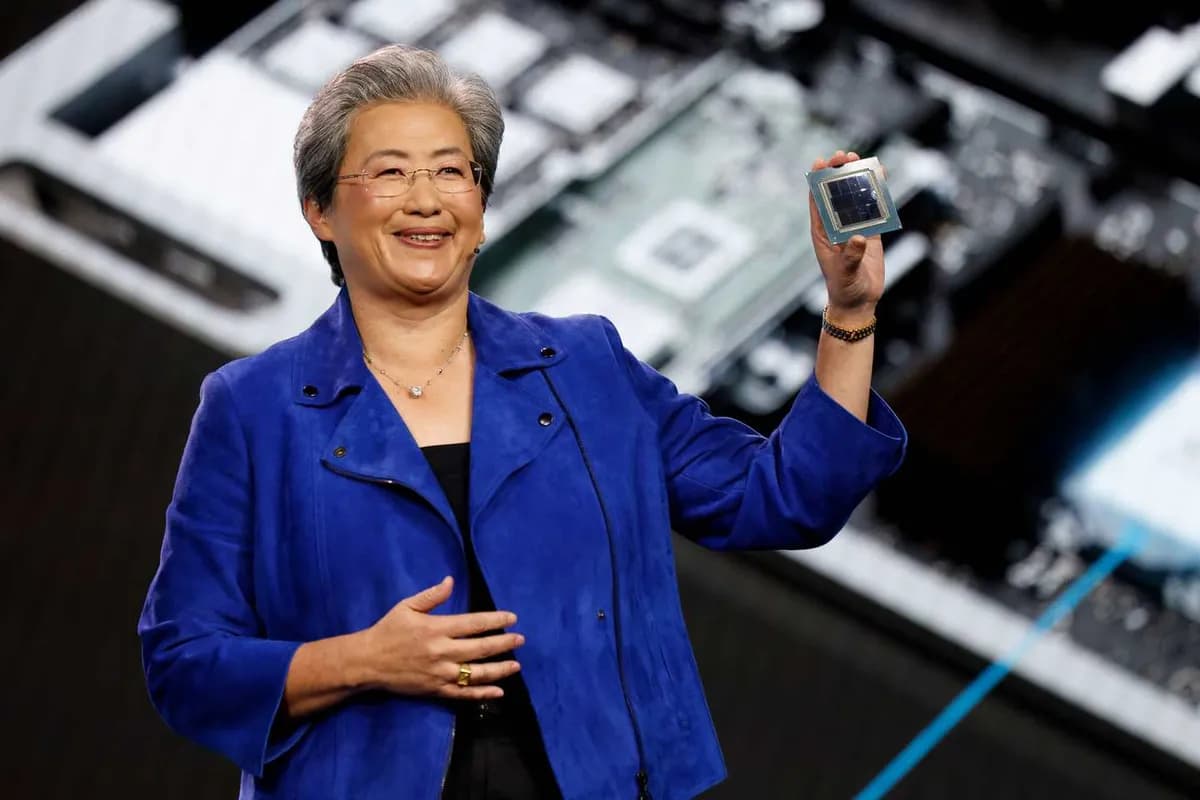
- •AMD has selected Samsung Electronics as a key supplier of HBM4 for its next-generation AI GPU 'Instinct MI455X', strengthening AI semiconductor collaboration.
- •AMD CEO Lisa Su visited Korea for the first time in 10 years to discuss foundry collaboration possibilities with Samsung, pursuing a strategy to move away from sole TSMC dependence.
- •By signing a GPU supply contract with Naver, AMD is cracking NVIDIA's monopoly structure and making a full-scale push into the Asian AI market.
AMD Signs HBM4 Memory Supply Agreement with Samsung
AMD has selected Samsung Electronics as a key supplier of 6th-generation High Bandwidth Memory (HBM4) for its next-generation artificial intelligence (AI) accelerator 'Instinct MI455X'. The decision was made as AMD CEO Lisa Su visited Korea for the first time since becoming CEO in 2014, signing a Memorandum of Understanding (MoU) at Samsung Electronics' Pyeongtaek semiconductor facility.
HBM4 is a next-generation ultra-high-speed memory essential for AI computation, offering significantly improved bandwidth and power efficiency compared to existing HBM3. AMD's Instinct MI455X is a core product designed to compete with NVIDIA's H200 and next-generation GPUs, and is expected to significantly enhance AI training and inference performance through HBM4 integration.
Foundry Collaboration Possibilities Emerge Beyond Memory
This collaboration extends beyond a simple memory supply contract. Both parties reportedly discussed foundry collaboration possibilities as well. This suggests the potential for Samsung Electronics to directly manufacture AMD's GPU chips through contract manufacturing.
Currently, AMD relies entirely on Taiwan's TSMC for GPU manufacturing. If Samsung Foundry participates in AMD chip production, AMD can reduce geopolitical risks and secure production flexibility through supply chain diversification. For Samsung Electronics, this represents an opportunity to enter the advanced GPU foundry market that TSMC has virtually monopolized.
Samsung Electronics has recently focused on improving its 3-nanometer process technology to strengthen foundry competitiveness. Collaboration with AMD could serve as a catalyst for enhancing Samsung Foundry's technological credibility.
GPU Supply Contract with Naver Reduces NVIDIA Dependency
CEO Lisa Su also signed a separate contract with Naver on the same day. This GPU infrastructure optimization contract for Naver's large language model (LLM) HyperCLOVA X includes supplying AMD GPUs to Naver's AI data centers.
Major Korean AI companies have been almost entirely dependent on NVIDIA GPUs. Naver has also primarily used NVIDIA products such as H100 and A100. The contract with AMD represents strategic collaboration where Naver diversifies its GPU supply chain while AMD expands its position in the Asian AI market.
AMD's Instinct MI300 series is evaluated as suitable for LLM training and inference tasks, showing strengths in price competitiveness and memory bandwidth compared to NVIDIA's H100.
What Has Changed: AMD's Asia Strategy Shift
| Category | Previous Strategy | Current Collaboration | Significance of Change |
|---|---|---|---|
| HBM Supply | SK hynix-centered | Samsung added (HBM4) | Supply chain diversification |
| Foundry | TSMC exclusive | Samsung collaboration discussed | Geopolitical risk mitigation |
| Korean AI Market | Limited entry | GPU supply with Naver | Emerging NVIDIA alternative |
| CEO Korea Visit | None for 10 years | Lisa Su's first visit | Rising importance of Korean market |
Lisa Su's Korea visit demonstrates that AMD has begun positioning Korea as a core hub in its AI semiconductor strategy for the Asian market. The first Korea visit in 10 years since becoming CEO in 2014 makes this even more symbolic.
Why Samsung, Why Now
Several factors underlie AMD's selection of Samsung as an HBM4 supplier.
First, reducing excessive dependence on SK hynix. Currently, SK hynix holds approximately 50% of the HBM market share in first place, followed by Samsung Electronics and US-based Micron. AMD needed to reduce single-supplier dependency risks and increase negotiating power.
Second, Samsung Electronics' HBM4 development speed. Samsung demonstrated technological capability by fully ramping up production of 12-stack (12-Hi) HBM3E from late 2024. HBM4 is expected to launch in the second half of 2026, and the assessment that Samsung can establish mass supply systems by that time played a role.
Third, geopolitical considerations. As US-China technology competition intensifies, sole dependence on Taiwan's TSMC has emerged as a supply chain risk. Samsung Electronics in Korea is the only company possessing both memory and foundry capabilities, giving it high strategic value to AMD.
[AI Analysis] Potential Changes in AI Semiconductor Market Landscape
The AMD-Samsung collaboration presents several important implications for the AI semiconductor ecosystem.
Cracks Emerging in NVIDIA's Monopoly Structure
NVIDIA currently dominates over 80% of the AI GPU market. AMD's aggressive expansion of Asian partnerships is likely to crack this monopolistic structure. Particularly, Asian AI companies with high price sensitivity have strong incentives to choose AMD's cost-effective products.
Restructuring of Korea's Semiconductor Ecosystem
If Samsung Electronics takes on AMD GPU foundry work, Korea will complete an integrated AI semiconductor value chain combining memory-foundry-AI chip design. This could form a new collaborative structure connecting SK hynix (HBM)-Samsung (HBM+foundry)-AMD (GPU design).
HBM4 Market Competition Intensifies in 2026
HBM4 is expected to begin full-scale supply from the second half of 2026. Samsung, SK hynix, and Micron are expected to compete fiercely while collaborating with NVIDIA, AMD, and Intel respectively. In particular, HBM4 is expected to significantly improve AI inference performance, accelerating the spread of edge AI and real-time AI services.
Supply Chain Diversification Trend Accelerates
AMD's move aligns with the industry-wide trend of AI companies moving away from single supply chain dependency. Big tech companies including Meta, Microsoft, and Google are also pursuing supplier diversification alongside proprietary AI chip development. The AI semiconductor market is likely to transition from a NVIDIA-centered unipolar system to a multipolar system where AMD, Intel, and proprietary chip developers compete.
Lisa Su's Korea visit is interpreted not as a ceremonial tour, but as the beginning of AMD's strategic move to reshape the landscape for the AI era.
댓글 (2)
AMD 관련 기사 잘 읽었습니다. 유익한 정보네요.
Selects에 대해 더 알고 싶어졌습니다. 후속 기사 부탁드립니다.
More in this series
More in AI & Tech

영국 정치지도자들, 아동 성착취 혐의에 대한 긴급 조사 촉구

A humanoid robot performing in China has a child's face on it.

U.S. jury finds Meta and Google responsible for ‘social media addiction’… 3.7 billion won compensation ruling

Japanese X-ray Observatory makes first direct measurement of ultrafast 'cosmic wind' in galaxy M82

NASA selects 24 people for 2026 Astrophysics Postdoctoral Fellowships

Ethereum is at a crossroads to ‘redefine its identity’ ahead of the quantum computing and AI era
Latest News
"간부 잘 아는데 교통비 좀" 휴가 군인들 돈 뜯은 50대 구속
50대 A씨가 휴가 중인 군인들에게 부대 간부를 아는 척 접근해 돈을 사취
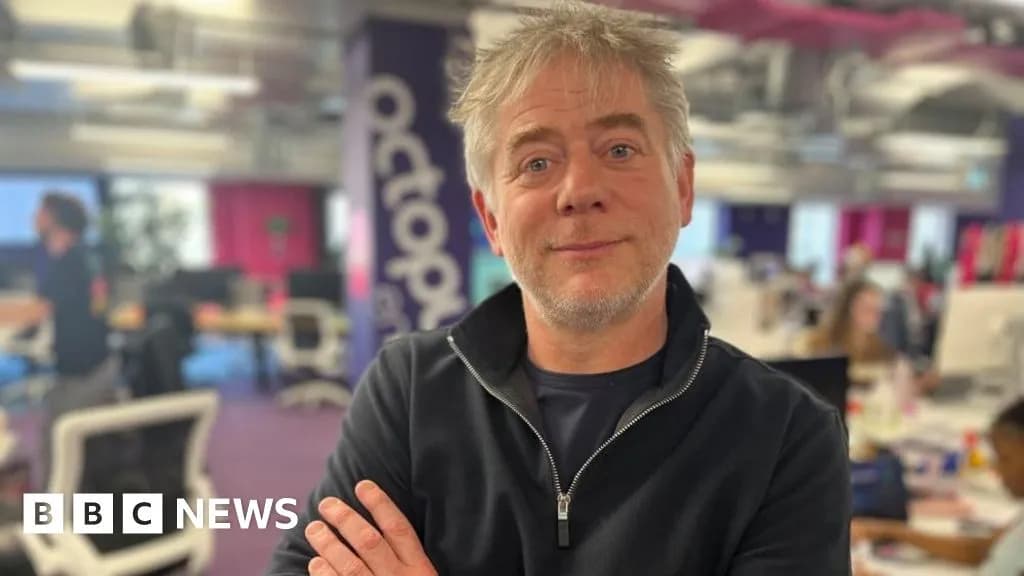
英 옥토퍼스, 이란 전쟁 이후 태양광 판매 50% 증가
이란 전쟁 이후 영국 옥토퍼스의 태양광 판매량 50% 증가
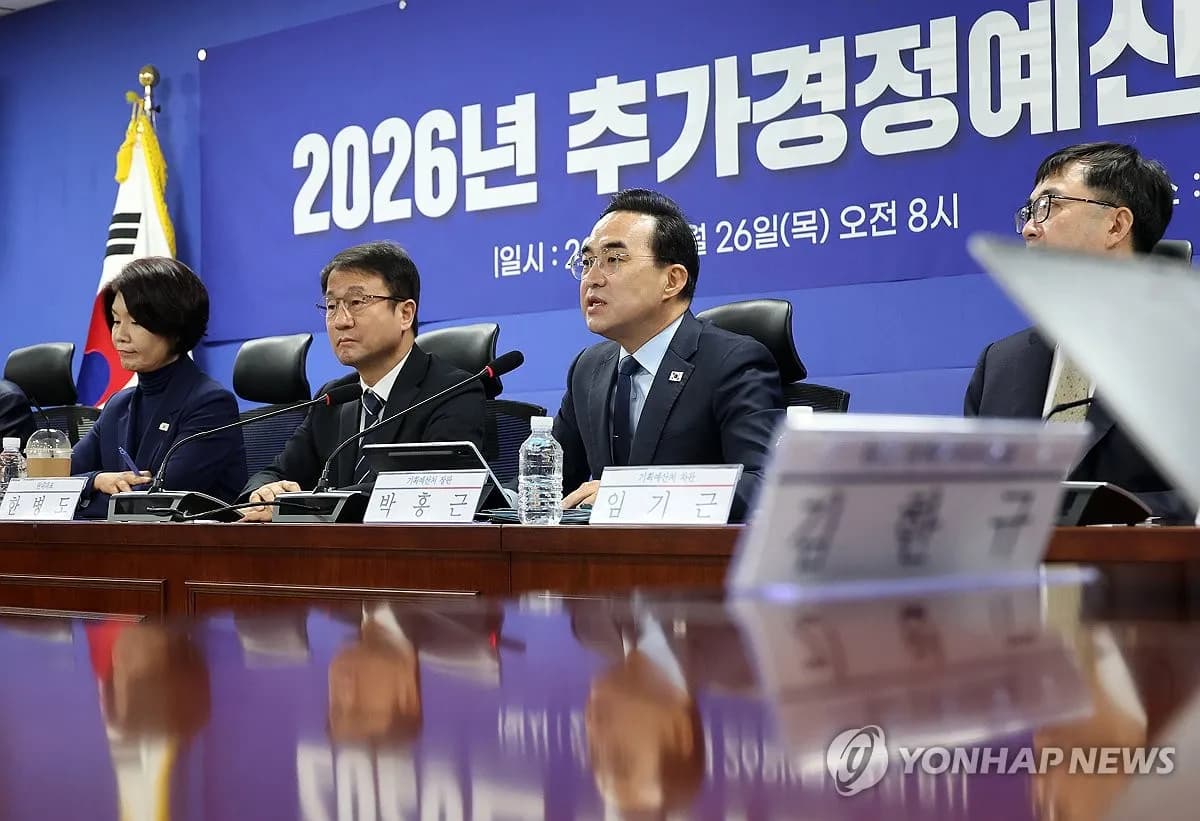
당정 "추경, 지방·취약계층에 더 지원되는 방식으로"
당정이 지방자치단체와 취약계층 중심의 추경 편성 방침 재확인
당정, 석유 최고가격제 손실 보전을 추경에 반영키로
당정이 석유 최고가격제 손실을 추경에 반영하기로 결정
어머니 폭행하고 금팔찌 빼앗은 30대 아들 경찰에 붙잡혀
어머니 폭행 후 금팔찌 빼앗은 30대 남성 체포

아이티 갱단 폭력사태로 10개월간 5천명 이상 사망
아이티에서 지난 10개월간 갱단 폭력으로 5천명 이상 사망
서방 정보당국 "러시아, 우크라이나 전쟁 후 이란에 드론·식량 공급"
서방 정보당국, 러시아의 이란 드론·식량 공급 작업 거의 완료 파악

6년 전 세 살 딸 살해한 30대 친모 구속송치
경찰, 6년 전 세 살 딸 살해 혐의 30대 친모를 구속송치