Hugging Face Releases TRL v1.0: A Post-Training Library Built to Evolve with the Field
Six years of iteration, 75+ methods, and 3 million monthly downloads mark the shift from research codebase to production infrastructure
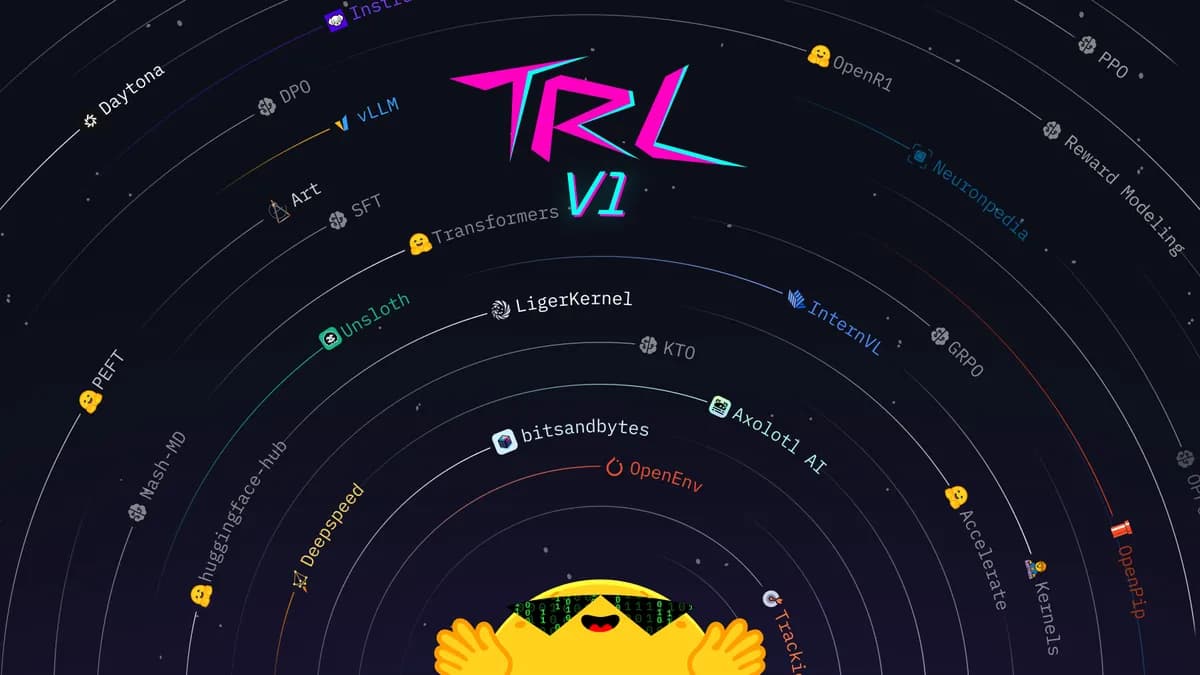
- •Hugging Face released TRL v1.0 after 6 years of development, now supporting 75+ post-training methods.
- •With 3 million monthly downloads, TRL has become critical infrastructure for projects like Unsloth and Axolotl.
- •Its 'chaos-adaptive' design philosophy — built to survive paradigm shifts from PPO to DPO to RLVR — is the defining feature of v1.0.
Hugging Face Launches TRL v1.0, Declaring Production-Grade Status for Post-Training
Hugging Face has officially released TRL v1.0, a major milestone for its large language model (LLM) post-training library. More than six years after the first commit, TRL now supports over 75 post-training methods and records 3 million downloads per month. With v1.0, the project formally transitions from a research codebase to a stable, production-grade library. "This isn't just a version bump," Hugging Face stated. "It reflects the reality that TRL now powers production systems, and embraces that responsibility."
Why It Matters: Post-Training Becomes Infrastructure
The significance of TRL v1.0 goes beyond a feature update. It signals that post-training — the core technology behind modern AI services like ChatGPT — has matured from experimental research into industry-standard infrastructure.
Major downstream projects with thousands of users, including Unsloth and Axolotl, have built directly on top of TRL's trainers and APIs. This means any change in TRL propagates instantly across the entire ecosystem. A renamed argument, a shifted default, a restructured output — any of these can become someone else's incident.
Hugging Face acknowledged: "TRL didn't make a deliberate decision to become a library. It found out it already was one." v1.0 is the moment TRL officially accepts that weight.
The Historical Arc of Post-Training Methods
Understanding the paradigm shifts that shaped TRL is key to grasping its v1.0 design philosophy.
PPO Era (2017–2022): Schulman et al.'s PPO (Proximal Policy Optimization) and Ziegler et al.'s application to LLMs established a canonical architecture: a policy model, a reference model, a learned reward model, sampled rollouts, and an RL loop.
DPO Revolution (2023): Rafailov et al.'s DPO (Direct Preference Optimization) dismantled this stack. Preference optimization worked without a separate reward model, value model, or online RL. Components that had seemed fundamental became optional. ORPO and KTO followed suit.
RLVR Era (2024–present): On tasks like math, code, and tool use, GRPO (Shao et al.) brought back sampling and rollouts — but rewards now come from verifiers or deterministic checks rather than learned models. The loop returned, but in a different shape.
The lesson is not just that methods change. The definition of the core changes with them. Strong assumptions have a short half-life.
What Changed: Before and After v1.0
| Aspect | TRL v0.x | TRL v1.0 | Change |
|---|---|---|---|
| Supported methods | Limited | 75+ | Major expansion |
| Stability contract | Research codebase | Production library | Official stability guarantee |
| API compatibility | Frequent breaking changes | Backward compatibility prioritized | Ecosystem stability |
| Design philosophy | Algorithm-centric | Chaos-adaptive | Paradigm-shift resilient |
| Monthly downloads | Early stage | 3 million | Infrastructure scale |
| Reward model handling | Fixed PPO abstraction | Flexible verifier support | RLVR-ready |
Chaos-Adaptive Design: TRL's Core Philosophy
The heart of TRL v1.0 is not its feature list — it's the design philosophy. Hugging Face focused not on "how to design the perfect abstraction" but on "how to make stable software in a domain that keeps invalidating its own assumptions."
Reward models illustrate why: essential in PPO, eliminated in DPO, and resurrected as verifiers in RLVR — structures that could be deterministic functions rather than learned models. Any abstraction built around their original form would have been obsolete twice over. TRL's survival depends on recognizing that strong assumptions have a short life, and making changeability central to how the codebase is organized.
The design was not decided upfront. It is the result of years of iteration — shaped by every algorithm, every model, and every shifting paradigm the field produced.
[Expert Analysis] What Comes Next
The TRL v1.0 release carries several important implications for the AI post-training ecosystem.
First, open-source post-training infrastructure is likely entering a maturity phase. With 3 million monthly downloads and critical dependencies from projects like Unsloth and Axolotl, TRL has become a de facto standard — extending Hugging Face's influence from the model hub into the training infrastructure layer.
Second, the rapid evolution of post-training methods is likely to continue. As RLVR, Constitutional AI, and synthetic-data-based training approaches keep emerging, TRL's chaos-adaptive architecture may prove to be a durable competitive advantage.
Third, maintaining backward compatibility will improve ecosystem stability, but balancing it with rapid innovation remains an open challenge. Managing the boundary between experimental research features and production-level stability is likely to be TRL's next defining test. v1.0 declared the shift from code to contract — the next question is how long that contract can hold.
댓글 (23)
Hugging의 향후 전망이 궁금합니다.
매일 여기서 뉴스 보고 있어요.
유익한 기사네요.
요즘 이 매체 기사가 제일 읽기 좋아요.
이런 시각도 있었군요. LLM 관련 해외 동향도 궁금합니다.
이런 시각도 있었군요. Hugging의 전문가 코멘트가 설득력 있었습니다. 후속 기사 부탁드립니다.
Face 관련 통계가 의외였습니다. 다른 시각의 분석도 읽어보고 싶습니다.
좋은 정리입니다. Releases 관련 용어 설명이 친절해서 좋았습니다.
흥미로운 주제입니다. TRL 관련 배경 설명이 이해하기 쉬웠습니다.
LLM에 대해 처음 접하는 정보가 있었습니다. 주변에도 공유해야겠어요.
Hugging이 앞으로 어떻게 전개될지 주목해야겠습니다.
몰랐던 사실을 알게 됐습니다. Face 주제로 시리즈 기사가 나오면 좋겠습니다.
기사 퀄리티가 좋습니다.
TRL 관련 용어 설명이 친절해서 좋았습니다. 좋은 기사 감사합니다.
깔끔한 기사입니다. LLM의 전문가 코멘트가 설득력 있었습니다.
이런 시각도 있었군요. Hugging에 대해 처음 접하는 정보가 있었습니다.
출퇴근길에 항상 읽고 있습니다.
몰랐던 사실을 알게 됐습니다. Releases이 일상에 어떤 영향을 줄지 생각해보게 됩니다. 생각이 바뀌었습니다.
TRL 주제로 시리즈 기사가 나오면 좋겠습니다.
LLM에 대해 처음 접하는 정보가 있었습니다.
Hugging 관련 통계가 의외였습니다.
Face에 대해 더 알고 싶어졌습니다. 잘 정리된 기사네요.
참고가 됩니다. Releases 관련 해외 동향도 궁금합니다. 잘 정리된 기사네요.
More in this series
More in AI & Tech

애플 맥북 네오 4월 물량 완판...신규 주문 5월로 밀려
OpenAI Launches GPT-Rosalind, Specialized Reasoning AI for Life Sciences... Shaking Up Drug Development Paradigm

EU Begins Direct Talks with Anthropic Over Claude Mythos AI Cybersecurity Threats

Perplexity Officially Launches Mac-Exclusive AI Agent 'Personal Computer'
Global Financial Authorities Launch Coordinated Emergency Response to Anthropic's 'Mythos' AI Cyber Threat

Anthropic Secures 800-Person London Office...Building European Foothold Amid Pentagon Conflict
Latest News

ICIJ Exposes Merck's Keytruda Pricing Strategy and Patent Abuse
ICIJ's Cancer Calculus investigation exposes Merck's Keytruda pricing and patent strategies.

Israel-Lebanon 10-Day Ceasefire Takes Effect; UN Hopes It Opens Path to Talks
A 10-day Israel-Lebanon ceasefire took effect at midnight on April 17.
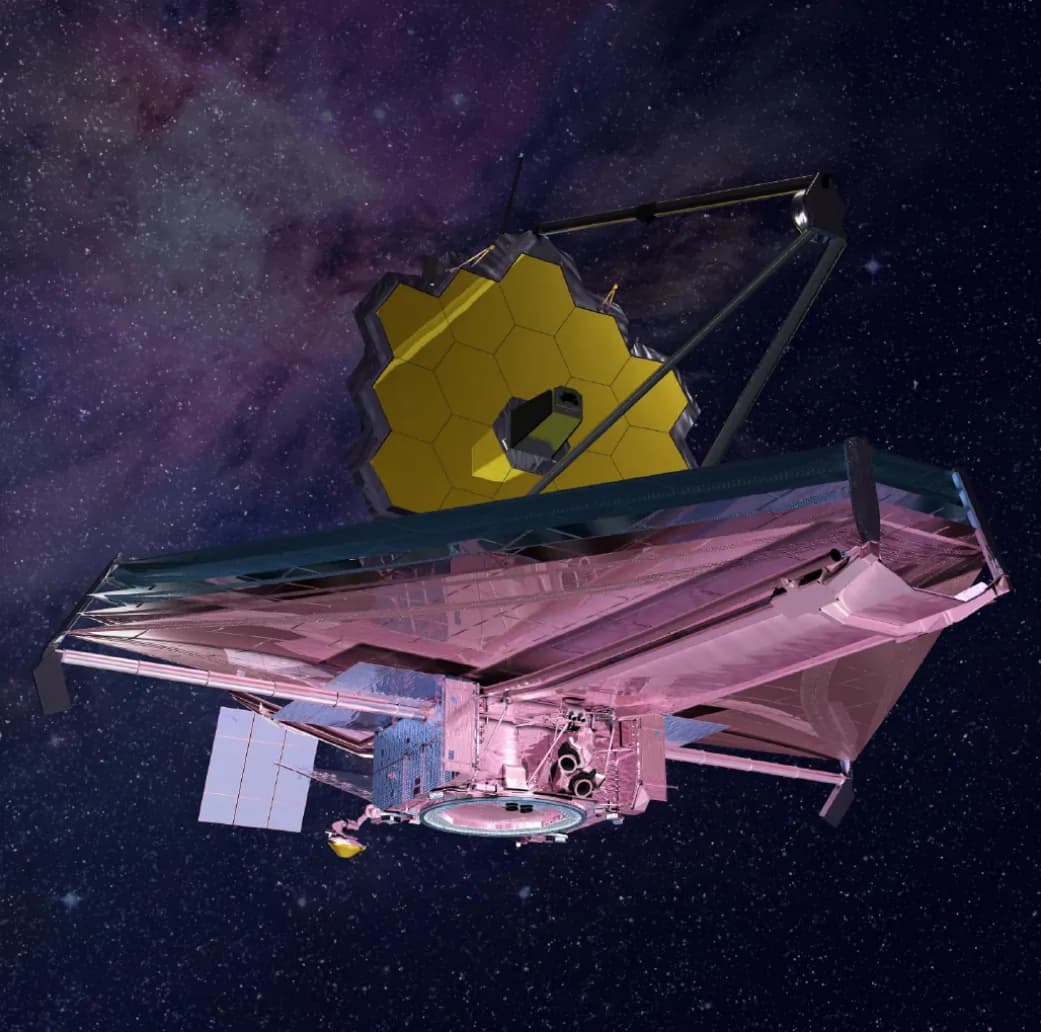
JWST, 성간 혜성 3I/ATLAS에서 메테인 최초 검출…외계 행성계 단서 포착
JWST가 성간 혜성 3I/ATLAS에서 메테인을 최초 직접 검출, 외계 행성계 내부 조성 단서 확보.

IMF Resumes Relations with Venezuela After 7 Years...Hopes for $4.9 Billion Frozen SDR Release
The IMF has resumed official relations with Venezuela after 7 years of suspension since 2019.
America's Political Cartoonists Capture the Week in Washington
Political cartoonists across the U.S. document the era through weekly satire.

IMF Resumes Relations with Venezuela After 7 Years...Possibility of Unfreezing $4.9 Billion
The IMF decided to resume official cooperation with Venezuela after seven years.

When the Jungle Swallowed Concrete: The Paradox of London's Barbican Conservatory
Photographer Altrath captures the spatial paradox of London's Barbican Conservatory in a new series.

Record-High Current Account Surplus, Yet Why is the Won Weakening?
Bank of Korea officially analyzes structural causes of continued won depreciation despite current account surplus.