US Attack on Iran Imminent: What Are Iran's Retaliatory Options?
US Carrier Strike Group Deployed to Middle East as Iran Prepares 2,000 Missiles and Drones
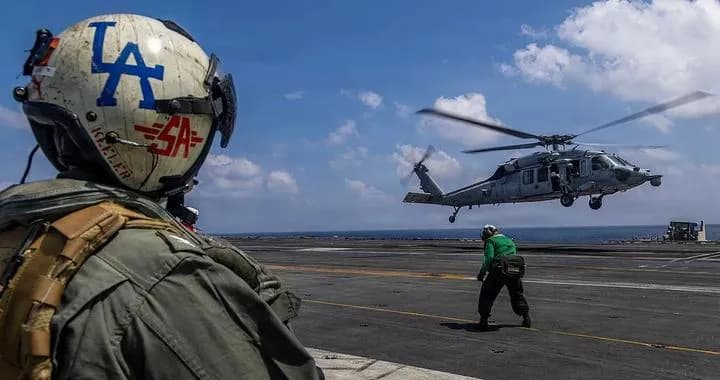
- •The US is reviewing various military strike options against Iran, including large-scale bombing operations targeting the regime and Revolutionary Guard facilities, with carrier strike groups and fighter aircraft fully deployed to the Middle East.
- •Iran possesses approximately 2,000 medium- to long-range ballistic missiles and 1,000 strategic drones, with the capability to severely impact global energy markets through a Strait of Hormuz blockade.
- •US interceptor missile shortages and military bases dispersed across the Middle East are identified as vulnerabilities, with South Korea expected to face direct impacts on energy supply and trade if the conflict escalates.
US Develops Large-Scale Air Strike Plans Against Iran
The Trump administration is escalating its military involvement with Iran. The USS Abraham Lincoln carrier strike group has already been deployed to the Middle East, and significant combat aircraft reinforcements are in place.
According to Xinhua News Agency, citing anonymous US officials, President Trump is reviewing various military strike options against Iran. These options include large-scale bombing operations targeting the Iranian regime and Revolutionary Guard facilities, with provisions to intensify strikes if Iran does not halt its nuclear program.
Additional multilayered pressure tactics being discussed include cyber attacks on Iran's banking system and further sanctions against the government.
Iran's Response Capabilities: 2,000 Missiles
Despite the military power disparity, Iran possesses its own means of retaliation. According to The Wall Street Journal, Iran currently maintains approximately 2,000 medium- to long-range ballistic missiles capable of striking Israel. It also has secured numerous short-range missiles that can attack US military bases in the Persian Gulf region.
Although 70% of Iran's launch facilities were destroyed during the "12-Day War" in June last year, the country has rapidly rebuilt. Jin Liangxiang, director of the Middle East Research Center at the Shanghai Institute for International Studies, noted that "Iran has improved its launch methods to fire missiles directly from cave-based launch sites," adding that "this eliminates the vulnerability of being exposed while deploying launchers as in the past."
Ali Shamkhani, political advisor to Iran's Supreme Leader Khamenei, warned via social media on the 28th that "if the US takes military action, Iran will immediately retaliate and strike key Israeli areas." Following orders from Iranian Armed Forces Commander-in-Chief Khatami, 1,000 strategic drones were officially integrated into operational formations on the 29th.
America's Greatest Weakness: Interceptor Missile Shortage
Although the US has deployed substantial Patriot and THAAD missile defense systems in the Middle East, experts point out that the defense coverage area is too vast for complete protection. Farzin Nadimi, senior fellow at The Washington Institute for Near East Policy, predicted that "a significant number of missiles could hit their targets."
The "12-Day War" demonstrated Iran's ability to rapidly deplete Israeli and American interceptor missiles through saturation attacks. The Wall Street Journal analyzed that "the difficulty in replenishing interceptor missiles means the US and Israel will face painful choices if the war continues."
Dana Stroul, former Deputy Assistant Secretary of Defense for Middle East Policy during the Biden administration, expressed concern that "Iran's short-range missiles alone could inflict massive damage on US bases in the Gulf region," adding that "the scale would be difficult for the US and Gulf Arab countries to counter."
According to Council on Foreign Relations data, the US operates about 20 ground military bases in the Middle East with approximately 40,000 troops deployed. Secretary of State Rubio stated on the 28th that "30,000 to 40,000 US troops are stationed at 8 to 9 bases within range of Iranian missiles."
Possibility of Strait of Hormuz Blockade
Another retaliatory option for Iran is blockading the Strait of Hormuz. CNN analyzed that if Iran closes this strait, it would severely impact global oil markets.
Retired Lieutenant General Robert Howard, former Deputy Commander of US Central Command, warned that "asymmetric tactics including mines and drones would pose serious threats to shipping and oil transportation." Omid Shokri, visiting scholar at George Mason University, emphasized that "strait blockade is one of Iran's most effective retaliatory means," stating it "could lead to international oil price spikes, supply chain disruptions, and intensified global inflation, potentially triggering a global economic recession."
According to public data, approximately 20% of the world's liquefied natural gas (LNG) exports and 20-25% of oil and petroleum products pass through this strait.
The Islamic Revolutionary Guard Corps Navy announced on the 29th plans to conduct live-fire exercises in the Strait of Hormuz on February 1-2. The BBC reported that "the Revolutionary Guard Navy is skilled in asymmetric warfare and has the capability to launch saturation attacks on US warships with large numbers of drones and high-speed torpedo boats."
Iran's Middle East Alliance Network
Although Iran's Middle Eastern allied forces have significantly weakened over the past two years, they still retain the ability to influence regional affairs. The Hezbollah Brigades under Iraq's paramilitary Popular Mobilization Forces and Lebanon's Hezbollah stated this week that they would "provide support if Iran comes under military attack." Yemen's Houthi rebels also have the capability to attack US targets in Saudi Arabia and the United Arab Emirates.
Farzin Nadimi of The Washington Institute for Near East Policy analyzed that "if Iran views this war as an existential threat, it will employ all available means," adding that "the next war is more likely to occur in the Strait of Hormuz and Persian Gulf region rather than in downtown Tehran."
Impact on South Korea
South Korea imports a substantial portion of its crude oil from the Middle East, making it vulnerable to direct impact in the event of a Strait of Hormuz blockade or regional full-scale war. International oil price spikes would create inflationary pressure on the Korean economy and impose cost increases across the petrochemical, transportation, and manufacturing sectors.
Disruptions are also inevitable for Middle Eastern construction projects and trade involving Korean companies. The government must review energy supply stabilization measures along with protection plans for Korean nationals abroad.
Future Outlook [AI Analysis]
Experts emphasize that the threat facing Iran is far greater than that facing the US and its allies. During the "12-Day War," Israel destroyed most of Iran's air defense systems and secured air superiority on the first day of conflict. In this situation, Israeli fighter jets could operate freely and strike Iranian ground targets, significantly limiting Iran's retaliatory capabilities.
Jin Liangxiang of the Shanghai Institute for International Studies stated that "Trump's achievements in Venezuela and Israel's victory in the '12-Day War' are factors encouraging US-Israeli military adventurism," adding that "if Trump actually attacks Iran, the outcome is difficult to predict."
Military experts analyze that if the US attacks Iran, even if seeking a short decisive battle, escalation to a regional full-scale war is highly likely. Iran's asymmetric capabilities and alliance network could prolong the conflict, potentially serving as a long-term destabilizing factor for the global economy and energy markets.
댓글 (3)
팩트에 기반한 냉정한 판단이 필요한 시점입니다.
Attack 문제는 양쪽 입장을 모두 들어봐야 할 것 같습니다.
중요한 포인트를 짚으셨네요.
More in Global


Latest News

Middle East Conflict Drives Manufacturing Outlook to 10-Month Low
The Korea Institute for Industrial Economics & Trade survey shows April manufacturing outlook PSI plummeted to 88, falling below baseline for the first time in 10 months.

Lee Jae-myung Administration Excludes Multi-Home Officials from Real Estate Policymaking
President Lee Jae-myung has ordered the exclusion of multi-home owning public officials from all real estate policy processes.

Volkswagen CEO Says Germany Should Learn from China's Industrial Strategy
Volkswagen CEO stated that Germany should learn from China's systematic industrial planning approach.

Reddit Considers Face ID to Block Bots While Maintaining Anonymity
Reddit is considering implementing biometric authentication systems such as Face ID and Touch ID to block AI bots while maintaining anonymity.

BTS Tops March Artist Brand Reputation Rankings with First Full Group Comeback in 4 Years
BTS ranked first in the Korean Corporate Reputation Research Institute's March Artist Brand Reputation Rankings based on 99 million data points.

Santo Domingo's Malecón Sports Park Construction Progressing Smoothly
Construction of a soccer field and skate park is progressing smoothly in the Malecón area of Santo Domingo, Dominican Republic.

Pogačar Overcomes Crash to Win Milano-Sanremo, Achieves Four Monument Victories
Tadej Pogačar defeated Tom Pidcock to win Milano-Sanremo, achieving his fourth Monument victory.
BTS's New Album 'ARIRANG' Sweeps Spotify Global Chart Positions 1-14
BTS's new album 'ARIRANG' monopolized Spotify Global Chart positions 1-14 on its first day, establishing the largest album debut record in K-POP history.