Why Greenland Has Become the Epicenter of NATO's Greatest Crisis
Trump's 'Greenland Handover' Demand Creates Worst Rift in 70-Year History of Western Alliance
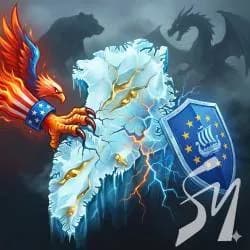
- •On January 14, 2026, President Trump demanded Denmark immediately relinquish Greenland, triggering the greatest crisis in NATO history.
- •The White House and Europe engaged in an illustration war as ideological confrontation intensified, with Denmark responding with military measures.
- •The backdrop involves U.S.-Russia-China competition over Arctic resources and routes, with implications for South Korea regarding alliance credibility, shipping, and rare earth supply chains.
January 2026: A Historic Fracture in the Western Alliance
In mid-January 2026, an event occurred that would mark a watershed moment in world diplomatic history. It was the deepest division the Western world had experienced since the end of World War II. What had been dismissed as election rhetoric or a geopolitical bargaining chip escalated into a full-blown crisis, threatening the territorial integrity of Europe and the very stability of the North Atlantic Treaty Organization (NATO).
Greenland — the world's largest island, 80% covered by permanent ice sheets — suddenly became the center of the most acute diplomatic and military standoff within the Western world.
January 14: Trump's Ultimatum
The crisis reached its peak on January 14, 2026. U.S. President Donald Trump posted what amounted to an ultimatum on his social media platform Truth Social. He demanded that Denmark "leave immediately" from Greenland, asserting that only the United States could guarantee control and security in the Arctic region.
Trump cited the growing threat from Russia and China in the Arctic as his justification. In his characteristically blunt tone, he appealed directly to NATO leadership.
"NATO, tell Denmark to get out of there right now! Two dog sleds won't cut it. Only America can do this."
This statement was based on Danish intelligence assessments regarding Moscow's and Beijing's increased interest in Greenland and the Arctic region. However, the manner in which he demanded an ally withdraw from its own territory sent shockwaves through European capitals. Trump emphasized that no option other than U.S. control of Greenland would be acceptable.
The Illustration War: "Which Way, Greenland Man?"
Simultaneously with the political statements, a massive ideological "picture war" unfolded. The official White House account posted an image titled "Which way, Greenland man?" — a stark contrast structure.
On the left: the White House bathed in bright sunshine with the American flag waving — symbols of protection and prosperity. On the right: an ominous storm zone with purple lightning, showing the Kremlin and Great Wall with Russian and Chinese flags flying above. In the center of the composition: two dog sleds bearing Greenland's flag standing on snow before a crossroads signpost.
The European community's response was immediate. In a re-edited version, the "bright side" featured Danish and European Union flags against a Copenhagen backdrop with its symbolic Little Mermaid statue and seascape. The United States was moved to the "dark side" — the storm and lightning zone, placed on the same line as Russia and China. It was a clear signal: Europe now perceived Washington's policies as undermining world order just as much as authoritarian regimes.
Copenhagen's Military Response
Denmark responded immediately. According to multiple foreign media reports, the Danish government took military action, including deploying military aircraft over Nuuk, Greenland's capital. This was not merely a symbolic gesture but a substantive action demonstrating firm resolve regarding its territorial sovereignty.
Historical Context: The Lineage of Arctic Competition
The conflict over Greenland did not emerge suddenly. The Arctic region has been a geopolitical battleground for the past two decades.
Early 2000s: Climate change melted Arctic ice, opening new maritime routes and access to natural resources. Russia actively asserted territorial claims, including planting a titanium flag on the Arctic Ocean continental shelf.
2010s: China declared itself a "near-Arctic state" and announced its "Polar Silk Road" initiative. Chinese investment attempts in Greenland's rare earth mineral resources triggered Western vigilance.
2019: During Trump's first administration, he first expressed interest in purchasing Greenland, but Denmark's immediate rejection ended the matter. While it ended in controversy at the time, it signaled the beginning of serious U.S. strategic interest.
Mid-2020s: Following Russia's invasion of Ukraine, Arctic militarization accelerated. Russia rebuilt military bases along Arctic routes and deployed icebreakers and nuclear submarines.
Within this trajectory, the 2026 crisis is not merely a diplomatic faux pas but the explosion of structurally accumulated tensions.
Impact on South Korea
This crisis is not unrelated to the Korean Peninsula. First, the credibility of the ROK-U.S. alliance. The situation where the United States pressures NATO ally Denmark to cede territory raises questions about the reliability of security commitments. The South Korean government must consider concerns that U.S. extended deterrence commitments could become subjects of political bargaining at any time.
Second, the Arctic route economy. South Korea is the world's fifth-largest shipping nation and a major shipbuilding country. Full utilization of Arctic routes would shorten Asia-Europe maritime transport distances by 40%. Military tensions in waters around Greenland directly affect the safety and commercial viability of these routes.
Third, rare earth supply chains. Greenland is one of the world's largest rare earth repositories, containing resources essential for South Korea's semiconductor and battery industries. Political instability in this region demands reconsideration of supply chain diversification strategies.
Future Outlook [AI Analysis]
The current crisis will likely develop along one of three scenarios.
Scenario 1: Diplomatic Compromise — A solution where the U.S. gains expanded military bases in Greenland and leadership in Arctic defense in exchange for formally recognizing Danish sovereignty. This is the most realistic option, but difficult given the Trump administration's hardline stance.
Scenario 2: Deepening NATO Division — European countries may react to U.S. unilateralism by strengthening independent defense systems. This could realize the "strategic autonomy" advocated by French President Macron.
Scenario 3: Escalating Military Tensions — In the worst case, military standoffs between allies could lead to actual conflict. This would be unprecedented in NATO history.
Whichever path is taken, Western alliance cohesion has already been seriously damaged. The fundamental premise of NATO maintained for 77 years since its 1949 founding — mutual respect for territorial integrity among member states — faces fundamental challenge. This is likely a historical turning point where the foundation of the postwar international order is shaken, not merely an issue confined to the Arctic region.
댓글 (3)
이 위기를 어떻게 극복할 수 있을지 전문가 의견이 더 필요합니다.
경제 상황이 좋지 않은데, 정부의 대응이 아쉽습니다.
불안한 시기에 정확한 보도가 중요합니다. 좋은 기사 감사합니다.
More in Global


Latest News

Middle East Conflict Drives Manufacturing Outlook to 10-Month Low
The Korea Institute for Industrial Economics & Trade survey shows April manufacturing outlook PSI plummeted to 88, falling below baseline for the first time in 10 months.

Lee Jae-myung Administration Excludes Multi-Home Officials from Real Estate Policymaking
President Lee Jae-myung has ordered the exclusion of multi-home owning public officials from all real estate policy processes.

Volkswagen CEO Says Germany Should Learn from China's Industrial Strategy
Volkswagen CEO stated that Germany should learn from China's systematic industrial planning approach.

Reddit Considers Face ID to Block Bots While Maintaining Anonymity
Reddit is considering implementing biometric authentication systems such as Face ID and Touch ID to block AI bots while maintaining anonymity.
BTS Tops March Artist Brand Reputation Rankings with First Full Group Comeback in 4 Years
BTS ranked first in the Korean Corporate Reputation Research Institute's March Artist Brand Reputation Rankings based on 99 million data points.
Santo Domingo's Malecón Sports Park Construction Progressing Smoothly
Construction of a soccer field and skate park is progressing smoothly in the Malecón area of Santo Domingo, Dominican Republic.
Pogačar Overcomes Crash to Win Milano-Sanremo, Achieves Four Monument Victories
Tadej Pogačar defeated Tom Pidcock to win Milano-Sanremo, achieving his fourth Monument victory.
BTS's New Album 'ARIRANG' Sweeps Spotify Global Chart Positions 1-14
BTS's new album 'ARIRANG' monopolized Spotify Global Chart positions 1-14 on its first day, establishing the largest album debut record in K-POP history.