Iran Declares Direct Attacks on U.S. Civilians... International Condemnation Spreads
Tehran State TV Warns 'All Americans in Region Are Targets,' Hints at Retaliation for Nuclear Facility Strike
- •Iran publicly declared through state television that it would target all U.S. civilians in the Middle East.
- •This represents an unprecedented threat to civilians under international law, signaling retaliation for the U.S. strike on Iranian nuclear facilities.
- •The 15,000 Korean nationals in the Middle East region are also exposed to indirect danger, prompting the Ministry of Foreign Affairs to urge caution.
Tehran's Unprecedented Declaration
On June 22, 2025, the Iranian government publicly declared through state television that "all U.S. citizens and military personnel in the region are now targets." This is not diplomatic rhetoric or veiled suggestion, but a direct threat against civilians that has sent shockwaves through the international community.
The announcement came just hours after a U.S.-led coalition struck key portions of Iran's nuclear facilities. While the U.S. stated it was an unavoidable measure to prevent Iran's nuclear armament, Tehran made clear its position to retaliate against not only military personnel but civilians as well.
Impact on South Korea
Iran's statement has direct implications for South Korea. With approximately 15,000 Korean nationals and business personnel residing in the Middle East, citizens of U.S. allied nations could also be exposed to indirect danger.
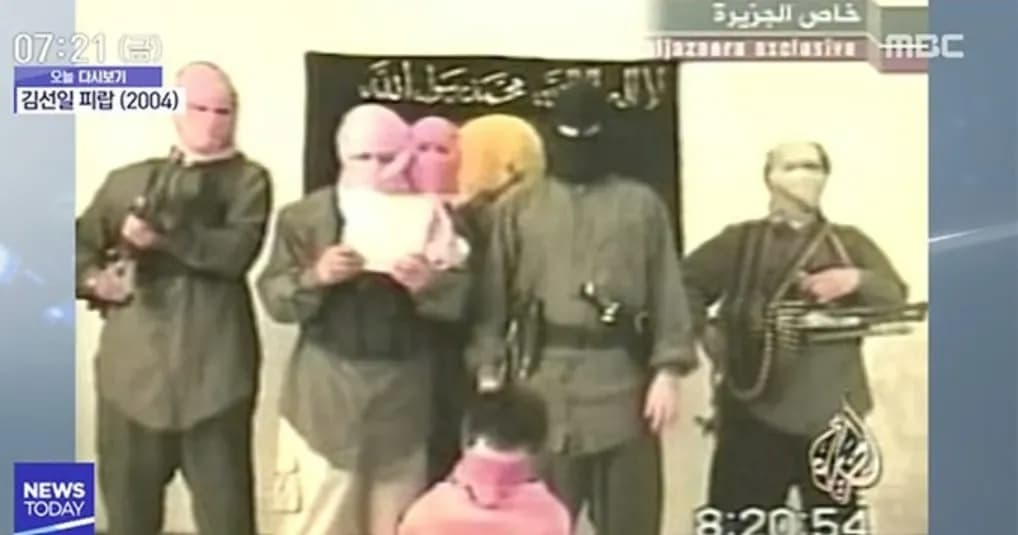
The 2004 killing of Kim Sun-il by Al-Qaeda-linked extremist forces in Iraq serves as a reminder that Koreans are not safe from harm in the Middle East region. As Saudi Crown Prince Mohammed bin Salman acknowledged, the spread of radical ideology following Iran's 1979 Revolution has endangered innocent civilians regardless of their country's alliance status.
The Ministry of Foreign Affairs is currently urging Korean residents in the Middle East to exercise extreme caution while reviewing upgrades to travel advisories.
A History of Terror as State Strategy
Iran's latest statement is not new. Since the 1979 Islamic Revolution, the Tehran regime has utilized terrorism as a core tool of foreign policy.
Key Cases:
- 1979: U.S. Embassy hostage crisis (52 people held for 444 days)
- 1983: Beirut U.S. Marine barracks bombing (241 deaths)
- 2000s-Present: Ongoing proxy attacks against U.S. forces in Iraq and Syria
Iran has maintained continuous threats through proxy organizations like Hezbollah and Hamas while avoiding direct military confrontation. Some have interpreted Iran's aggression as merely reactive or strategic, but this declaration of intent to kill civilians completely eliminates such interpretive leeway.
International Legal Implications and Precedent
It is extremely rare in international law for a sovereign state to publicly designate another nation's civilians as targets. The Geneva Conventions clearly define intentional attacks on non-combatants as war crimes.
International law experts point out that Iran's statement goes beyond threats to constitute explicit criminal intent. This could serve as grounds for referral to the International Criminal Court (ICC) or strengthened UN Security Council sanctions.
Comparative Cases:
- While North Korea has made belligerent statements toward the U.S., it has never directly designated specific civilian groups as targets
- Russia has officially denied targeting civilians even during the Ukraine war
Iran's declaration is assessed to have broken even these implicit boundaries.
Shifts in Regional Security Landscape
Iran's threats are heightening tensions throughout the Middle East. Tens of thousands of U.S. civilians currently reside in the region, and they now face direct threats.
Major Areas of Concern:
- Iraq, Syria: Active Iranian-backed militia operations
- Lebanon: Strengthening Hezbollah influence
- Yemen: Houthi rebels' proven attack capabilities
- Persian Gulf coastal states: Numerous U.S. corporate and military facilities
The U.S. State Department has already advised Americans in the region to evacuate immediately, and allied nations are urgently reviewing measures to protect their citizens.
Future Outlook [AI Analysis]
Iran's declaration is likely to produce three short-term outcomes.
First, intensified Western pressure on Iran. Threats against civilians provide justification for even European nations to join in strengthening economic sanctions. China and Russia may also refrain from defending Iran in the face of international pressure.
Second, the possibility of increased proxy attacks in the region. Since Iran lacks the capacity to sustain direct warfare, it is expected to intensify asymmetric attacks through Hezbollah, Iraqi militias, and other proxies.
Third, shifts in Iran's internal political dynamics. While hardline statements may rally domestic support, international isolation and economic deterioration could burden the regime long-term.
The South Korean government is expected to focus on strengthening protection for nationals in the region while securing Korean safety through diplomatic coordination with the U.S. and Middle Eastern nations. Simultaneously, there is a need to review mid- to long-term strategies to reduce dependence on the Middle East from an energy security perspective.
댓글 (3)
이런 일이 다시는 반복되지 않았으면 합니다. Iran 관련 대책이 시급합니다.
이런 비극이 일어나지 않도록 사회 전체가 경각심을 가져야 합니다.
너무 슬픈 소식이네요. 피해자 분들과 가족에게 위로를 보냅니다.
More in Global


Latest News

Middle East Conflict Drives Manufacturing Outlook to 10-Month Low
The Korea Institute for Industrial Economics & Trade survey shows April manufacturing outlook PSI plummeted to 88, falling below baseline for the first time in 10 months.

Lee Jae-myung Administration Excludes Multi-Home Officials from Real Estate Policymaking
President Lee Jae-myung has ordered the exclusion of multi-home owning public officials from all real estate policy processes.

Volkswagen CEO Says Germany Should Learn from China's Industrial Strategy
Volkswagen CEO stated that Germany should learn from China's systematic industrial planning approach.

Reddit Considers Face ID to Block Bots While Maintaining Anonymity
Reddit is considering implementing biometric authentication systems such as Face ID and Touch ID to block AI bots while maintaining anonymity.
BTS Tops March Artist Brand Reputation Rankings with First Full Group Comeback in 4 Years
BTS ranked first in the Korean Corporate Reputation Research Institute's March Artist Brand Reputation Rankings based on 99 million data points.

Santo Domingo's Malecón Sports Park Construction Progressing Smoothly
Construction of a soccer field and skate park is progressing smoothly in the Malecón area of Santo Domingo, Dominican Republic.

Pogačar Overcomes Crash to Win Milano-Sanremo, Achieves Four Monument Victories
Tadej Pogačar defeated Tom Pidcock to win Milano-Sanremo, achieving his fourth Monument victory.
BTS's New Album 'ARIRANG' Sweeps Spotify Global Chart Positions 1-14
BTS's new album 'ARIRANG' monopolized Spotify Global Chart positions 1-14 on its first day, establishing the largest album debut record in K-POP history.