India-Arab Summit Agrees to Double Trade by 2030
Joint Declaration Condemns Pahalgam Terror While Reaffirming Palestinian Support
- •India and the Arab League agreed to double trade to $500 billion by 2030, with enhanced cooperation in space, agriculture, and technology.
- •A joint declaration condemned the Pahalgam terror attack while reaffirming Palestinian support, attempting diplomatic balance between security cooperation and traditional positions.
- •The establishment of a space cooperation working group and exploration of local currency settlement systems reflect global supply chain restructuring and de-dollarization trends.
India Sets $500 Billion Trade Target with Arab League
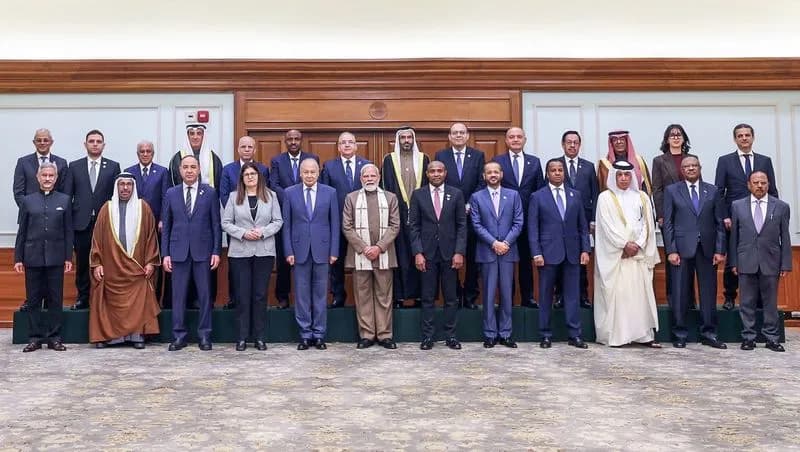
India and the Arab League have agreed to expand bilateral trade to $500 billion by 2030, doubling the current volume. At the India-Arab Foreign Ministers' Meeting held in New Delhi on the 1st (local time), Prime Minister Narendra Modi issued a joint declaration that reaffirmed support for the Palestinian people while strongly condemning the Pahalgam terrorist attack that occurred in April last year.
Current trade between India and Arab nations stands at $240 billion. To double this within six years, both sides have committed to strengthening SME cooperation, expanding investment linkages, and introducing local currency settlement systems.
Terror Condemnation and Diplomatic Balance
The joint declaration stated, "We strongly condemn the heinous terrorist attack targeting innocent Indian tourists in Pahalgam" and "reaffirm the full and unwavering support of India and Arab countries against all forms of terrorism."
Notably, the minister from Saudi Arabia, which signed a defense agreement with Pakistan last year, also attended the meeting. India is attempting diplomatic balance by maintaining relationships with Arab nations that have traditionally supported Palestine while building consensus on cross-border terrorism issues.
Blueprint for Space, Agriculture, and Technology Cooperation
Both sides have detailed cooperation across various sectors through the 'India-Arab Cooperation Forum Action Programme (2026-2028)'.
Space Cooperation
- Establishment of India-Arab Space Cooperation Working Group
- Joint remote sensing missions for climate, agriculture, urban planning, and disaster management
- Training programs for Arab scientists and engineers at Indian space research centers
- Joint incubation hubs for space technology startups
Economic and Technology Cooperation
- Strengthening cooperation between small and medium enterprises (SMEs)
- Exploration of voluntary local currency settlement systems
- Cooperation in agriculture and food security
- Expanded private sector participation in satellite development, launch, and data services
Implications for South Korea
India's moves demonstrate a new paradigm in Middle East diplomacy. It represents 'pragmatic diplomacy' that pursues security cooperation and economic interests while maintaining traditional support for Palestine.
South Korea has also been strengthening cooperation with Middle Eastern countries in energy, construction, and defense, while maintaining a cautious stance on the Palestinian-Israeli conflict. India's case suggests that an approach harmonizing diplomatic principles with practical interests is possible.
The space cooperation sector offers particular insights for Korea. The Korea Aerospace Research Institute (KARI) is pursuing lunar exploration cooperation with the United Arab Emirates (UAE), and Saudi Arabia has shown strong interest in building its own space program. The India-Arab space cooperation model provides a reference for Korea to expand space sector collaboration with Middle Eastern countries.
Future Outlook [AI Analysis]
The India-Arab trade expansion demonstrates the growing role of the Middle East in global supply chain restructuring. The introduction of local currency settlement systems aligns with the global de-dollarization trend aimed at reducing dollar dependency.
Space cooperation is expected to expand beyond simple technology sharing to data sovereignty dimensions. Arab countries need independent satellite data to address domestic challenges such as climate change, water scarcity, and desertification, and India can support this with its low-cost space launch technology.
However, the long-term sustainability of India's balanced diplomacy remains uncertain. Conflicts with Pakistan and strengthening defense cooperation with Israel could potentially impact relations with Arab countries.
댓글 (3)
India-Arab 관련 기사 잘 읽었습니다. 유익한 정보네요.
그 부분은 저도 궁금했습니다.
Summit에 대해 더 알고 싶어졌습니다. 후속 기사 부탁드립니다.
More in Global






Latest News

Middle East Conflict Drives Manufacturing Outlook to 10-Month Low
The Korea Institute for Industrial Economics & Trade survey shows April manufacturing outlook PSI plummeted to 88, falling below baseline for the first time in 10 months.

Lee Jae-myung Administration Excludes Multi-Home Officials from Real Estate Policymaking
President Lee Jae-myung has ordered the exclusion of multi-home owning public officials from all real estate policy processes.

Volkswagen CEO Says Germany Should Learn from China's Industrial Strategy
Volkswagen CEO stated that Germany should learn from China's systematic industrial planning approach.

Reddit Considers Face ID to Block Bots While Maintaining Anonymity
Reddit is considering implementing biometric authentication systems such as Face ID and Touch ID to block AI bots while maintaining anonymity.

BTS Tops March Artist Brand Reputation Rankings with First Full Group Comeback in 4 Years
BTS ranked first in the Korean Corporate Reputation Research Institute's March Artist Brand Reputation Rankings based on 99 million data points.

Santo Domingo's Malecón Sports Park Construction Progressing Smoothly
Construction of a soccer field and skate park is progressing smoothly in the Malecón area of Santo Domingo, Dominican Republic.

Pogačar Overcomes Crash to Win Milano-Sanremo, Achieves Four Monument Victories
Tadej Pogačar defeated Tom Pidcock to win Milano-Sanremo, achieving his fourth Monument victory.
BTS's New Album 'ARIRANG' Sweeps Spotify Global Chart Positions 1-14
BTS's new album 'ARIRANG' monopolized Spotify Global Chart positions 1-14 on its first day, establishing the largest album debut record in K-POP history.