Trump Administration Raises Possibility of UN Withdrawal
After exiting 66 UN bodies, pressure to relocate headquarters... Experts warn of 'fundamental rejection of international order'
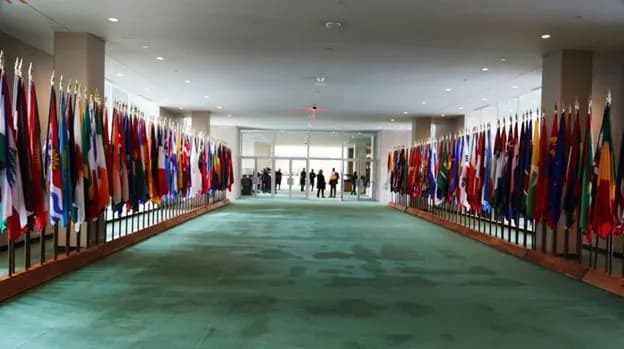
- •As the Trump administration withdraws from 66 UN bodies, experts are raising the possibility of U.S. withdrawal from the UN itself.
- •President Trump evaluates the UN as an 'outdated useless organization,' showing an attitude of rejecting the post-World War II international order itself.
- •U.S. departure from the UN could lead to a reorganization of international order, making it more difficult for South Korea to balance between the ROK-U.S. alliance and multilateral diplomacy.
How Far Will America's Mass UN Withdrawal Go?
As the Donald Trump administration has withdrawn from 66 UN agencies and international treaties, concerns are emerging that the United States may ultimately withdraw from the UN itself and pressure the relocation of its New York headquarters.
The U.S. has already withdrawn from the Human Rights Council, World Health Organization (WHO), UN Relief and Works Agency for Palestine Refugees (UNRWA), and UNESCO, while drastically cutting budget support for remaining UN bodies. Despite the UN-U.S. headquarters agreement signed in 1947, the Trump administration's unpredictable behavior makes it impossible to rule out more extreme measures.
Trump's UN Criticism Is Not Just Rhetoric
In his speech at the UN General Assembly last September, President Trump delivered sharp criticism, stating "What is the purpose of the UN? It's not even close to its potential." He dismissed the UN as outdated and useless, saying "I ended seven wars and negotiated with world leaders, but I never once received an offer of help from the UN."
Professor Stephen Zunes of the University of San Francisco's Political Science Department analyzed: "While past Reagan and Bush administrations were critical of the UN, they recognized the importance of the UN system for American interests. However, the Trump administration appears to be rejecting the entire international legal framework established after World War II."
Particularly following recent statements after the Venezuela attack, he warned these reflect "a return to 19th-century imperialist privilege," adding "with this attitude, we cannot rule out the possibility that the U.S. might actually withdraw from the UN and force the headquarters out of New York."
Bluff or Real Strategy?
Martin Edwards, Associate Dean of Seton Hall University's School of Diplomacy and International Relations, characterized this as "a political show for Trump's base, packaged under the guise of improving efficiency and opposing diversity." Noting that official withdrawal documents have not been delivered to the UN Secretary-General, he pointed out this follows "the Trump pattern of taking extreme positions and ultimately gaining almost nothing."
However, Edwards raised serious concerns on two fronts.
First, this approach decreases rather than increases U.S. influence within the UN. "Stable diplomatic relations are based on credibility. The U.S. continues to squander trust assets, and other nations will fill that void," he explained.
Second, while this policy may work as social media talking points, it has no real-world meaning. "What the White House wants is veto power over every aspect of UN operations, but dues are not an à la carte menu," he criticized.
International Response and South Korea's Position
Mandeep Tiwana, Secretary-General of global civil society alliance CIVICUS, expressed concern: "U.S. withdrawal is not simply one country's problem but an event that shakes the entire multilateral system."
For South Korea, this situation demands fundamental reconsideration of diplomatic strategy. South Korea has traditionally maintained both the ROK-U.S. alliance and UN-centered multilateral diplomacy simultaneously, but if the U.S. withdraws from the UN system, balancing between the two becomes increasingly difficult.
Particularly for South Korea, where the UN Security Council's role is crucial in resolving North Korean issues, the U.S. withdrawal from the UN could lead to weakening of the sanctions regime against North Korea—a serious consideration. Simultaneously, preparations must be made for the possibility of China and Russia expanding their influence within the UN.
Future Outlook [AI Analysis]
While the Trump administration's potential UN withdrawal remains an extreme scenario, it cannot be entirely ruled out. Several projections:
In the short term, the Trump administration is more likely to continue cutting UN dues and selectively withdrawing from agencies rather than completely withdrawing from the UN. The permanent Security Council seat remains an important tool for U.S. global influence.
In the medium term, weakening U.S. influence at the UN will likely lead to stronger voices from China, the EU, India, and others. This could mark a transition of the international order from U.S.-centered to multipolar.
In the long term, if Trump succeeds in re-election and maintains an extreme isolationist line, UN headquarters could leave New York. In this case, European cities like Geneva or Vienna, or Asian countries like Singapore, could be considered as alternatives.
South Korean diplomacy must prepare complex strategies for these various scenarios, including expanding independent influence within the UN, strengthening middle-power coalitions, and building regional multilateral cooperation frameworks.
댓글 (2)
흥미로운 주제입니다. 주변에도 공유해야겠어요.
Raises 관련 기사 잘 읽었습니다. 유익한 정보네요.
More in Global


Latest News
Middle East Conflict Drives Manufacturing Outlook to 10-Month Low
The Korea Institute for Industrial Economics & Trade survey shows April manufacturing outlook PSI plummeted to 88, falling below baseline for the first time in 10 months.
Lee Jae-myung Administration Excludes Multi-Home Officials from Real Estate Policymaking
President Lee Jae-myung has ordered the exclusion of multi-home owning public officials from all real estate policy processes.
Volkswagen CEO Says Germany Should Learn from China's Industrial Strategy
Volkswagen CEO stated that Germany should learn from China's systematic industrial planning approach.

Reddit Considers Face ID to Block Bots While Maintaining Anonymity
Reddit is considering implementing biometric authentication systems such as Face ID and Touch ID to block AI bots while maintaining anonymity.
BTS Tops March Artist Brand Reputation Rankings with First Full Group Comeback in 4 Years
BTS ranked first in the Korean Corporate Reputation Research Institute's March Artist Brand Reputation Rankings based on 99 million data points.

Santo Domingo's Malecón Sports Park Construction Progressing Smoothly
Construction of a soccer field and skate park is progressing smoothly in the Malecón area of Santo Domingo, Dominican Republic.

Pogačar Overcomes Crash to Win Milano-Sanremo, Achieves Four Monument Victories
Tadej Pogačar defeated Tom Pidcock to win Milano-Sanremo, achieving his fourth Monument victory.
BTS's New Album 'ARIRANG' Sweeps Spotify Global Chart Positions 1-14
BTS's new album 'ARIRANG' monopolized Spotify Global Chart positions 1-14 on its first day, establishing the largest album debut record in K-POP history.