Apple Earns $900M from AI App Fees Without Its Own Model... App Store 'Monopoly Controversy'
Generated $900M in 2025 from generative AI app commissions including ChatGPT, projected to surpass $1B in 2026
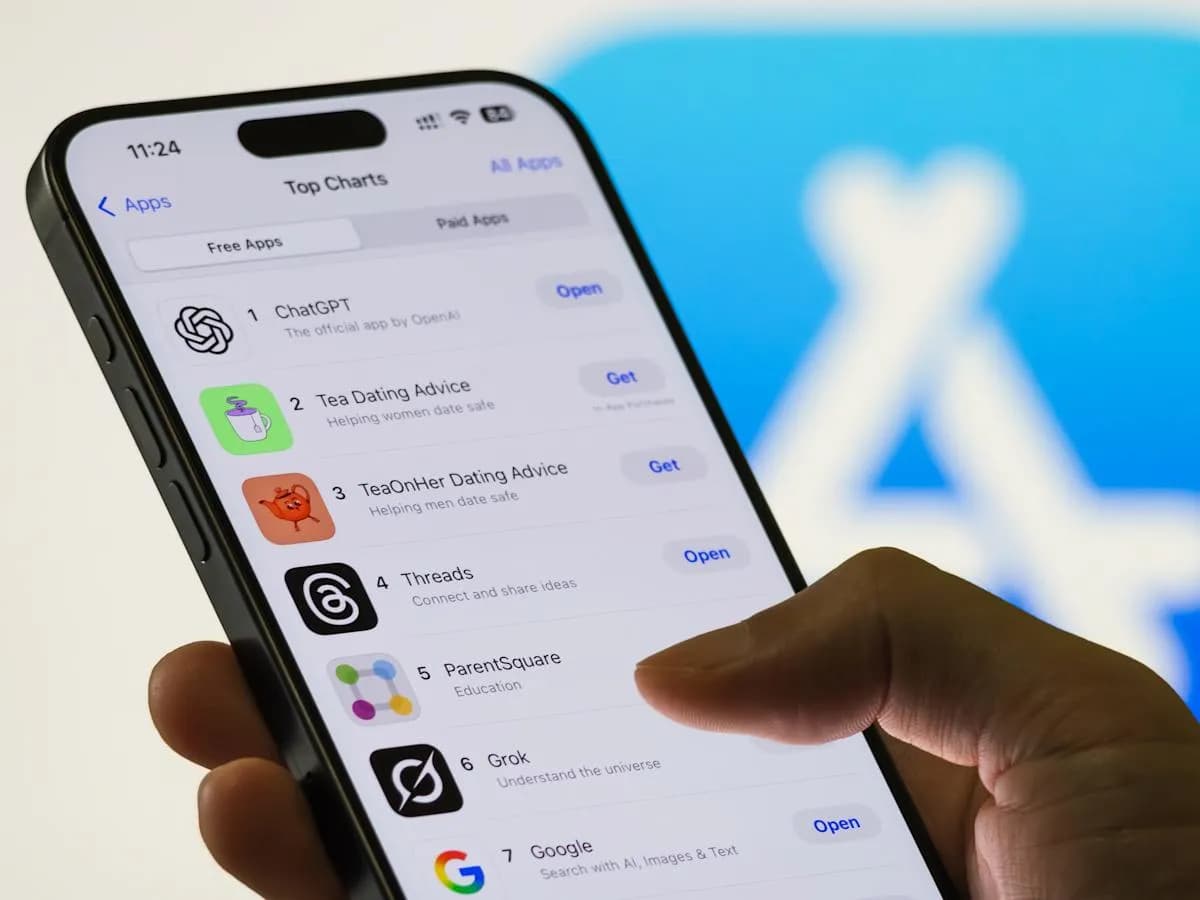
- •Apple generated $900 million in 2025 from generative AI app commissions without its own AI model, with 75% coming from ChatGPT.
- •Acting as a 'toll booth' in the AI boom by charging up to 30% App Store commission rates, but facing antitrust lawsuit from Elon Musk's xAI.
- •Projected to surpass $1 billion in 2026, but facing increasing risks from EU/US regulatory pressure and AI apps' potential migration to independent platforms.
$900 Million Annually Without Its Own AI Model
Apple has been generating massive revenue from the generative AI boom without developing its own artificial intelligence model. The Wall Street Journal (WSJ) reported on the 19th (local time), citing data from analytics firm AppMagic, that Apple collected approximately $900 million in App Store commissions from generative AI apps throughout 2025. Three-quarters of this came from OpenAI's ChatGPT, with projections to exceed $1 billion in 2026.
Apple charges up to 30% commission in the first year and 15% thereafter on app subscription fees distributed through the App Store. While rates vary by country, this means that while competitors like OpenAI, Google DeepMind, and Meta invest billions of dollars in AI infrastructure, Apple is essentially acting as a 'toll booth operator' and generating high profits.
Why It Matters: A New Dimension of Platform Dominance
These figures starkly demonstrate the result of Apple's business model transition from hardware sales to service revenue. Since launching the App Store in 2008, Apple has created high switching costs through its 'Walled Garden' strategy. iPhone users can only install apps through the App Store, and all payments must go through Apple's in-app purchase (IAP) system.
As the generative AI boom accelerates, numerous AI apps including ChatGPT, Elon Musk's Grok, and Google Gemini have registered on the App Store, creating a structure where Apple automatically profits from their growth. ChatGPT, in particular, was the AI app that paid the most commissions on the App Store as of 2025, accounting for 75% of Apple's AI revenue. This suggests Apple is fully enjoying the benefits of AI market growth without directly developing AI models.
Antitrust Controversy and Regulatory Pressure
However, this revenue model is raising antitrust concerns. Elon Musk's xAI recently filed an antitrust lawsuit against Apple, claiming the App Store makes it "impossible" for ChatGPT's competitors to compete fairly. xAI accused Apple of creating an environment favorable to ChatGPT compared to other AI apps by integrating ChatGPT with its AI assistant Siri.
Regulations on Apple's App Store policies are also intensifying in the European Union (EU) and the United States. The EU's Digital Markets Act (DMA) requires Apple to allow alternative app stores and reduce commissions, while antitrust investigations are ongoing in the U.S. On March 15, 2026, Apple announced it would voluntarily reduce commissions in the Chinese market, interpreted as a preemptive measure to respond to global regulatory pressure.
Apple's Service Business Transformation Strategy
Apple's business model has changed dramatically over the past 15 years. Since launching the App Store in 2008, Apple has transitioned from hardware-centric to service-centric, securing high-margin revenue sources. Apple's current business divisions are structured as follows:
- Hardware including iPhone, iPad, Mac, Apple Watch
- Services including App Store, Apple Music, Apple TV+, iCloud
- Financial services including Apple Pay, Apple Card
The services division's share of Apple's total revenue continues to increase, with App Store commissions being a core pillar of service revenue. The explosive growth of generative AI apps provides Apple with a 'golden opportunity' to generate revenue in the AI market without direct investment.
Apple's Positioning Compared to Competitors
| Category | Apple | OpenAI | Meta | |
|---|---|---|---|---|
| AI Model Development Investment | Minimal (no proprietary model) | Billions of dollars | Tens of billions | Tens of billions |
| AI Revenue Method | App Store commissions (indirect) | Direct subscription fees | Advertising & cloud | Advertising & hardware |
| 2025 AI-Related Revenue | ~$900M (commissions) | Est. $3B+ | Est. $10B+ | Est. billions |
| Profit Margin | Ultra-high (30-15%) | Medium | High | Medium |
| Regulatory Risk | High (antitrust lawsuits) | Medium | High | Medium |
Apple is generating revenue at much higher margins than competitors by leveraging platform dominance without massive AI infrastructure investments. However, this is also a double-edged sword that makes it a primary target for antitrust regulations.
[AI Analysis] Sustainability of the Platform Commission Model
Apple's AI commission model is highly efficient in the short term but likely faces three risks in the medium to long term.
First, intensifying regulatory pressure. The EU's DMA is already forcing Apple to allow alternative app stores, and investigations into App Store monopoly continue in the United States. Voluntary commission reductions in China suggest potential global expansion. If commission rates drop from 30% to 10-15%, Apple's service revenue could decrease by tens of billions of dollars.
Second, AI apps' migration to independent platforms. OpenAI is already securing users with web-based ChatGPT, and the possibility of launching its own hardware or operating system cannot be ruled out. Google, Microsoft, and Meta are also building their own AI ecosystems, potentially reducing App Store dependency.
Third, Apple's lack of proprietary AI competitiveness. Apple does not yet possess large language models (LLMs) on par with OpenAI or Google. Siri's AI performance lags behind ChatGPT and Gemini, and strengthening proprietary AI capabilities is essential for Apple to maintain leadership in AI platform competition long-term.
Nevertheless, Apple's hardware ecosystem and user loyalty remain strong defensive barriers. iPhone users don't easily switch to Android due to high switching costs, and the App Store is likely to remain a core channel for AI app distribution for the foreseeable future. If Apple responds flexibly to the regulatory environment while gradually strengthening its proprietary AI competitiveness, it could double AI-related revenue by 2030, beyond the projected $1 billion in 2026.
댓글 (2)
이 문제의 본질이 무엇인지 깊이 생각해볼 필요가 있습니다.
Earns 문제는 양쪽 입장을 모두 들어봐야 할 것 같습니다.
More in this series
More in AI & Tech

영국 정치지도자들, 아동 성착취 혐의에 대한 긴급 조사 촉구

A humanoid robot performing in China has a child's face on it.

U.S. jury finds Meta and Google responsible for ‘social media addiction’… 3.7 billion won compensation ruling

Japanese X-ray Observatory makes first direct measurement of ultrafast 'cosmic wind' in galaxy M82

NASA selects 24 people for 2026 Astrophysics Postdoctoral Fellowships

Ethereum is at a crossroads to ‘redefine its identity’ ahead of the quantum computing and AI era
Latest News

"간부 잘 아는데 교통비 좀" 휴가 군인들 돈 뜯은 50대 구속
50대 A씨가 휴가 중인 군인들에게 부대 간부를 아는 척 접근해 돈을 사취
英 옥토퍼스, 이란 전쟁 이후 태양광 판매 50% 증가
이란 전쟁 이후 영국 옥토퍼스의 태양광 판매량 50% 증가

당정 "추경, 지방·취약계층에 더 지원되는 방식으로"
당정이 지방자치단체와 취약계층 중심의 추경 편성 방침 재확인

당정, 석유 최고가격제 손실 보전을 추경에 반영키로
당정이 석유 최고가격제 손실을 추경에 반영하기로 결정

어머니 폭행하고 금팔찌 빼앗은 30대 아들 경찰에 붙잡혀
어머니 폭행 후 금팔찌 빼앗은 30대 남성 체포

아이티 갱단 폭력사태로 10개월간 5천명 이상 사망
아이티에서 지난 10개월간 갱단 폭력으로 5천명 이상 사망

서방 정보당국 "러시아, 우크라이나 전쟁 후 이란에 드론·식량 공급"
서방 정보당국, 러시아의 이란 드론·식량 공급 작업 거의 완료 파악

6년 전 세 살 딸 살해한 30대 친모 구속송치
경찰, 6년 전 세 살 딸 살해 혐의 30대 친모를 구속송치