China Reduces Hypersonic Missile Core Technology Simulation to 7 Days
AI Software Achieves 300x Speed Improvement in Scramjet Engine Analysis That Previously Took Years
- •The Chinese Academy of Sciences has developed software that reduces scramjet engine simulation from years to 7 days.
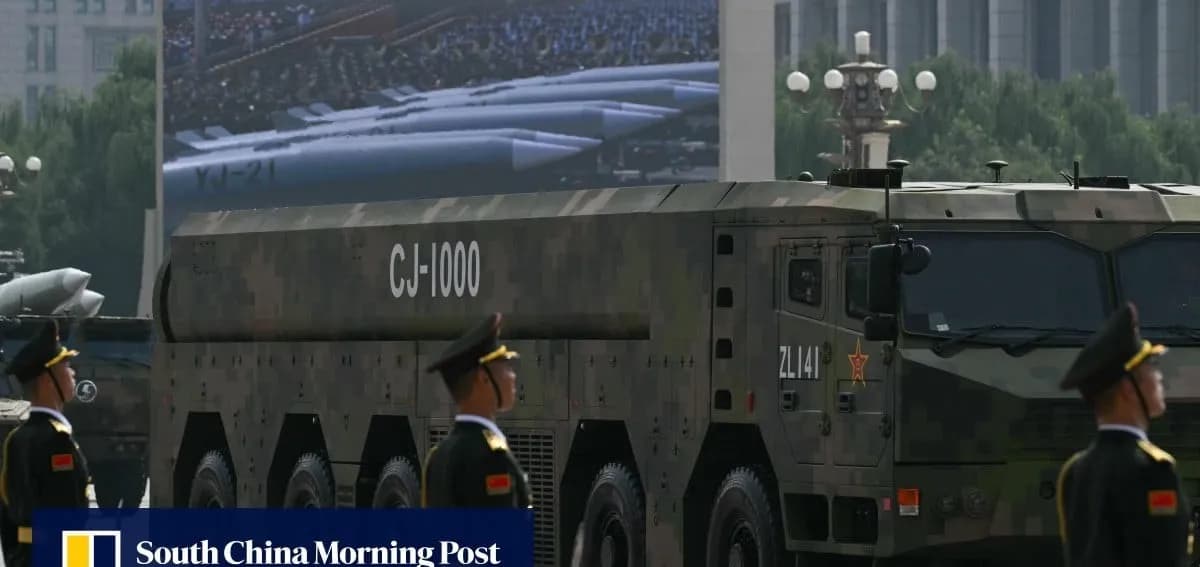
- •This technology is already being applied to classified national projects including the hypersonic missile CJ-1000.
- •China has built a full spectrum of hypersonic weapons over the past 6 years since 2019, leading ahead of the United States.
A Breakthrough That Could Change the Hypersonic Weapons Development Landscape
The Institute of Mechanics at the Chinese Academy of Sciences has developed software that can complete ultra-precise simulations of scramjet engines, the core technology of hypersonic missiles, in just 7 days. Previously, this process took years using supercomputers.
The software developed by researcher Yao Wei's team models supersonic combustion phenomena across hundreds of millions of computational cells. This represents a resolution more than 20 times higher than what is typically used in global research. Despite the extreme complexity, completing the entire simulation within a week is considered a groundbreaking achievement.
In a January announcement, the Chinese Academy of Sciences revealed that this technology is already supporting classified national projects.
Why This Matters
Scramjet engines are propulsion systems that are more efficient and reusable than rocket engines or turbojets for hypersonic flight (Mach 5 and above). They operate by compressing incoming air through shock waves generated at the intake, but achieving stable combustion under extreme speed and thermal conditions is technically very challenging.
The significance of this simulation software lies in its ability to dramatically shorten design cycles. For example, it could significantly accelerate the development of systems like the CJ-1000, known as the world's first ground-launched scramjet-powered hypersonic missile.
The CJ-1000 is a long-range cruise missile capable of striking ground, sea, and even airborne targets from thousands of kilometers away. Additionally, the YJ-19 anti-ship hypersonic missile, which can be launched from ships and submarines, is already reportedly operationally deployed.
Air-breathing hypersonic cruise missiles, unlike boost-glide systems, maintain propulsion throughout their entire flight profile and are characterized by being smaller, faster, and harder to intercept.
Historical Context of the Hypersonic Weapons Race
The hypersonic weapons development race dates back to the Cold War era. The United States has been researching air-breathing hypersonic technology since the 1950s but has continued to face challenges in practical implementation.
In contrast, China has built a full spectrum of hypersonic weapons in just six years since first operationally deploying the DF-17 hypersonic glide vehicle in 2019. As of 2025, the prevailing assessment is that China leads the United States in this field.
The U.S. Department of Defense acknowledged in a 2023 congressional report that "China has secured numerical and technological superiority in the hypersonic weapons field." U.S. hypersonic missile development programs have been delayed by multiple test failures.
Future Outlook [AI Analysis]
The emergence of this simulation software is likely to further accelerate the pace of hypersonic weapons development competition. The reduction of design verification time from years to a week means that trial-and-error costs are dramatically reduced.
Particularly, the fact that this technology is already being applied to classified national projects suggests that China is preparing a new generation of hypersonic weapon systems. Smaller, faster, and more accurate hypersonic missiles may emerge within the next few years.
Other countries, including the United States and Russia, are expected to accelerate development of similar simulation technologies. This is because technological gaps in the hypersonic weapons field directly impact national security.
Additionally, this software technology may expand beyond military applications to civilian fields such as space launch vehicles and hypersonic civil aircraft. Precise simulation of supersonic combustion phenomena can be applied to various extreme environment engineering applications.
댓글 (4)
기사 잘 봤습니다. 다른 시각의 분석도 읽어보고 싶네요.
흥미로운 주제입니다. 주변에도 공유해야겠어요.
공감합니다. 참고하겠습니다.
Hypersonic 관련 기사 잘 읽었습니다. 유익한 정보네요.
More in AI & Tech

Reddit Considers Face ID to Block Bots While Maintaining Anonymity

BTS Gwanghwamun Concert: AI Network Prevents Communication Crisis for 40,000 Fans

Czech Drone Factory Fire Under Investigation for Terrorism

Trump Slams NATO Allies as 'Cowards' Over Strait of Hormuz Refusal

Google Unveils Gemini 3.1 Flash-Lite Optimized for High-Volume Processing

From Go AI to Life Sciences: AlphaGo's 10-Year Journey
Latest News

이스라엘, 헤즈볼라 무기 통로 레바논 다리 공습
이스라엘군, 헤즈볼라 무기 통로 레바논 다리 공습

중동행 전세기 전쟁보험료 최고 7천500만원
중동행 전세기 전쟁보험료가 최고 5만달러(7천500만원)로 상승

이란 탄도미사일, 이스라엘 방어망 뚫고 160명 부상
이란 탄도미사일이 이스라엘 방공망을 통과해 160명 부상

Middle East Conflict Drives Manufacturing Outlook to 10-Month Low
The Korea Institute for Industrial Economics & Trade survey shows April manufacturing outlook PSI plummeted to 88, falling below baseline for the first time in 10 months.

Lee Jae-myung Administration Excludes Multi-Home Officials from Real Estate Policymaking
President Lee Jae-myung has ordered the exclusion of multi-home owning public officials from all real estate policy processes.

Southeast Asia Growth Forecasts Cut Amid Oil Price Surge, Threatening Korean Exports
Maybank Research has downgraded ASEAN-6's 2026 growth forecast from 4.8% to 4.5%.

Volkswagen CEO Says Germany Should Learn from China's Industrial Strategy
Volkswagen CEO stated that Germany should learn from China's systematic industrial planning approach.

BTS Tops March Artist Brand Reputation Rankings with First Full Group Comeback in 4 Years
BTS ranked first in the Korean Corporate Reputation Research Institute's March Artist Brand Reputation Rankings based on 99 million data points.