Rubin Observatory Discovers 11,000 New Asteroids, Reshaping Our Map of the Solar System
Early data alone yields tens of thousands of refined orbits — full operations could uncover millions more
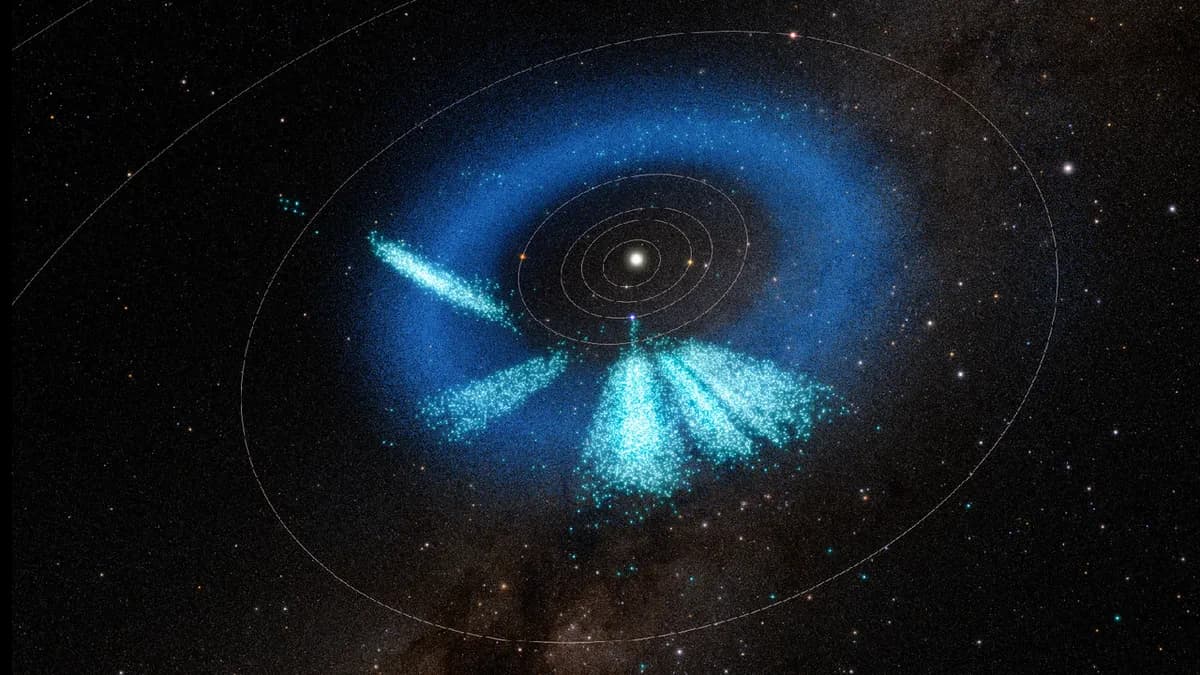
- •Rubin Observatory found 11,000 new asteroids using only early engineering data.
- •33 near-Earth objects and 380 trans-Neptunian objects were among the discoveries.
- •Full operations could reveal millions of additional solar system objects over 10 years.
11,000 Asteroids in Just Days
The Vera C. Rubin Observatory in Chile has discovered more than 11,000 previously unknown asteroids using only preliminary engineering data — before its formal science operations have even begun. The NSF NOIRLab announced the findings, declaring that Rubin is ready to fundamentally transform humanity's inventory of the solar system.
"What used to take years or decades to discover, Rubin will unearth in months," said Mario Juric, Rubin Solar System Lead Scientist. "We are opening the door to discoveries we haven't yet imagined."
Why It Matters
Astronomers currently know of roughly 1.4 to 1.5 million asteroids, most concentrated in the main belt between Mars and Jupiter. Over its 10-year Legacy Survey of Space and Time (LSST), Rubin is expected to push that number into the millions.
Of particular significance are 33 newly identified near-Earth objects (NEOs) — asteroids and comets whose orbits bring them close to the Sun and are closely monitored for planetary defense purposes. None of the newly found NEOs pose a threat to Earth, according to officials.
The observatory also detected approximately 380 trans-Neptunian objects (TNOs) — icy bodies beyond Neptune's orbit. Harvard-Smithsonian Center research scientist Kevin Napier noted that TNOs could reveal how planets migrated in the early solar system and whether an undiscovered ninth large planet still exists at the solar system's edge.
Historical Context
Asteroid surveys have evolved from manual cataloging to urgent planetary defense programs.
- 1800s–1990s: Telescopic observations yielded only thousands of known asteroids
- Post-1998: NASA's Spaceguard Survey aimed to find 90% of NEOs larger than 1 km
- 2005: U.S. Congress mandated 90% detection of NEOs above 140 m by 2020 — a goal still unmet
- 2010s: Pan-STARRS and Catalina Sky Survey automated and accelerated discovery rates
- 2025 onward: Rubin's 8.4-meter mirror and largest-ever astronomical camera image the entire southern sky every few nights
"Even with just early, engineering-quality data, Rubin discovered 11,000 asteroids and measured more precise orbits for tens of thousands more," said Ari Heinze, who helped build the detection software.
Implications [AI Analysis]
Once fully operational, Rubin is likely to restructure planetary defense capabilities. Currently, only about 40% of larger NEOs (140 m or more) have been identified; Rubin is projected to raise that figure to 70%, dramatically extending early-warning timelines for potential Earth impacts.
Accumulated TNO data could also provide decisive evidence for or against the Planet Nine hypothesis — the theory that an undiscovered large planet lurks in the outer solar system.
The sheer volume of data Rubin generates — tens of terabytes per night — makes AI-driven analysis not optional but essential. The algorithms that identified these distant objects already tested billions of possible motion paths. Rubin is likely to become a flagship platform for AI-assisted astronomy, with discovery rates now far beyond any human observational capacity.
댓글 (4)
Rubin 관련 기사 잘 읽었습니다. 유익한 정보네요.
기사 잘 봤습니다. 다른 시각의 분석도 읽어보고 싶네요.
좋은 의견이십니다.
간결하면서도 핵심을 잘 정리한 기사네요.
More in Special




Latest News

DAY6's Wonpil Shatters His Own Record With 142,651 First-Week Sales for 'Unpiltered'
Wonpil's mini album 'Unpiltered' sold 142,651 copies in its first week.

'Perfect Crown' Tops Drama Buzz Charts Before Its Premiere
MBC's 'Perfect Crown' ranks No. 1 in drama buzz ahead of its premiere.

BTS Makes History: 'ARIRANG' Stays at No. 1 on Billboard 200 for Second Consecutive Week
BTS's 'ARIRANG' becomes the first Korean artist album to spend multiple weeks at No. 1 on the Billboard 200.

One Line on a Whiteboard: 'Don't Hit It to Adell'
Jo Adell robbed three Mariners home runs in one of baseball's greatest defensive games.

Astros Ace Hunter Brown Lands on IL with Right Shoulder Strain
Astros ace Hunter Brown is placed on the 15-day IL with a shoulder strain.

Adell's Triple Robbery and Ohtani's Rainy-Day Gift Steal the MLB Weekend
Jo Adell robbed three home runs in one game, lifting the Angels to a 1-0 win.

'Recipe for Love' Hits New Turning Point as Kim Seung Soo and Kim Hyung Mook's Bond Deepens
Yang Dong Ik takes a knife meant for Gong Jeong Han in a dramatic scene.
Lego's New Educational Space Sets Teach Kids Physics Through Play
Lego launched four science education kits focused on space and polar themes.