Samsung Electronics to Close Slovakia TV Plant After 24 Years
Europe's Largest Production Hub to Halt Operations in May Amid Global TV Market Decline and Soaring Energy Costs
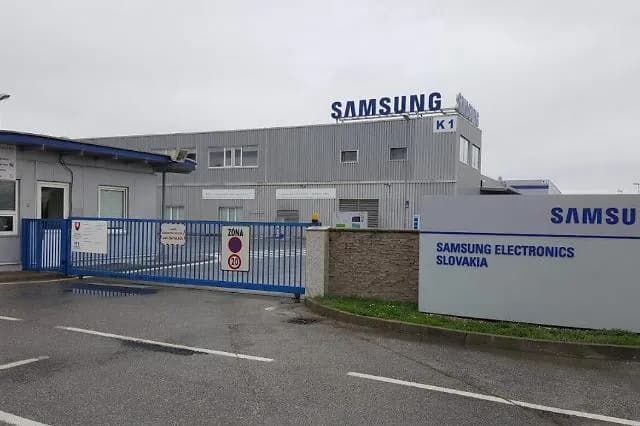
- •Samsung Electronics has begun the shutdown of its Galanta, Slovakia TV plant established in 2002, planning to close in May and reduce approximately 700 employees.
- •The VD and DA divisions recorded a 600 billion won operating loss in Q4 2024, with market share loss to TCL and deteriorating profitability serving as decisive factors.
- •Production volume will be transferred to Vietnam, Egypt, and Hungary, while the product lineup is being restructured with premium Micro RGB and budget Mini-LED additions.
Core Hub Established in 2002 to Close After 24 Years
Samsung Electronics has finalized the closure of its TV manufacturing plant in Galanta, Slovakia, and begun the shutdown process. The facility, a key European hub since its establishment in 2002, has supplied LCD TVs to the European market and recorded annual revenue of approximately €1.7 billion (about 2.89 trillion won) as of 2024. With around 700 employees currently working at the site, Samsung plans to gradually halt production by May and begin phased workforce reductions starting in late June.
Jaroslav Zilka, Vice President of Samsung Electronics Slovakia, stated that "this decision reflects structural changes in the global TV manufacturing market," adding that "Slovakia's high energy costs were also a major contributing factor." The Galanta plant primarily produces LCD TVs, while the nearby Gan logistics center (employing approximately 700 staff) will continue normal operations.
Why Abandon Europe's Largest Production Base?
This decision is directly linked to deteriorating profitability in Samsung Electronics' Visual Display (VD) and Digital Appliances (DA) divisions. In Q4 2024, the VD and DA divisions recorded an operating loss of 600 billion won, and in December of the same year, Samsung lost its global TV market share leadership to Chinese competitor TCL for the first time in monthly rankings, reflecting intensifying competition.
The Galanta plant had already undergone downsizing once before in 2018, when it absorbed the nearby Voderady facility. At that time, the primary drivers were also declining global TV demand and production efficiency improvements. Slovakia has become less attractive for manufacturing due to high energy costs and rising labor expenses within Europe, prompting Samsung to adopt a strategy of relocating production to more cost-efficient bases.
According to labor unions, some of Galanta's production volume will be transferred to Samsung's other manufacturing hubs in Vietnam, Egypt, and Hungary. While Samsung plans to offer re-employment support programs for affected workers, the displacement of approximately 700 employees is expected to deliver a significant blow to the local Slovakian economy.
Global TV Business Restructuring and Premium Strategy Enhancement
To improve TV business profitability, Samsung is simultaneously restructuring its production bases and completely overhauling its product lineup. The company is adding Micro RGB technology to its premium line and Mini-LED technology to its budget line, shifting away from competition with Chinese manufacturers like TCL and Hisense in the mid-to-low price segment toward high-value-added product categories.
| Category | Previous Strategy | Post-Restructuring Strategy | Objective |
|---|---|---|---|
| Premium Line | QLED, Neo QLED | Add Micro RGB | Expand ultra-premium market |
| Budget Line | LCD, Standard LED | Add Mini-LED | Differentiate mid-to-low segment |
| Production Bases | Europe (Slovakia) | Vietnam, Egypt, Hungary | Cost efficiency |
| Market Strategy | Volume-focused | Profitability-focused | Improve operating margins |
This closure does not represent Samsung's complete withdrawal from the European market. Rather, the company is transitioning to a model where production shifts to cost-efficient regions while maintaining logistics and sales hubs in Europe. Indeed, the Gan logistics center will continue normal operations, preserving the company's European market response capabilities.
Structural Changes in the Global TV Market [AI Analysis]
Samsung Electronics' closure of the Slovakia plant symbolically illustrates structural transformation in the global TV manufacturing industry. Until the early 2020s, the TV market was characterized by panel-centered volume competition, but post-pandemic demand collapse and aggressive pricing by Chinese manufacturers severely eroded profitability.
Particularly significant is TCL's achievement of first place in monthly market share in December 2024, indicating that Chinese manufacturers have moved beyond simple low-price strategies to secure genuine technological competitiveness. In response, Samsung is pivoting from volume competition to a premium market concentration strategy, with investments in Micro RGB and Mini-LED technologies forming the core of this directional shift.
The TV manufacturing industry is likely to bifurcate into a small number of premium technology leaders and volume-focused Chinese manufacturers. Whether Samsung can restore profitability through this restructuring and solidify its position in the premium market will determine the future trajectory of its TV business. The trend of relocating manufacturing bases to Asia and the Middle East is expected to accelerate further due to rising energy costs and geopolitical risks.
댓글 (6)
흥미로운 주제입니다. 주변에도 공유해야겠어요.
공감합니다. 참고하겠습니다.
간결하면서도 핵심을 잘 정리한 기사네요.
그 부분은 저도 궁금했습니다.
to에 대해 더 알고 싶어졌습니다. 후속 기사 부탁드립니다.
그 부분은 저도 궁금했습니다.
More in this series
More in AI & Tech

영국 정치지도자들, 아동 성착취 혐의에 대한 긴급 조사 촉구

A humanoid robot performing in China has a child's face on it.

U.S. jury finds Meta and Google responsible for ‘social media addiction’… 3.7 billion won compensation ruling

Japanese X-ray Observatory makes first direct measurement of ultrafast 'cosmic wind' in galaxy M82

NASA selects 24 people for 2026 Astrophysics Postdoctoral Fellowships

Ethereum is at a crossroads to ‘redefine its identity’ ahead of the quantum computing and AI era
Latest News
"간부 잘 아는데 교통비 좀" 휴가 군인들 돈 뜯은 50대 구속
50대 A씨가 휴가 중인 군인들에게 부대 간부를 아는 척 접근해 돈을 사취

英 옥토퍼스, 이란 전쟁 이후 태양광 판매 50% 증가
이란 전쟁 이후 영국 옥토퍼스의 태양광 판매량 50% 증가
당정 "추경, 지방·취약계층에 더 지원되는 방식으로"
당정이 지방자치단체와 취약계층 중심의 추경 편성 방침 재확인
당정, 석유 최고가격제 손실 보전을 추경에 반영키로
당정이 석유 최고가격제 손실을 추경에 반영하기로 결정
어머니 폭행하고 금팔찌 빼앗은 30대 아들 경찰에 붙잡혀
어머니 폭행 후 금팔찌 빼앗은 30대 남성 체포
아이티 갱단 폭력사태로 10개월간 5천명 이상 사망
아이티에서 지난 10개월간 갱단 폭력으로 5천명 이상 사망
서방 정보당국 "러시아, 우크라이나 전쟁 후 이란에 드론·식량 공급"
서방 정보당국, 러시아의 이란 드론·식량 공급 작업 거의 완료 파악

6년 전 세 살 딸 살해한 30대 친모 구속송치
경찰, 6년 전 세 살 딸 살해 혐의 30대 친모를 구속송치