TSA agents go unpaid. Why can't airline security fees be used as salaries?
$3.5 billion in annual security fees paid by passengers cannot be used to resolve government shutdown due to federal law
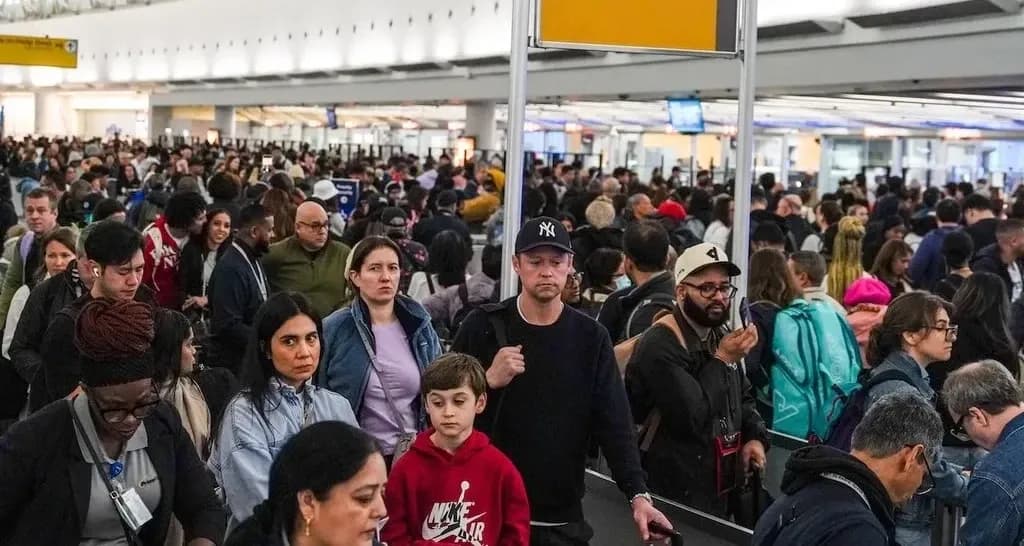
- •Due to the U.S. government shutdown, the unpaid situation of TSA agents is worsening and airport security paralysis is spreading.
- •The airline security fee paid by passengers cannot be used directly to pay TSA benefits under federal law.
- •A structural problem was revealed in that only 35% of the security fee was allocated to TSA and the rest was used to reduce federal debt.
U.S. airport security paralyzes, unpaid TSA agent absenteeism rate triples
As the partial shutdown of the U.S. federal government continues, the unpaid work situation of Transportation Security Administration (TSA) agents is becoming more serious. According to the Department of Homeland Security, TSA agent absenteeism rates have tripled since the shutdown began on February 14. Atlanta Hartsfield-Jackson International Airport is urging passengers to arrive four hours before departure, while Houston and New Orleans airports are also warning of significant wait times and security checkpoint closures.
Some TSA employees are not getting paid and are looking for other jobs to make ends meet. President Donald Trump has deployed Immigration and Customs Enforcement (ICE) agents to airports since March 23 to assist with apprehension of undocumented immigrants and security operations.
Passenger security fee, why can’t it be used as TSA salary?
Meanwhile, fundamental questions were raised on social media. “Why isn’t the security fee on every airline ticket used to pay TSA agents?” Atlanta TV reporter Brendan Keefe argued on
Passenger security fees are real. Under this system, which was introduced after the September 11 terrorist attacks, airlines collect a security fee when selling tickets and pass it on to TSA. The current rate, which was raised by Congress in 2014, is $5.60 one-way and $11.20 round-trip.
But the problem lies in the structure of federal law. According to a law enacted in 2013, the entire passenger security fee does not go to TSA. First, a certain amount of money must be deposited into the government's general fund to reduce federal debt. $1.64 billion in fiscal year 2026 and $1.68 billion in fiscal year 2027 are mandated to the general fund. Separately, $250 million will be used to reimburse airport costs related to baggage scanners and explosive detection equipment.
History of chronic lack of financial resources
These structural problems are not new. According to the Congressional Research Service (CRS), revenue from passenger security fees has not been sufficient to cover TSA's operating costs in recent years. As of fiscal year 2024, TSA's total cost was about $9.8 billion, but the amount covered by passenger security fees was $3.5 billion, or only about 35% of the total. The remaining 65% has been covered by Congress-approved funds, the very funds whose payments are currently suspended due to a dispute between the Trump administration and Democratic lawmakers.
Ultimately, the passenger security fee system was introduced after 9/11 under the pretext of strengthening aviation security, but in reality, it was incorporated as part of the federal budget system rather than as an independent financial resource for TSA. As it is combined with another policy goal of reducing federal debt, it is working differently from its original purpose.
There is no possibility of legal transfer
So, wouldn't it be possible to transfer funds even in the short term in an emergency situation? Joshua Suel, director of research and policy at the federal budget watchdog group Taxpayers for Common Sense, said it was impossible. There is no basis for allowing such a transfer anywhere in the text of the federal appropriations bill or in the provisions of the U.S. code regulating security fees.
Future outlook [AI analysis]
If the current situation continues for a long time, several scenarios are likely to unfold. First, as the departure of TSA agents accelerates, the aviation security system itself may be in crisis. Second, discussion on revising the law on where passenger security fees are used may be triggered in Congress. Third, there is a possibility that the economic impact will spread throughout the airline industry due to a decrease in air travel demand.
This incident went beyond a simple government shutdown and revealed fundamental vulnerabilities in the U.S. aviation security financial structure. Unless the structural contradiction in which the security fee paid by passengers for each ticket is not actually used to pay security personnel is resolved, a similar situation can be repeated at any time.
댓글 (4)
TSA 관련 기사 잘 읽었습니다. 유익한 정보네요.
공감합니다. 참고하겠습니다.
간결하면서도 핵심을 잘 정리한 기사네요.
그 부분은 저도 궁금했습니다.
More in Special

U.S. political funding tracking debate: To what extent does TrackAIPAC view ‘pro-Israel funding’?

U.S. Department of Defense seeks to criminalize reporter's 'unauthorized questioning' itself
How to avoid ICE agents checking your phone at the airport
Intruder at Chinese Embassy in Japan Identified as Active JSDF Officer

New York City public hospital breaks up with Palantir... Ending controversy over commercialization of citizen health data
Canada cancels registration of 35 cryptocurrency companies... Strengthening money laundering crackdown
Latest News

Man in His 30s Arrested After Crashing into Streetlight While Driving Under Propofol
Man in his 30s crashes into streetlight while driving after illegally taking propofol

Goyang Sono's 10-Game Winning Streak Ends as DB's Ellenson Explodes for 38 Points
Wonju DB ends Goyang Sono's 10-game winning streak with Henry Ellenson's 38-point explosion

Yemen's Houthis Launch Missiles at Israel, Enter War as Red Sea Security Crisis Deepens
Yemen's Houthi rebels launched missiles at Israel on the 28th, directly entering the US-Iran war
Nepal's Ex-PM Oli Arrested Over Deadly Protest Crackdown
Nepal's former PM KP Sharma Oli arrested over deadly protest crackdown

Iranian Missiles Breach Israeli Air Defense, Strike Southern Cities Dimona and Arad
Iranian ballistic missiles penetrated Israeli multi-layered air defense, striking southern cities Dimona and Arad

Mastermind of 'Revenge-for-Hire' Ring Faces Arrest Warrant Over Feces Terror Attacks
Mastermind of revenge-for-hire ring faces arrest hearing over orchestrating excrement attacks and graffiti

BBC Investigation Uncovers Error in Dopamine Agonist Drug Warnings... UK Authorities Launch Review
BBC investigation discovers critical error in patient leaflets for dopamine agonist drugs

Israel Activates Air Defense as Houthi Rebels Launch Missile from Yemen
Israeli military detects Houthi rebel missile launch from Yemen on the 28th and activates air defense