US Stock Market Falls Across the Board on First Day of December, Dow Plunges 427 Points
S&P 500 Closes Down 0.53% as Markets Enter Correction Phase Amid Fed Rate Cut Expectations
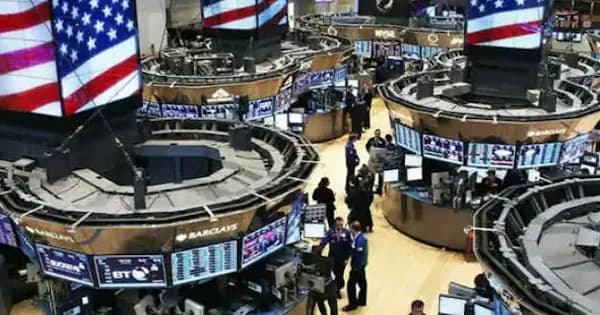
- •US stock markets fell across the board on the first day of December, with the Dow plunging 427 points (0.90%) to close at 47,289.
- •The S&P 500 fell 0.53% and the Nasdaq declined 0.38%, but experts note that market fundamentals remain solid amid expectations for Fed rate cuts.
- •While most European markets fell, Hong Kong's Hang Seng Index (0.67%) and Malaysia's index (1.25%) showed strength.
US Major Indices Fall in Tandem, Dow Records Largest Decline
US stock markets closed broadly lower on December 2 (local time), the first trading day of December. While the tech-heavy Nasdaq limited its losses relatively, the Dow Jones Industrial Average fell more than 400 points, recording the steepest decline among the three major indices.
The Dow Jones Industrial Average closed at 47,289.33, down 427.09 points (0.90%) from the previous session. The S&P 500 index fell 36.46 points (0.53%) to 6,812.63, while the Nasdaq Composite dropped 89.76 points (0.38%) to 23,275.92. S&P 500 trading volume reached 2.77 billion shares, with Nasdaq volume hitting 6.84 billion shares.
"Correction Phase, But Fundamentals Remain Solid"
Market experts are interpreting this decline as a short-term correction. Robert Schein, Chief Investment Officer (CIO) at Blanke Schein Wealth Management, told CNBC that "the stock market is going through a digestion period," adding that "considering the high likelihood that the Fed will cut rates again next week, the backdrop for the stock market remains strong."
Ahead of the December Federal Open Market Committee (FOMC) regular meeting, markets are treating an additional rate cut as a foregone conclusion. This serves as the foundation for maintaining medium- to long-term investment sentiment despite short-term volatility.
Dollar Strengthens Against Yen, Weakens Against Euro
In foreign exchange markets, the dollar showed strength against the yen but lost ground to the euro. EUR/USD rose 0.11% to 1.1608, while GBP/USD fell 0.09% to close at 1.3211.
The largest movement occurred in USD/JPY. The dollar weakened 0.41% against the yen, closing at 155.49. Meanwhile, USD/CAD rose 0.21% to 1.3999, and USD/CHF gained 0.18% to 0.8045.
Commodity currencies including the Australian and New Zealand dollars showed slight weakness. AUD/USD fell 0.06% to 0.6542, while NZD/USD declined 0.05% to close at 0.5726.
European Markets Generally Fall, Asian Markets Show Mixed Results
Global stock markets showed divergent patterns by region. Canada's S&P/TSX Composite Index plunged 281.00 points (0.90%) to close at 31,101.78, mirroring the Dow's decline.
Most major European indices closed lower. The UK's FTSE 100 fell 0.18% to 9,702.53, while Germany's DAX index plummeted 1.04% to 23,589.44. France's CAC 40 declined 0.32% to close at 8,097.00. The pan-European EURO STOXX 50 remained nearly flat, down just 0.01%.
In contrast, Asian markets showed upward momentum. Hong Kong's Hang Seng Index recorded the largest gain, rising 0.67% to 26,033.26. Malaysia's FTSE Bursa Malaysia KLCI surged 1.25% to 1,624.57, continuing its strong performance. Singapore's STI index (up 0.05%), Indonesia's IDX Composite (up 0.47%), and China's Shanghai Composite Index also closed higher.
[AI Analysis] Wait-and-See Attitude Expected to Intensify Ahead of Fed Meeting
The across-the-board decline on the first trading day of December appears to result from a combination of year-end portfolio rebalancing and anticipation ahead of the FOMC meeting. The Dow's 0.90% plunge particularly suggests that traditional industrial stocks faced more pressure than tech stocks.
Over the coming week, the Fed's rate decision and dot plot release are likely to be the key variables determining market direction. Even if the rate cut proceeds as expected, additional corrections could occur if the Fed's signals regarding the 2026 rate path prove conservative.
Meanwhile, the upward trend in Asian markets appears to reflect expectations for China's economic stimulus measures and export optimism driven by regional currency weakness. As decoupling between global stock markets intensifies, this may be the time for differentiated regional investment strategies.
댓글 (2)
US 문제가 장기화되면 어떻게 될지 우려됩니다.
Stock 상황이 심각하네요. 서민들 피해가 걱정됩니다.
More in AI & Tech

Reddit Considers Face ID to Block Bots While Maintaining Anonymity

China Reduces Hypersonic Missile Core Technology Simulation to 7 Days

BTS Gwanghwamun Concert: AI Network Prevents Communication Crisis for 40,000 Fans

Czech Drone Factory Fire Under Investigation for Terrorism

Trump Slams NATO Allies as 'Cowards' Over Strait of Hormuz Refusal

Google Unveils Gemini 3.1 Flash-Lite Optimized for High-Volume Processing
Latest News

이스라엘, 헤즈볼라 무기 통로 레바논 다리 공습
이스라엘군, 헤즈볼라 무기 통로 레바논 다리 공습

중동행 전세기 전쟁보험료 최고 7천500만원
중동행 전세기 전쟁보험료가 최고 5만달러(7천500만원)로 상승

이란 탄도미사일, 이스라엘 방어망 뚫고 160명 부상
이란 탄도미사일이 이스라엘 방공망을 통과해 160명 부상

Middle East Conflict Drives Manufacturing Outlook to 10-Month Low
The Korea Institute for Industrial Economics & Trade survey shows April manufacturing outlook PSI plummeted to 88, falling below baseline for the first time in 10 months.

Lee Jae-myung Administration Excludes Multi-Home Officials from Real Estate Policymaking
President Lee Jae-myung has ordered the exclusion of multi-home owning public officials from all real estate policy processes.

Southeast Asia Growth Forecasts Cut Amid Oil Price Surge, Threatening Korean Exports
Maybank Research has downgraded ASEAN-6's 2026 growth forecast from 4.8% to 4.5%.

Volkswagen CEO Says Germany Should Learn from China's Industrial Strategy
Volkswagen CEO stated that Germany should learn from China's systematic industrial planning approach.

BTS Tops March Artist Brand Reputation Rankings with First Full Group Comeback in 4 Years
BTS ranked first in the Korean Corporate Reputation Research Institute's March Artist Brand Reputation Rankings based on 99 million data points.