Alchip Technologies Reports Q2 2025 Results
Revenue Down 29% as AI Accelerator Chip Shipments End and Demand Slows
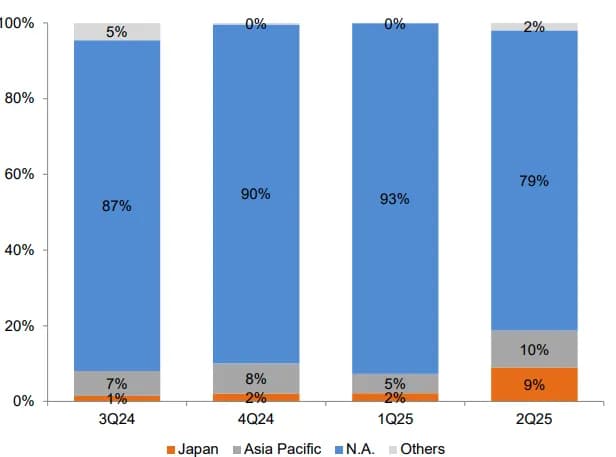
- •Alchip Technologies reported Q2 2025 revenue of $297.4 million and net income of $42.9 million, down 29.4% and 12.8% year-over-year respectively.
- •The end of AI accelerator chip shipments, slowing 5nm AI accelerator demand, and 3nm tape-out delays were identified as primary causes for the performance decline.
- •North America accounted for 79% of total revenue, while 3nm/2nm and 5nm/7nm advanced process designs represented 86% of total revenue.
AI Semiconductor Design Firm's Earnings Decline
Alchip Technologies, a Taiwan-based specialist in high-performance computing (HPC) and AI infrastructure ASIC design, has announced its Q2 2025 financial results. Revenue for the quarter reached $297.4 million (approximately 401.1 billion KRW), representing a 29.4% year-over-year decrease and a 6.7% decline from the previous quarter.
Net income totaled $42.9 million (approximately 57.9 billion KRW), down 12.8% year-over-year and 3.3% quarter-over-quarter. Founded in 2003 and listed on the Taiwan Stock Exchange, Alchip has built its reputation across North America, Japan, Israel, and Asia through advanced ASIC design methodologies and cutting-edge packaging technologies.
Key Factors Behind the Decline
Chairman and CEO Johnny Shen identified three primary causes for the performance decline. First, shipments of AI accelerator ASICs to North American customers concluded in the first half of 2025. Second, demand for a separate 5nm process AI accelerator slowed more than anticipated. Third, delays in the tape-out schedule for 3nm process designs and seasonal fluctuations in non-recurring engineering (NRE) projects impacted both revenue and profitability.
This quarter's results highlight the volatility of the AI semiconductor market, revealing characteristic challenges of the ASIC design industry: revenue fluctuations tied to specific customer dependencies and project timing. The termination of AI accelerator chip shipments particularly underscores the risks associated with heavy reliance on a single major customer.
Technology Portfolio and Regional Revenue Composition
Despite the earnings decline, Alchip's technology portfolio remains concentrated in advanced process nodes. In Q2, 5% of revenue came from 3nm/2nm designs, while 5nm/7nm designs accounted for 81%. Legacy processes of 12nm and above comprised the remaining 16%.
By application, high-performance computing (HPC) applications represented 82% of total revenue, confirming the company's core business domain. This demonstrates a strong position in AI infrastructure and supercomputing markets.
Regional Revenue Distribution
| Region | Revenue Share |
|---|---|
| North America | 79% |
| Japan | 9% |
| Asia and Others | 12% |
North America accounts for an overwhelming 79% of revenue, creating a structure where project trends among North American customers decisively influence company performance. Japan represents 9%, with Asia and other regions comprising 12%.
Advanced Packaging and Chiplet Design Capabilities
Alchip possesses industry-leading capabilities in 2.5D/3D CoWoS (Chip-on-Wafer-on-Substrate) packaging technology and chiplet design. These advanced packaging technologies are essential elements for designing high-performance AI accelerators and HPC chips.
The company's customer base includes global leaders across diverse sectors: artificial intelligence, high-performance computing, supercomputing, mobile communications, entertainment devices, and networking equipment. Alchip's business model of providing ASIC design and production services enables customers to bring complex, high-volume chips to market faster and more cost-effectively.
Connection to Semiconductor Industry Trends
ASIC design firms' performance is directly influenced by end customers' product launch schedules and market demand. In Alchip's case, the end of AI accelerator chip shipments and slowing 5nm AI accelerator demand reflect the AI semiconductor market's ongoing restructuring.
In the 2025 AI semiconductor market, major players including NVIDIA, AMD, and Intel are intensifying competition with next-generation AI accelerator launches. Within this environment, ASIC design firms inevitably respond sensitively to changes in customer product strategies and market demand fluctuations.
The 3nm tape-out delay particularly reveals technical challenges and schedule management difficulties encountered during the transition to advanced processes. In semiconductor design, tape-out is a critical stage where completed designs enter actual manufacturing; delays at this juncture directly impact revenue recognition timing.
[AI Analysis] Second-Half Outlook and Challenges
While Alchip's Q2 performance decline appears to be a temporary project timing issue, it also reveals several structural challenges.
In the short term, completion of 3nm project tape-outs and securing new customer projects will likely be key variables for second-half performance recovery. Since NRE project seasonal fluctuations follow recurring patterns, revenue improvement is anticipated as project initiations increase in the second half.
In the medium to long term, there's a need to reduce North American revenue concentration (79%) and pursue geographic diversification. Expanding market share in Japan and Asia could serve as a strategy to mitigate revenue volatility.
From a technical perspective, continuously expanding the proportion of 2nm/3nm advanced process designs and strengthening advanced packaging technologies like CoWoS along with chiplet design capabilities remain core to maintaining competitiveness. While AI accelerator market growth is expected to continue, diversifying the customer portfolio and managing the project pipeline appear to be essential conditions for stable growth.
댓글 (2)
기사 잘 봤습니다. 다른 시각의 분석도 읽어보고 싶네요.
Technologies 관련 기사 잘 읽었습니다. 유익한 정보네요.
More in AI & Tech

Reddit Considers Face ID to Block Bots While Maintaining Anonymity

China Reduces Hypersonic Missile Core Technology Simulation to 7 Days

BTS Gwanghwamun Concert: AI Network Prevents Communication Crisis for 40,000 Fans

Czech Drone Factory Fire Under Investigation for Terrorism

Trump Slams NATO Allies as 'Cowards' Over Strait of Hormuz Refusal

Google Unveils Gemini 3.1 Flash-Lite Optimized for High-Volume Processing
Latest News

이스라엘, 헤즈볼라 무기 통로 레바논 다리 공습
이스라엘군, 헤즈볼라 무기 통로 레바논 다리 공습

중동행 전세기 전쟁보험료 최고 7천500만원
중동행 전세기 전쟁보험료가 최고 5만달러(7천500만원)로 상승

이란 탄도미사일, 이스라엘 방어망 뚫고 160명 부상
이란 탄도미사일이 이스라엘 방공망을 통과해 160명 부상

Middle East Conflict Drives Manufacturing Outlook to 10-Month Low
The Korea Institute for Industrial Economics & Trade survey shows April manufacturing outlook PSI plummeted to 88, falling below baseline for the first time in 10 months.

Lee Jae-myung Administration Excludes Multi-Home Officials from Real Estate Policymaking
President Lee Jae-myung has ordered the exclusion of multi-home owning public officials from all real estate policy processes.

Southeast Asia Growth Forecasts Cut Amid Oil Price Surge, Threatening Korean Exports
Maybank Research has downgraded ASEAN-6's 2026 growth forecast from 4.8% to 4.5%.

Volkswagen CEO Says Germany Should Learn from China's Industrial Strategy
Volkswagen CEO stated that Germany should learn from China's systematic industrial planning approach.

BTS Tops March Artist Brand Reputation Rankings with First Full Group Comeback in 4 Years
BTS ranked first in the Korean Corporate Reputation Research Institute's March Artist Brand Reputation Rankings based on 99 million data points.