Strikes Escalate Across Middle East as UN Chief Urges 'Peaceful Way Out'
Oil prices surge to $107 as US-Israel strikes on Iran expand; civilian toll deepens across the region

- •Middle East strikes pushed oil prices to $107 per barrel amid escalating conflict.
- •UN Secretary-General urged an immediate halt to the spiral of destruction.
- •Trump's signal of weeks more attacks has dimmed hopes for a quick ceasefire.
War Spreads Across the Middle East
Since the United States and Israel launched strikes on eastern Tehran on February 28, the conflict has rapidly spread to Lebanon, evolving into a multi-front regional war. Deadly new strikes were reported across the Middle East on April 2, rattling energy markets and pushing crude oil prices to $107 per barrel in early trading.
UN Secretary-General António Guterres told reporters at UN Headquarters that the conflict "is already being felt everywhere" and warned that "the spiral of destruction must stop." He called on all parties to find "a peaceful way out" before the entire region is engulfed by war.
Trump Signals Weeks More of Strikes
President Trump indicated attacks would continue for "another two to three weeks" while simultaneously noting that discussions with Tehran remain "ongoing" — a mixed signal that dims hopes for an early ceasefire.
In Lebanon, renewed clashes between Israel and Hezbollah have claimed the lives of UN peacekeepers, while civilians across the region continue to face severe hardship and displacement.
A Crisis Built Over Decades
The current Middle East crisis is not the product of a single event but a structural explosion of decades of accumulated regional tensions. The conflict that began with Hamas's October 2023 attack on Israel and Israel's subsequent Gaza offensive expanded over 2024 and 2025 to draw in Lebanon's Hezbollah, Yemen's Houthi rebels, and Iran. The direct US-Israeli strikes on Iranian soil in February 2026 marked a decisive escalation into open regional war.
Oil prices have climbed steadily throughout this period as threats to the Strait of Hormuz — a critical chokepoint for global energy supply — have intensified fears of supply disruptions affecting both developing and industrialized nations.
Outlook [AI Analysis]
Given the current structure of the conflict, a comprehensive ceasefire in the near term appears unlikely. The dual-track US approach of continued strikes alongside diplomatic contact with Tehran may persist, prolonging civilian suffering and displacement.
Oil prices could rise further toward $110 or beyond if supply disruptions remain unresolved. For South Korea, which sources over 70% of its crude oil imports from the Middle East, a prolonged conflict carries significant risks of inflation and trade balance deterioration.
While the UN Security Council has convened emergency sessions, competing interests among permanent members make binding resolutions difficult. Without a diplomatic breakthrough, the war risks triggering a compounding global crisis spanning energy, food security, and supply chain stability.
댓글 (5)
이 사안은 신중하게 접근해야 한다고 봅니다.
중요한 포인트를 짚으셨네요.
댓글란이 과열되지 않았으면 합니다. 차분한 논의가 필요해요.
Across 문제는 양쪽 입장을 모두 들어봐야 할 것 같습니다.
균형 잡힌 시각이 필요하다는 데 동의합니다.
More in Global
'We Watched Them Die': Sudan's Last Maternity Hospital on the Brink

Deminers Struggle to Keep Pace as Smart Mines Rewrite the Rules of War

Artemis 2 Departs for the Moon — First Crewed Lunar Mission in 52 Years
UN Chief Warns of Imminent Full-Scale Middle East War as Three UNIFIL Peacekeepers Killed
South Sudan Crisis Reaches 'Catastrophic' Level; WHO Updates Opioid Treatment Guidelines
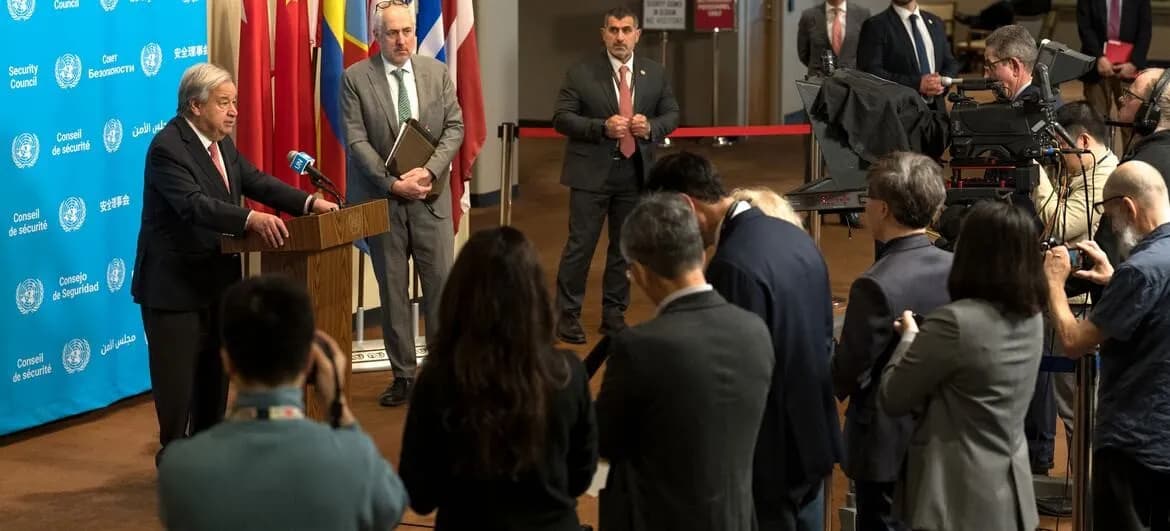
Guterres Warns of 'Wider War' as Middle East Conflict Enters Second Month
Latest News

Yoo Yeon Seok and Esom Share Charged Amusement Park Moment in 'Phantom Lawyer' Episode 8
Episode 8 of 'Phantom Lawyer' previews an emotional amusement park scene between the two leads.

Coma Survivor Returns to Shake Up the Fragile Alliance in 'Mad Concrete Dreams'
Min Hwal Seong wakes from a coma and approaches Kim Seon at a dinner party.

Shiloh Jolie to Appear in WJSN Dayoung's MV — STARSHIP Says They Didn't Know Who She Was
Shiloh Jolie appeared as a dancer in Dayoung's solo MV teaser.

Han Ji Min Moves In With Park Sung Hoon After Falling Out With Her Mom in 'The Practical Guide to Love'
Lee Ui Yeong (Han Ji Min) moves into Song Tae Seop's home after a fight with her mother.

10 Nasty New Pitches to Watch in the 2026 MLB Season
Over 10 MLB pitchers debuted new or significantly altered pitches in the first week of 2026.

CORTIS Shatters Own Record With 1.2 Million Stock Pre-Orders for 'GREENGREEN'
CORTIS's comeback album 'GREENGREEN' has surpassed 1.22 million stock pre-orders.

He Pondered Retirement. Now He's Hit His First Grand Slam.
Tristan Gray made the Twins' Opening Day roster the day after discussing retirement with his wife.

DeLauter Hits 5th Homer in 7 Games, Ties MLB History
DeLauter went 3-for-4 with a decisive two-run homer in Cleveland's home opener.